


Page 92 - 2023 SMOG Digital
P. 92
MILITARY WORKING DOG (MWD)

            MWD Normal Clinical Parameters

                             for further reference see
           Clinical Practice Guidelines for Military Working Dogs, 12 Dec 2018
                                   Vital Signs
                          •  Temperature (rectal) – 99.5°–103° F
                          •  Heart Rate/ Pulse – 60–80 (at rest) bpm
                          •  Respiratory Rate – 16–32 bpm
                            (Controlled panting is normal)
                          •  Blood Pressure – Systolic 120mmHg,
                            Diastolic 80mmHg, Mean 90–100mmHg
                                 Clinical Pearls for MWDs-
              •  Average MWD weighs 30-35kg (German shepherd dogs, Belgian Malinois, Labrador retrievers).
                All drug dosages should be calculated based on measured or estimated body weight.
                DOG HANDLER CARRIES DRUG CARD FOR THE DOG
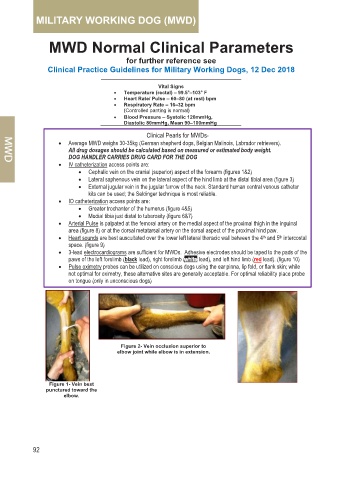
              •  IV catheterization access points are:
                  •  Cephalic vein on the cranial (superior) aspect of the forearm (figures 1&2)
                  •  Lateral saphenous vein on the lateral aspect of the hind limb at the distal tibial area (figure 3)
                  •  External jugular vein in the jugular furrow of the neck. Standard human central venous catheter
                    kits can be used; the Seldinger technique is most reliable.
              •  IO catheterization access points are:
                  •  Greater trochanter of the humerus (figure 4&5)
                  •  Medial tibia just distal to tuberosity (figure 6&7)
              •  Arterial Pulse is palpated at the femoral artery on the medial aspect of the proximal thigh in the inguinal
                area (figure 8) or at the dorsal metatarsal artery on the dorsal aspect of the proximal hind paw.
              •  Heart sounds are best auscultated over the lower left lateral thoracic wall between the 4 th  and 5 th  intercostal
                space. (figure 9)
              •  3-lead electrocardiograms are sufficient for MWDs.  Adhesive electrodes should be taped to the pads of the
                paws of the left forelimb (black lead), right forelimb (   lead), and left hind limb (red lead). (figure 10)
              •  Pulse oximetry probes can be utilized on conscious dogs using the ear pinna, lip fold, or flank skin; while
                not optimal for oximetry, these alternative sites are generally acceptable. For optimal reliability place probe
                on tongue (only in unconscious dogs)


                           Figure 2- Vein occlusion superior to
                           elbow joint while elbow is in extension.


            Figure 1- Vein best
           punctured toward the
               elbow.


        92

