


Page 33 - 2023 SMOG Digital
P. 33
Medical


                               EPISTAXIS

                          Signs and Symptoms:   Differential Diagnosis:
                       •  Bleeding From One or Both Nares •  Trauma
                       •  Pain             •  Infection
                       •  Nausea/Vomiting  •  Allergic/Chemical Rhinitis
                       •  Nasal Deformity  •  Nose Picking
                                           •  Lesions (Polyp, Ulcer)
                                           •  Hypertension
                                           •  Anticoagulant Therapy
                                           •  Thrombocytopenia (ITP)

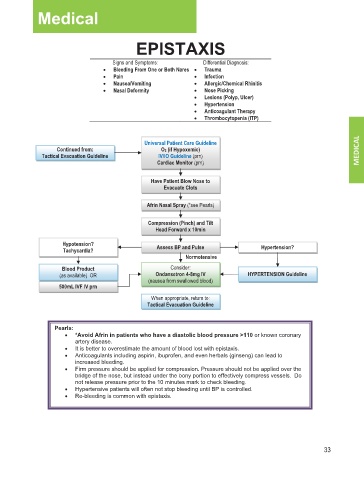
                                Universal Patient Care Guideline
             Continued from:        O2 (if Hypoxemic)
          Tactical Evacuation Guideline   IV/IO Guideline (prn)
                                   Cardiac Monitor (prn)
                                  Have Patient Blow Nose to
                                     Evacuate Clots
                                 Afrin Nasal Spray (*see Pearls)

                                 Compression (Pinch) and Tilt
                                   Head Forward x 10min
               Hypotension?        Assess BP and Pulse    Hypertension?
               Tachycardia?
                                         Normotensive
               Blood Product          Consider:
              (as available)  OR   Ondansetron 4-8mg IV    HYPERTENSION Guideline
                                 (nausea from swallowed blood)
              500mL IVF IV prn
                                  When appropriate, return to:
                                 Tactical Evacuation Guideline

             Pearls:
               •  *Avoid Afrin in patients who have a diastolic blood pressure >110 or known coronary
                 artery disease.
               •  It is better to overestimate the amount of blood lost with epistaxis.
               •  Anticoagulants including aspirin, ibuprofen, and even herbals (ginseng) can lead to
                 increased bleeding.
               •  Firm pressure should be applied for compression. Pressure should not be applied over the
                 bridge of the nose, but instead under the bony portion to effectively compress vessels.  Do
                 not release pressure prior to the 10 minutes mark to check bleeding.
               •  Hypertensive patients will often not stop bleeding until BP is controlled.
               •  Re-bleeding is common with epistaxis.


                                                                        33

