


Page 97 - 2022 Ranger Medic Handbook
P. 97
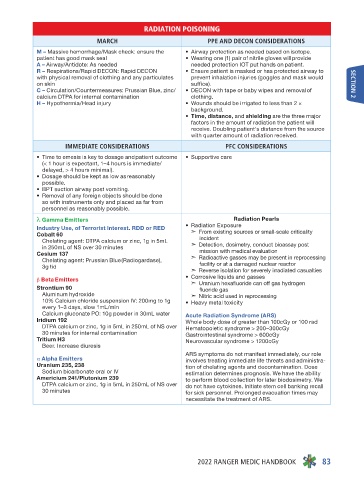
RADIATION POISONING
                      MARCH                   PPE AND DECON CONSIDERATIONS
         M – Massive hemorrhage/Mask check: ensure the   •  Airway protection as needed based on isotope.
         patient has good mask seal      •  Wearing one (1) pair of nitrile gloves will provide
         A – Airway/Antidote: As needed    needed protection IOT put hands on patient.
         R – Respirations/Rapid DECON: Rapid DECON    •  Ensure patient is masked or has protected airway to
         with physical removal of clothing and any particulates   prevent inhalation injuries (goggles and mask would
         on skin                           suffice).                         SECTION 2
         C – Circulation/Countermeasures: Prussian Blue, zinc/  •  DECON with tape or baby wipes and removal of
         calcium DTPA for internal contamination  clothing.
         H – Hypothermia/Head injury     •  Wounds should be irrigated to less than 2 ×
                                           background.
                                         •  Time, distance, and shielding are the three major
                                           factors in the amount of radiation the patient will
                                           receive. Doubling patient’s distance from the source
                                           with quarter amount of radiation received.
               IMMEDIATE CONSIDERATIONS           PFC CONSIDERATIONS
         •  Time to emesis is key to dosage and patient outcome   •  Supportive care
          (< 1 hour is expectant, 1–4 hours is immediate/
          delayed, > 4 hours minimal).
         •  Dosage should be kept as low as reasonably
          possible.
         •  BPT suction airway post vomiting.
         •  Removal of any foreign objects should be done
          so with instruments only and placed as far from
          personnel as reasonably possible.
         λ Gamma Emitters                           Radiation Pearls
         Industry Use, of Terrorist Interest. RDD or RED   •  Radiation Exposure
         Cobalt 60                         ➣   From existing sources or small-scale criticality
          Chelating agent: DTPA calcium or zinc, 1g in 5mL    incident
          in 250mL of NS over 30 minutes   ➣   Detection, dosimetry, conduct bioassay post
         Cesium 137                         mission with medical evaluation
          Chelating agent: Prussian Blue (Radiogardase),    ➣   Radioactive gasses may be present in reprocessing
          3g tid                            facility or at a damaged nuclear reactor
                                           ➣   Reverse isolation for severely irradiated casualties
         β Beta Emitters                 •  Corrosive liquids and gasses
                                              Uranium hexafluoride can off gas hydrogen
                                           ➣
         Strontium 90                       fluoride gas
          Aluminum hydroxide               ➣   Nitric acid used in reprocessing
          10% Calcium chloride suspension IV: 200mg to 1g   •  Heavy metal toxicity
          every 1–3 days, slow 1mL/min
          Calcium gluconate PO: 10g powder in 30mL water  Acute Radiation Syndrome (ARS)
         Iridium 192                     Whole body dose of greater than 100cGy or 100 rad
          DTPA calcium or zinc, 1g in 5mL in 250mL of NS over   Hematopoietic syndrome > 200–300cGy
          30 minutes for internal contamination  Gastrointestinal syndrome > 600cGy
         Tritium H3                      Neurovascular syndrome > 1200cGy
          Beer. Increase diuresis
                                         ARS symptoms do not manifest immediately, our role
         α Alpha Emitters                involves treating immediate life threats and administra-
         Uranium 235, 238                tion of chelating agents and decontamination. Dose
          Sodium bicarbonate oral or IV  estimation determines prognosis. We have the ability
         Americium 241/Plutonium 239     to perform blood collection for later biodosimetry. We
          DTPA calcium or zinc, 1g in 5mL in 250mL of NS over   do not have cytokines. Initiate stem cell banking recall
          30 minutes                     for sick personnel. Prolonged evacuation times may
                                         necessitate the treatment of ARS.

                                            2022 RANGER MEDIC HANDBOOK  83

