


Page 101 - 2022 Ranger Medic Handbook
P. 101
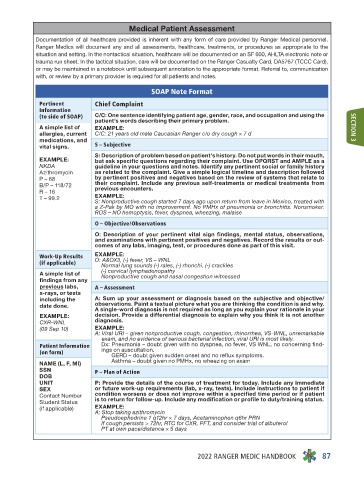
Medical Patient Assessment
         Documentation of all healthcare provided is inherent with any form of care provided by Ranger Medical personnel.
         Ranger Medics will document any and all assessments, healthcare, treatments, or procedures as appropriate to the
         situation and setting. In the nontactical situation, healthcare will be documented on an SF 600, AHLTA electronic note or
         trauma run sheet. In the tactical situation, care will be documented on the Ranger  Casualty Card, DA5767 (TCCC Card),
         or may be maintained in a notebook until subsequent annotation to the appropriate format. Referral to, communication
         with, or review by a primary provider is required for all patients and notes.
                                  SOAP Note Format
          Pertinent   Chief Complaint
          Information
          (to side of SOAP)  C/C: One sentence identifying patient age, gender, race, and occupation and using the
                      patient’s words describing their primary problem.
          A simple list of   EXAMPLE:                                        SECTION 3
          allergies, current   C/C: 21 years old male Caucasian Ranger c/o dry cough × 7 d
          medications, and
          vital signs.  S – Subjective
                      S: Description of problem based on patient’s history. Do not put words in their mouth,
          EXAMPLE:    but ask specific questions regarding their complaint. Use OPQRST and AMPLE as a
          NKDA        guideline in your questions and notes. Identify any pertinent social or family history
          Azithromycin    as related to the complaint. Give a simple logical timeline and description followed
          P – 68      by pertinent positives and negatives based on the review of systems that relate to
          B/P – 118/72    their complaint. Include any previous self-treatments or medical treatments from
                      previous  encounters.
          R – 16
          T – 99.2    EXAMPLE:
                      S: Nonproductive cough started 7 days ago upon return from leave in Mexico, treated with
                      a Z-Pak by MO with no improvement. No PMHx of pneumonia or bronchitis. Nonsmoker.
                      ROS – NO hemoptysis, fever, dyspnea, wheezing, malaise
                      O – Objective/Observations
                      O:  Description  of  your  pertinent  vital  sign  findings,  mental  status, observations,
                      and examinations with pertinent positives and negatives. Record the results or out-
                      comes of any labs, imaging, test, or procedures done as part of this visit.
          Work-Up Results  EXAMPLE:
          (if applicable)  O: A&OX3, (-) fever, VS – WNL
                       Normal lung sounds (-) rales, (-) rhonchi, (-) crackles
          A simple list of   (-) cervical lymphadenopathy
                       Nonproductive cough and nasal congestion witnessed
          findings from any
          previous labs,   A – Assessment
          x-rays, or tests
          including the    A: Sum up your assessment or diagnosis based on the subjective and objective/
          date done.  observations. Paint a textual picture what you are thinking the condition is and why.
                      A single-word diagnosis is not required as long as you explain your rationale in your
          EXAMPLE:    decision. Provide a differential diagnosis to explain why you think it is not another
          CXR-WNL     diagnosis.
          (09 Sep 10)  EXAMPLE:
                      A:  Viral URI – given nonproductive cough, congestion, rhinorrhea, VS-WNL, unremarkable
                       exam, and no evidence of serious bacterial infection, viral URI is most likely.
          Patient Information   Dx: Pneumonia – doubt given with no dyspnea, no fever, VS WNL, no concerning find-
          (on form)    ings on auscultation.
                         GERD – doubt given sudden onset and no reflux symptoms.
          NAME (L, F, MI)   Asthma – doubt given no PMHx, no wheezing on exam
          SSN         P – Plan of Action
          DOB
          UNIT        P: Provide the details of the course of treatment for today. Include any immediate
          SEX         or future work-up requirements (lab, x-ray, tests). Include instructions to patient if
          Contact Number   condition worsens or does not improve within a specified time period or if patient
          Student Status   is to return for follow-up. Include any modification or profile to duty/training status.
          (if applicable)  EXAMPLE:
                      A: Stop taking azithromycin
                       Pseudoephedrine 1 q12hr × 7 days, Acetaminophen q6hr PRN
                       If cough persists > 72hr, RTC for CXR, PFT, and consider trial of albuterol
                       PT at own pace/distance × 5 days
                                            2022 RANGER MEDIC HANDBOOK  87

