


Page 49 - JSOM Fall 2025
P. 49
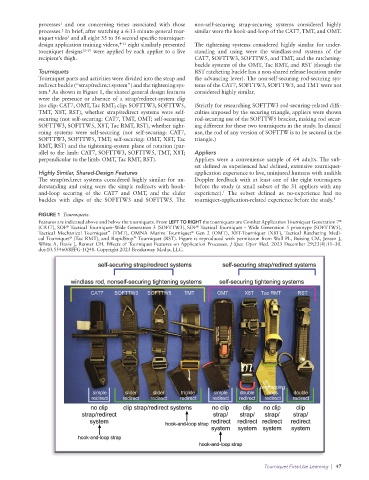
Across Tourniquet Designs First-Use Learning


                                    Piper Wall, DVM, PhD *; Charisse Buising, PhD ;
                                                         1
                                                                                  2
                                            Catherine Hackett Renner, PhD 3


          ABSTRACT
          Background: We hypothesized shared-design tourniquet fea-  tightening system involving rotation parallel or perpendicular
          tures have useful first-use learning when knowledge-of-results   to the limb surface. Depending on knowledge-of-results feed-
          occurs. Methods: In a prior study, after watching training vid-  back, we believe use of a tourniquet with a design feature sim-
          eos, 64 volunteers were videoed applying (Latin squares ran-  ilar to that of a different tourniquet (a shared general design
          domization): Combat Application Tourniquet Generation 7      regarding that feature) will result in first-use learning relevant
                                                         ®
          (CAT7), SOF  Tactical Tourniquet-Wide  Generation  3   to that part of the different tourniquet, even in the absence of
                     ®
          (SOFTTW3), SOF  Tactical Tourniquet-Wide  Generation  5   instructor-origin feedback. If true, this suggests even limited
                        ®
          (SOFTTW5), Tactical Mechanical Tourniquet  (TMT), OMNA   training with tourniquets with different strap/redirect-buckle
                                            ™
          Marine Tourniquet  (OMT), X8T-Tourniquet (X8T), Tactical   systems and different tightening systems may increase appli-
                         ®
          Ratcheting Medical Tourniquet  (Tac RMT), and RapidStop    cation success if faced with a new tourniquet (such as might
                                                         ™
                                  ®
          Tourniquet (RST). Tourniquets were applied to live thighs with   be the case with public access bleeding control kits or with
          audible distal Doppler pulses. Results: This study subset was   someone else’s first aid kit).
          10 experienced and 33 no-experience appliers. Experienced
          appliers had fewer strap/redirect and fewer tightening- system   When tourniquets are applied to live humans in practice set-
          understanding problems and faster associated times than   tings, some application aspects directly provide appliers with
          no-experience appliers.  Among no-experience appliers, first-  knowledge-of-results information and some aspects do not.
          use learning was supported by faster “Go” to “strap secured”   Examples of knowledge-of-results information present with-
          times for combined seventh and eighth versus first applications   out instructor-origin feedback include: limb encirclement with
          (p=.008), second- versus first-encounter CAT7/OMT applica-  the tourniquet, presence or absence of some degree of strap
          tions (p=.0005), and second- versus first-encounter SOFTTW3/  security around the limb, movement of aspects of the tight-
          SOFTTW5 applications (p=.079). Occlusion at  “Done” was   ening system, presence or absence of increasing tourniquet
          more frequent with experienced appliers (p=.006) and did not   tightness around the limb, presence or absence of some de-
          show first-use learning across all tourniquets in no-experience   gree of tightening-system security, and presence or absence of
          appliers. Occlusion at “Done” indicated possible first-use learn-  a distal pulse if a monitoring technology such as audible Dop-
          ing with  ratcheting-buckle versus windlass-rod tightening sys-  pler is involved. Examples of knowledge-of-results feedback
          tems (p=.028, no-experience appliers). Hook-and-loop strap   likely to require instructor involvement include: idealness of
          security, which provides no inherent knowledge-of-results,   placement location, movement patterns, strap tightness before
          showed no learning in experienced (five problem applications     tightening-system  use, strap  security, and tightening-system
          by two appliers) or no-experience appliers (29 problem applica-  security.
          tions by 18 appliers). Conclusions: Knowledge-of-results is crit-
          ical for, but does not guarantee, tourniquet-application- useful   The study purpose was to look for first-use learning regard-
          first-use learning. The existence of first-use learning can allow   ing shared general design features of several emergency-use
          limited experience with one tourniquet to improve performance   limb tourniquets. First-use learning would be demonstrated
          with a different tourniquet with shared-design features. There-  by increases in process speed and decreases in understand-
          fore, exposure to different designs may have value, and provid-  ing problems.  The hypotheses were, in the absence of any
          ing tourniquet-training knowledge-of-results is important.    instructor-origin feedback: some first-use learning would oc-
                                                             cur regarding similar strap/redirect systems, similar tightening
          Keywords: tourniquet; hemorrhage; first aid; emergency   systems, and achieving audible Doppler signal loss, and no
          treatment; learning                                first-use learning would occur regarding hook-and-loop strap
                                                             security and different windlass-rod securing systems.


          Introduction                                       Methods
          Many emergency-use limb tourniquets are commercially avail-  Data presented is a subset from a Drake University Institutional
          able. Most have some version of the following design features:   Review Board-approved study. Methods are detailed in two
          a limb-encircling nonelastic strap, strap-redirecting buckle, and   papers: one concerning evaluation of tourniquet application
          *Correspondence to piperwalldvm@gmail.com
                                                                                                    2
          1 Dr. Piper Wall is a researcher in the Department of Research, UnityPoint Health Iowa Methodist Medical Center, Des Moines, IA.  Dr. Charisse
          Buising is a professor of biology at Drake University, Des Moines, IA.  Dr. Catherine Hackett Renner is a volunteer researcher at UnityPoint
                                                            3
          Health Iowa Methodist Medical Center, Des Moines, IA.
                                                           46

