


Page 44 - JSOM Fall 2025
P. 44
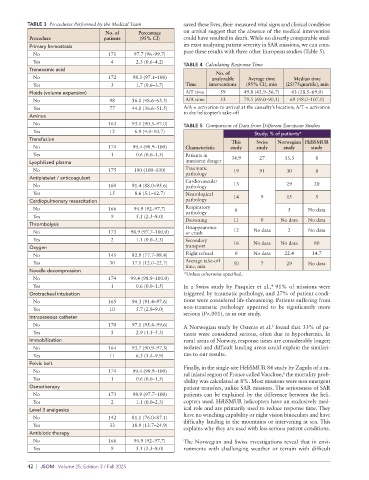
system (La classification Clinique des Maladies du SMUR),    antiplatelet agents (AAP) or anticoagulants (AC) (15; 8.6%).
                                                             3
              which ranks severity from 1 (stable patients requiring no med-  No transfusion of lyophilized plasma was performed.
              ical treatment) to 6 (patient deceased prior to medical team
              arrival). In this study, patients classified as CCMS 4 or 5 (pre-  FIGURE 1  Flow chart of the study.
              senting a functional or vital prognosis, with or without the
              need for resuscitation) were also considered to be in imminent     Total no. of patients
              danger.                                                           causing a SAR trigger
                                                                                      n=215
              Secondary Endpoints
              In addition to the primary endpoint, three quantitative second-
              ary endpoints were examined.
                                                                                              Patients whose SAR
              1.  Reason for mission activation, categorized as:                                 was cancelled
                •  Diving accident                                                                  n=36
                •  Plane crash
                •  Cardiac distress
                •  Neurological distress
                                                                                              Missing patients not
                •  Respiratory distress                                                      found by the SAR team
                •  Disappearance                                                                    n=4
                •  Gynecology
                •  Infection
                •  Drowning
                •  Patient transport                                           Total number of patients
                •  Trauma                                                      whose data were analyzed
                •  Digestive emergencies                                              n=175
              2.  Procedures performed by the medical team during the
                mission.
              3.  Speed of the medical response.                    Number of patients in      Number of patients
                                                                  “imminent danger” at the   not considered to be in
              Statistical Analysis                                   arrival of the SAR     “imminent danger” at the
              After data extraction from the mission report forms, all in-  n=61               time of treatment
              formation was anonymized. Categorical data are expressed as                          n=114
              percentages with corresponding 95% CIs.
                                                                 SAR = search and rescue.

              Results
                                                                 TABLE 2  Reasons for Departure
              Data were available for 175 of the 215 patient records (Figure          No. of patients
              1). Among these, we could not determine whether the patient               by reason;    Percentage
              was in imminent danger for 21 patients (12.0%) due to insuf-  Reason for departure   n=175  (95% CI)
              ficient data. Of these 175 patients, 61 (34.9%; 95% CI 27.4–  Diving accident  2       1.1 (0.0–8.1)
              42.7) were considered to be in imminent danger (Table 1).  Plane crash      11         6.3 (0.0–13.3)
                                                                 Cardiac distress         22        12.6 (6.3–19.6)
              TABLE 1  Number of Patients in Imminent Danger     Neurological distress    25        14.3 (8.0–21.3)
                                  No. of patients;    Percentage    Respiratory distress  10         5.7 (0.0–12.7)
              Status                 n=175         (95% CI)
                                                                 Disappearance            11         6.3 (0.0–13.3)
              Imminent danger         61        34.9 (27.4–42.7)  Gynecology               2         1.1 (0.0–8.1)
              No imminent danger      93        53.1 (45.7–61.0)  Unknown                  4         2.3 (0.0–9.3)
              Unknown                 21        12.0 (4.6–19.8)  Infection                 3         1.7 (0.0–8.7)
                                                                 Drowning                 19        10.9 (4.6–17.8)
              Reasons for launching a mission (Table 2) included traumatic   Secondary transport  28  16.0 (9.7–23.0)
              pathology (33; 18.9%), patient transfers (28; 16%), neuro-  Trauma          33        18.9 (12.6–25.8)
              logical distress (25; 14.3%), and cardiac distress (22; 12.6%).   Digestive emergency  5  2.9 (0.0–9.8)
              Other causes included drownings (19; 10.9%), crashes or lost
              individuals (11 each; 6.3% each), respiratory distress (n=10;   The average time from mission activation to the helicopter’s
              5.7%), digestive emergencies (5; 2.9%), diving accidents and   take-off (A/T time) was 49.8 (42.9–56.7) minutes. The average
              gynecological emergencies (n=2 each; 1.1% each), and infec-  time from activation to arrival at the casualty’s location (A/A
              tious emergencies (3; 1.7%). Lost individuals only included   time) was 79.5 (69.0–90.1) minutes (Table 4).
              individuals who had disappeared and were recovered by the
              SAR team with a completed mission report.
                                                                 Discussion
              Procedures performed by the medical team (Table 3) included   Primary Endpoint
              volume replenishment (77; 44%), oxygen therapy (30; 17.1%),   Of the 175 patients, 61 (34.9%) were considered to be in im-
              morphine administration (33; 18.9%), and treatment with     minent danger. While we cannot confirm that SAR intervention

                                                                  Search and Rescue Missions Conducted by the French Army  |  41

