


Page 94 - JSOM Summer 2025
P. 94
Session: The Future of SOF Medicine                Paris SOF CMC-Conference is scheduled for October 2026,
                                                             while the CMC-Conference in Ulm, Germany, will take place
          The conference emphasized cutting-edge developments shap-  in July 2025. 30
          ing the future of SOF medicine. 25–28  Topics such as “Stop the
          Bleeding – Blood-Time” underscored the urgency of rapid hem-
          orrhage control and transfusion in life-threatening scenarios.   Tips & Tricks with the Experts:
          Discussions on artificial blood research and the integration of   How Do I Manage a Major Burn?
          drones for medical evacuation and supply delivery showcased   Dr. Nicolas Donat and Dr. Winston de Mello
          innovative approaches to addressing challenges in austere and
          extreme conditions. Additionally, the prevention and manage-  Objectives and Scope
                                                             The presentation provides practical insights into treating se-
          ment of infections, early detection of mental health disorders,   vere burns in SOF settings. It covers critical points such as burn
          and the debated concept of the golden day—extending the tra-  classification, tactical considerations, physiological impacts,
          ditional golden hour of trauma care—were prominent themes.
                                                             and treatment priorities. Combat-related burns can result from
                                                             explosions, fire, and other wartime hazards, affecting 5%–20%
          The closing session looked ahead to the future of SOF med-  of wounded soldiers and often accompanied by trauma, com-
          icine since it’s no longer just a question of “thinking outside   plicating treatment. Burns have local and systemic effects:
          the box but thinking even without the box.” Dr. Mathieu Da-
          vid (SOFCOM/France) provided a French perspective on the   1.  Local effects: These include skin destruction, inflammation,
          evolving landscape, while COL Benjamin Ingram ( SOFCOM/  ischemia, and necrosis, with impaired skin functioning as a
          USA) shared insights from SOFCOM’s point of view. Dr. An-  barrier against infections and other complications.
          dre Cap (USA) discussed research initiatives shaping the field,   2.  Systemic effects: Burns covering more than 20% of total
          and Dr. Camille Brenet (France) highlighted the transformative   body surface area (TBSA) challenge the body’s adaptive
          medical  role  of  drones  in  special  operations. These  sessions   response, leading to capillary leakage, hypovolemic shock,
          reinforced the importance of international collaboration and   and potentially multiorgan failure.
          innovative thinking to meet the challenges of modern combat
          medical care.
                                                             Treatment Plan
                                                             The recommended 7-point treatment plan progresses from initial
          Major Lectures                                     assessment to preparing for prolonged field care. This involves:

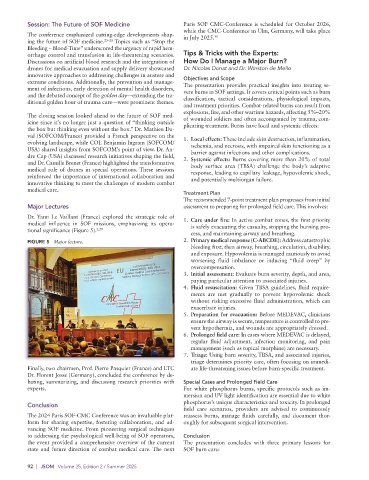
          Dr. Yann Le Vaillant (France) explored the strategic role of   1.  Care under fire: In active combat zones, the first priority
          medical influence in SOF missions, emphasizing its opera-  is safely evacuating the casualty, stopping the burning pro-
          tional significance (Figure 5). 2,29
                                                               cess, and maintaining airway and breathing.
          FIGURE 5   Major lecture.                          2.  Primary medical response (C-ABCDE): Address catastrophic
                                                               bleeding first, then airway, breathing, circulation, disability,
                                                               and exposure. Hypovolemia is managed cautiously to avoid
                                                               worsening fluid imbalance or inducing  “fluid creep” by
                                                               overcompensation.
                                                             3.  Initial assessment: Evaluate burn severity, depth, and area,
                                                               paying particular attention to associated injuries.
                                                             4.  Fluid resuscitation: Given TBSA guidelines, fluid require-
                                                               ments are met gradually to prevent hypovolemic shock
                                                               without risking excessive fluid administration, which can
                                                               exacerbate injuries.
                                                             5.  Preparation for evacuation: Before MEDEVAC, clinicians
                                                               ensure the airway is secure, temperature is controlled to pre-
                                                               vent hypothermia, and wounds are appropriately dressed.
                                                             6.  Prolonged field care: In cases where MEDEVAC is delayed,
                                                               regular fluid adjustment, infection monitoring, and pain
                                                               management (such as topical morphine) are necessary.
                                                             7.  Triage: Using burn severity, TBSA, and associated injuries,
                                                               triage determines priority care, often focusing on immedi-
          Finally, two chairmen, Prof. Pierre Pasquier (France) and LTC   ate life-threatening issues before burn-specific treatment.
          Dr. Florent Josse (Germany), concluded the conference by de-
          bating,  summarizing,  and  discussing  research  priorities  with   Special Cases and Prolonged Field Care
          experts.                                           For white phosphorus burns, specific protocols such as im-
                                                             mersion and UV light identification are essential due to white
                                                             phosphorus’s unique characteristics and toxicity. In prolonged
          Conclusion
                                                             field care scenarios, providers are advised to continuously
          The 2024 Paris SOF-CMC Conference was an invaluable plat-  reassess burns, manage fluids carefully, and document thor-
          form for sharing expertise, fostering collaboration, and ad-  oughly for subsequent surgical intervention.
          vancing  SOF  medicine.  From  pioneering  surgical  techniques
          to addressing the psychological well-being of SOF operators,   Conclusion
          the event provided a comprehensive overview of the current   The presentation concludes with three primary lessons for
          state and future direction of combat medical care. The next   SOF burn care:

          92  |  JSOM   Volume 25, Edition 2 / Summer 2025

