


Page 84 - JSOM Summer 2025
P. 84
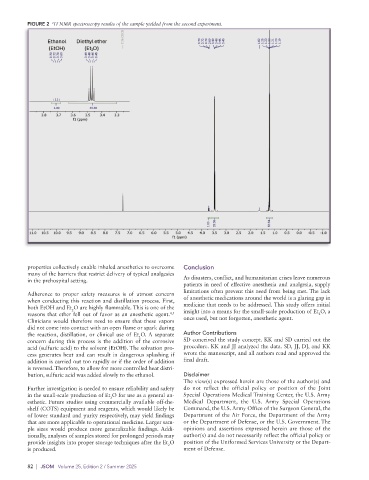
FIGURE 2   H NMR spectroscopy results of the sample yielded from the second experiment.
                  1


          properties collectively enable inhaled anesthetics to overcome   Conclusion
          many of the barriers that restrict delivery of typical analgesics
          in the prehospital setting.                        As disasters, conflict, and humanitarian crises leave numerous
                                                             patients in need of effective anesthesia and analgesia, supply
                                                             limitations often prevent this need from being met. The lack
          Adherence  to  proper  safety  measures  is  of  utmost  concern
          when conducting this reaction and distillation process. First,   of anesthetic medications around the world is a glaring gap in
          both EtOH and Et O are highly flammable. This is one of the   medicine that needs to be addressed. This study offers initial
                        2
          reasons that ether fell out of favor as an anesthetic agent.    insight into a means for the small-scale production of Et O, a
                                                         4,5
                                                                                                         2
          Clinicians would therefore need to ensure that these vapors   once used, but not forgotten, anesthetic agent.
          did not come into contact with an open flame or spark during
          the reaction, distillation, or clinical use of Et O. A  separate   Author Contributions
                                              2
          concern during this process is the addition of the corrosive   SD conceived the study concept. KK and SD carried out the
          acid (sulfuric acid) to the solvent (EtOH). The solvation pro-  procedure. KK and JJ analyzed the data. SD, JJ, DJ, and KK
          cess generates heat and can result in dangerous splashing if   wrote the manuscript, and all authors read and approved the
          addition is carried out too rapidly or if the order of addition   final draft.
          is reversed. Therefore, to allow for more controlled heat distri-
          bution, sulfuric acid was added slowly to the ethanol.  Disclaimer
                                                             The view(s) expressed herein are those of the author(s) and
          Further investigation is needed to ensure reliability and safety   do not reflect the official policy or position of the Joint
          in the small-scale production of Et O for use as a general an-  Special Operations Medical Training Center, the U.S. Army
                                     2
          esthetic. Future studies using commercially available off-the-  Medical Department, the U.S.  Army Special Operations
          shelf (COTS) equipment and reagents, which would likely be   Command, the U.S. Army Office of the Surgeon General, the
          of lower standard and purity respectively, may yield findings   Department of the Air Force, the Department of the Army
          that are more applicable to operational medicine. Larger sam-  or the Department of Defense, or the U.S. Government. The
          ple  sizes would  produce  more generalizable  findings.  Addi-  opinions and assertions expressed herein are those of the
          tionally, analyses of samples stored for prolonged periods may   author(s) and do not necessarily reflect the official policy or
          provide insights into proper storage techniques after the Et O   position of the Uniformed Services University or the Depart-
                                                        2
          is produced.                                       ment of Defense.
          82  |  JSOM   Volume 25, Edition 2 / Summer 2025

