


Page 83 - JSOM Summer 2025
P. 83
Methods                                            purification. For the two experiments conducted, the collected
                                                                 volumes were 2.6 and 1.5mL, respectively.
              A modification of the known acid-promoted dehydration of
                           8
              EtOH was used.  The reaction and distillation were carried
              out twice using standard laboratory equipment and American   Results
              Chemical Society (ACS) grade reagents. In both procedures,   The two samples were analyzed immediately by proton nu-
              a 50mL two-necked, round-bottomed flask was charged with   clear magnetic resonance ( H NMR) spectroscopy, a common
                                                                                     1
              EtOH (15mL) and a magnetic stir bar.               analytical method in organic chemistry. In each spectrum, two
                                                                 components were observed.  The identifying spectroscopic
              Concentrated sulfuric acid (15mL) was slowly added drop-  features for Et O and EtOH are known from chemical liter-
                                                                            2
              wise. The flask was fitted with a Vigreux distilling column/  ature; this information was used to assign the constituents in
              condenser, and a thermometer was inserted at the top of the   the annotated spectrum (Figure 2). For the non-chemist, the
              distilling column. The distilling column was wrapped in a layer   lines in the spectrum provide an identifying “signature” of the
              of aluminum foil. Ice-cold water was circulated through the   analyte that can be easily compared to established standards.
              condenser using a commercial fish pump. The condenser out-  Integration of the relevant peaks gives the Et O purity level
                                                                                                     2
              let was fitted with a receiving flask, which was submerged in   on a molar basis of approximately 97%, with the only other
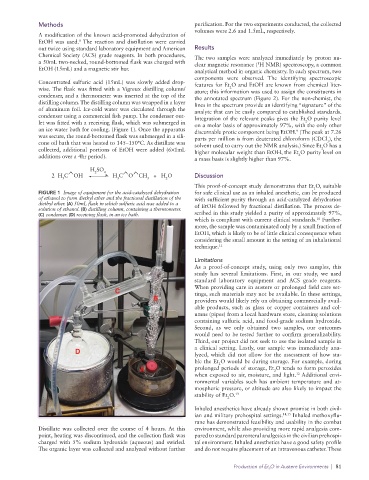
              an ice water bath for cooling. (Figure 1). Once the apparatus   discernable protic component being EtOH.  (The peak at 7.26
                                                                                                  9
              was secure, the round-bottomed flask was submerged in a sili-  parts per million is from deuterated chloroform (CDCl ), the
                                                                                                            3
              cone oil bath that was heated to 145–150°C. As distillate was   solvent used to carry out the NMR analysis.) Since Et O has a
                                                                                                          2
              collected, additional portions of EtOH were added (6×1mL   higher molecular weight than EtOH, the Et O purity level on
              additions over a 4hr period).                      a mass basis is slightly higher than 97%.  2
                       ∧       H SO 4      ∧ ∧
                                2
                  2  H C  OH        • H C  O  CH    +   H O      Discussion
                     3         •       3         3     2
                                                                 This proof-of-concept study demonstrates that Et O, suitable
                                                                                                        2
              FIGURE 1  Image of equipment for the acid-catalyzed dehydration   for safe clinical use as an inhaled anesthetic, can be produced
              of ethanol to form diethyl ether and the fractional distillation of the   with sufficient purity through an acid-catalyzed dehydration
              diethyl ether. (A) 50mL flask in which sulfuric acid was added to a   of EtOH followed by fractional distillation. The process de-
              solution of ethanol. (B) distilling column, containing a thermometer.
              (C) condenser. (D) receiving flask, in an ice bath.  scribed in this study yielded a purity of approximately 97%,
                                                                                                         10
                                                                 which is compliant with current clinical standards.  Further-
                                                                 more, the sample was contaminated only by a small fraction of
                                                                 EtOH, which is likely to be of little clinical consequence when
                                                                 considering the small amount in the setting of an inhalational
                                                                 technique. 11
                                                                 Limitations
                                                                 As a proof-of-concept study, using only two samples, this
                                                                 study has several limitations. First, in our study, we used
                                                                 standard laboratory equipment and  ACS grade reagents.
                                                                 When providing care in austere or prolonged field care set-
                                                                 tings, such materials may not be available. In these settings,
                                                                 providers would likely rely on obtaining commercially avail-
                                                                 able products, such as glass or copper containers and col-
                                                                 umns (pipes) from a local hardware store, cleaning solutions
                                                                 containing sulfuric acid, and food-grade sodium hydroxide.
                                                                 Second, as we only obtained two samples, our outcomes
                                                                 would need to be tested further to confirm generalizability.
                                                                 Third, our project did not seek to use the isolated sample in
                                                                 a clinical setting. Lastly, our sample was immediately ana-
                                                                 lyzed, which did not allow for the assessment of how sta-
                                                                 ble the Et O would be during storage. For example, during
                                                                        2
                                                                 prolonged periods of storage, Et O tends to form peroxides
                                                                                           2
                                                                 when exposed to air, moisture, and light.  Additional envi-
                                                                                                  12
                                                                 ronmental variables such has ambient temperature and at-
                                                                 mospheric pressure, or altitude are also likely to impact the
                                                                 stability of Et O. 13
                                                                           2
                                                                 Inhaled anesthetics have already shown promise in both civil-
                                                                 ian and military prehospital settings. 14,15  Inhaled methoxyflu-
                                                                 rane has demonstrated feasibility and usability in the combat
              Distillate was collected over the course of 4 hours. At this   environment, while also providing more rapid analgesia com-
              point, heating was discontinued, and the collection flask was   pared to standard parenteral analgesics in the civilian prehospi-
              charged with 5% sodium hydroxide (aqueous) and swirled.   tal environment. Inhaled anesthetics have a good safety profile
              The organic layer was collected and analyzed without further   and do not require placement of an intravenous catheter. These

                                                                             Production of Et O in Austere Environments  |  81
                                                                                         2

