


Page 67 - JSOM Winter 2023
P. 67
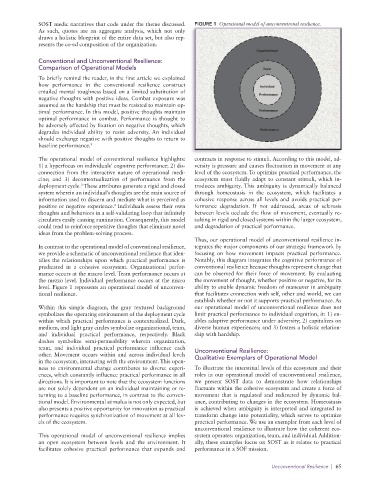
SOST medic narratives that code under the theme discussed.   FIGURE 1  Operational model of unconventional resilience.
              As  such,  quotes  are  an aggregate  analysis,  which  not  only
              draws a holistic blueprint of the entire data set, but also rep-
              resents the co-ed composition of the organization.


              Conventional and Unconventional Resilience:
              Comparison of Operational Models
              To briefly remind the reader, in the first article we explained
              how performance in the conventional resilience construct
              entailed mental toughness based on a limited substitution of
              negative thoughts with positive ideas. Combat exposure was
              assumed as the hardship that must be resisted to maintain op-
              timal performance. In this model, positive thoughts maintain
              optimal performance in combat. Performance is thought to
              be adversely affected by fixation on negative thoughts, which
              degrades  individual  ability to  resist  adversity. An individual
              should exchange negative with positive thoughts to return to
              baseline performance. 3

              The operational model of conventional resilience highlights:    contracts in response to stimuli. According to this model, ad-
              1) a hyperfocus on individuals’ cognitive performance; 2) dis-  versity is pressure and causes fluctuation in movement at any
              connection from the interactive nature of operational medi-  level of the ecosystem. To optimize practical performance, the
              cine; and 3) decontextualization of performance from the   ecosystem must fluidly adapt to constant stimuli, which in-
                           3
              deployment cycle.  These attributes generate a rigid and closed   troduces ambiguity. This ambiguity is dynamically balanced
              system wherein an individual’s thoughts are the main source of   through homeostasis in the ecosystem, which facilitates a
              information used to discern and mediate what is perceived as   cohesive response across all levels and avoids practical per-
                                      4
              positive or negative experience.  Individuals assess their own   formance degradation. If not addressed, areas of sclerosis
              thoughts and behaviors in a self-validating loop that infinitely   between levels occlude the flow of movement, eventually re-
              circulates easily causing rumination. Consequently, this model   sulting in rigid and closed systems within the larger ecosystem,
              could tend to reinforce repetitive thoughts that eliminate novel   and degradation of practical performance.
              ideas from the problem-solving process.
                                                                 Thus, our operational model of unconventional resilience in-
              In contrast to the operational model of conventional resilience,   tegrates the major components of our strategic framework by
              we provide a schematic of unconventional resilience that iden-  focusing  on  how  movement  impacts  practical  performance.
              tifies the relationships upon which practical performance is   Notably, this diagram integrates the cognitive performance of
              predicated in a cohesive ecosystem. Organizational perfor-  conventional resilience because thoughts represent change that
              mance occurs at the macro level. Team performance occurs at   can be observed for their force of movement. By evaluating
              the mezzo level. Individual performance occurs at the micro   the movement of thought, whether positive or negative, for its
              level. Figure 1 represents an operational model of unconven-  ability to enable dynamic freedom of maneuver in ambiguity
              tional resilience.                                 that facilitates connection with self, other and world, we can
                                                                 establish whether or not it supports practical performance. As
              Within  this simple  diagram,  the gray  textured  background   our operational model of unconventional resilience does not
              symbolizes the operating environment of the deployment cycle   limit practical performance to individual cognition, it: 1) en-
              within which practical performance is contextualized. Dark,   ables adaptive performance under adversity; 2) capitalizes on
              medium, and light gray circles symbolize organizational, team,   diverse human experiences; and 3) fosters a holistic relation-
              and individual practical performance, respectively. Black   ship with hardship.
              dashes symbolize semi-permeability wherein organization,
              team, and individual practical performance influence each   Unconventional Resilience:
              other. Movement occurs within and across individual levels   Qualitative Exemplars of Operational Model
              in the ecosystem, interacting with the environment. This open-
              ness to environmental change contributes to diverse experi-  To illustrate the interstitial levels of this ecosystem and their
              ences, which constantly influence practical performance in all   roles in our operational model of unconventional resilience,
              directions. It is important to note that the ecosystem functions   we present SOST data to demonstrate how relationships
              are not solely dependent on an individual maintaining or re-  fluctuate within the cohesive ecosystem and create a force of
              turning to a baseline performance, in contrast to the conven-  movement that is regulated and redirected by dynamic bal-
              tional model. Environmental stimulus is not only expected, but   ance, contributing to changes in the ecosystem. Homeostasis
              also presents a positive opportunity for innovation as practical   is achieved when ambiguity is interpreted and integrated to
              performance requires synchronization of movement at all lev-  transform change into potentiality, which serves to optimize
              els of the ecosystem.                              practical performance. We use an exemplar from each level of
                                                                 unconventional resilience to illustrate how the coherent eco-
              This operational model of unconventional resilience implies   system operates: organization, team, and individual. Addition-
              an open ecosystem between levels and the environment. It   ally, these examples focus on SOST as it relates to practical
              facilitates cohesive practical performance that expands and   performance in a SOF mission.

                                                                                          Unconventional Resilience  |  65

