


Page 31 - JSOM Fall 2023
P. 31
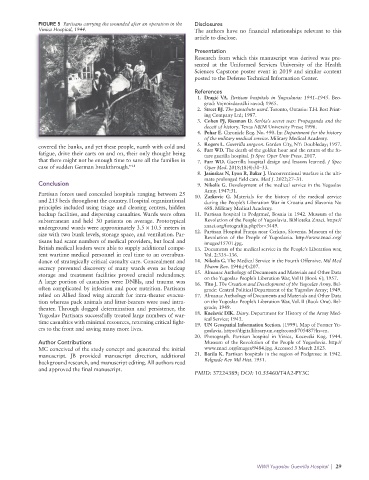
FIGURE 5  Partisans carrying the wounded after an operation in the   Disclosures
              Vinica Hospital, 1944.                             The authors have no financial relationships relevant to this
                                                                 article to disclose.

                                                                 Presentation
                                                                 Research  from which this manuscript was derived was pre-
                                                                 sented at the Uniformed Services University of the Health
                                                                 Sciences Capstone poster event in 2019 and similar content
                                                                 posted to the Defense Technical Information Center.

                                                                 References
                                                                 1.  Dragic´ VA.  Partisan hospitals in  Yugoslavia: 1941–1945. Beo-
                                                                    grad: Vojnoizdavacki zavod; 1965.
                                                                                 ˇ
                                                                 2.  Street BJ. The parachute ward. Toronto, Ontario: T.H. Best Print-
                                                                    ing Company Ltd; 1987.
                                                                 3.  Cohen PJ, Riesman D. Serbia’s secret war: Propaganda and the
                                                                    deceit of history. Texas A&M University Press; 1996.
                                                                 4.  Pohar E. Chronicle Reg. No. 490. In: Department for the history
                                                                    of the military medical service. Military Medical Academy.
              covered the banks, and yet these people, numb with cold and   5.  Rogers L. Guerrilla surgeon. Garden City, NY: Doubleday; 1957.
              fatigue, drive their carts on and on, their only thought being   6.  Farr WD. The death of the golden hour and the return of the fu-
                                                                    ture guerilla hospital. Jt Spec Oper Univ Press. 2017.
              that there might not be enough time to save all the families in   7.  Farr WD. Guerrilla hospital design and lessons learned. J Spec
              case of sudden German breakthrough.” 18               Oper Med. 2018;18(4):30–33.
                                                                 8.  Jasinskas N, Lyon R, Baker J. Unconventional warfare is the ulti-
                                                                    mate prolonged field care. Med J. 2022;27–31.
              Conclusion                                         9.  Nikolis G. Development of the medical service in the Yugoslav
                                                                    Army. 1947:31.
              Partisan forces used concealed hospitals ranging between 25   10.  Zarkovic G. Materials for the history of the medical zervice
              and 215 beds throughout the country. Hospital organizational   during the People’s Liberation War in Croatia and Slavonia No
              principles included using triage and clearing centers, hidden   688. Military Medical Academy.
              backup facilities, and dispersing casualties. Wards were often   11.  Partisan hospital in Podgrmec´, Bosnia in 1942. Museum of the
              subterranean and held 30 patients on average. Prototypical   Revolution of the People of Yugoslavia. Biblioteka Znaci. https://
              underground wards were approximately 3.5 × 10.5 meters in   znaci.org/fotografija.php?br=3449.
              size with two bunk levels, storage space, and ventilation. Par-  12.  Partisan Hospital Franja near Cerkno, Slovenia. Museum of the
                                                                    Revolution of the People of  Yugoslavia.  http://www.znaci.org/
              tisans had scant numbers of medical providers, but local and   images/15701.jpg.
              British medical leaders were able to supply additional compe-  13.  Documents of the medical service in the People’s Liberation war,
              tent wartime medical personnel in real time to an overabun-  Vol. 2:335–336.
              dance of strategically critical casualty care. Concealment and   14.  Nikolis G. The Medical Service in the Fourth Offensive. Mil Med
              secrecy  prevented discovery of many wards even as backup   Pharm Rev. 1946;(4):207.
              storage  and  treatment  facilities  proved  crucial  redundancy.   15.  Almanac Anthology of Documents and Materials and Other Data
                                                                    on the Yugoslav People’s Liberation War, Vol II (Book 6); 1957.
              A  large portion  of  casualties  were  DNBIs, and  trauma  was   16.  Tito J. The Creation and Development of the Yugoslav Army. Bel-
              often complicated by infection and poor nutrition. Partisans   grade: Central Political Department of the Yugoslav Army; 1949.
              relied on Allied fixed wing aircraft for intra-theater evacua-  17.  Almanac Anthology of Documents and Materials and Other Data
              tion whereas pack animals and litter-bearers were used intra-   on the Yugoslav People’s Liberation War, Vol. II (Book One). Bel-
              theater. Through dogged determination and persistence, the   grade; 1949.
              Yugoslav Partisans successfully treated large numbers of war-  18.  Kneževic´ DIK. Diary. Department for History of the Army Med-
                                                                    ical Service; 1943.
              time casualties with minimal resources, returning critical fight-  19.  UN Geospatial Information Section. (1999). Map of Former Yu-
              ers to the front and saving many more lives.          goslavia. https://digitallibrary.un.org/record/705487?ln=en.
                                                                 20.  Photograph. Partisan hospital in  Vinica, Kocevski Kog. 1944.
              Author Contributions                                  Museum of the Revolution of the People of Yugoslavia. http://
              MC conceived of the study concept and generated the initial   www.znaci.org/images/9484.jpg. Accessed 3 March 2023.
              manuscript. JB provided manuscript direction, additional   21.  Barila K. Partisan hospitals in the region of Podgrmec in 1942.
              background research, and manuscript editing. All authors read   Belgrade Rev Mil Hist. 1951.
              and approved the final manuscript.
                                                                 PMID: 37224389; DOI: 10.55460/T4A2-PY3C


                                                                                     WWII Yugoslav Guerrilla Hospital  |  29

