


Page 40 - JSOM Summer 2023
P. 40
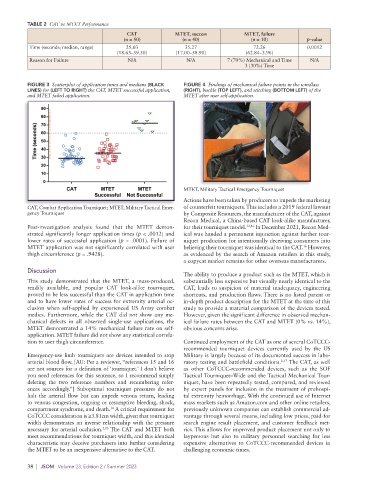
TABLE 2  CAT vs MTET Performance
                                           CAT            MTET, success          MTET, failure
                                         (n = 50)            (n = 40)              (n = 10)          p-value
           Time (seconds; median, range)  29.03              35.27                  72.26            0.0012
                                       (18.63–59.50)      (17.00–58.90)          (62.84–3.96)
           Reason for Failure              N/A                N/A          7 (70%) Mechanical and Time   N/A
                                                                                 3 (30%) Time


          FIGURE 3  Scatterplot of application times and medians (BLACK   FIGURE 4  Findings of mechanical failure points in the windlass
          LINES) for (LEFT TO RIGHT) the CAT, MTET successful application,   (RIGHT), buckle (TOP LEFT), and stitching (BOTTOM LEFT) of the
          and MTET failed application.                       MTET after user self-application.


                                                             MTET, Military Tactical Emergency Tourniquet
                                                             Actions have been taken by producers to impede the marketing
          CAT, Combat Application Tourniquet; MTET, Military Tactical Emer-  of counterfeit tourniquets. This includes a 2019 federal lawsuit
          gency Tourniquet                                   by Composite Resources, the manufacturer of the CAT, against
                                                             Recon Medical, a China-based CAT look-alike manufacturer,
          Post-investigation  analysis  found  that  the  MTET  demon-  for their tourniquet model. 12,16  In December 2021, Recon Med-
          strated significantly longer application times (p < .0012) and   ical was handed a permanent injunction against further tour-
          lower rates of successful application (p = .0001). Failure of   niquet production for intentionally deceiving consumers into
          MTET application was not significantly correlated with user   believing their tourniquet was identical to the CAT.  However,
                                                                                                    16
          thigh circumference (p = .9428).                   as evidenced by the search of Amazon retailers in this study,
                                                             a copycat market remains for other overseas manufacturers.
          Discussion
                                                             The ability to produce a product such as the MTET, which is
          This study demonstrated that the MTET, a mass-produced,   substantially less expensive but visually nearly identical to the
          readily available, and popular CAT look-alike tourniquet,   CAT, leads to suspicion of material inadequacy, engineering
          proved to be less successful than the CAT in application time   shortcuts, and production flaws. There is no listed patent or
          and to have lower rates of success for extremity arterial oc-  in-depth product description for the MTET at the time of this
          clusion when self-applied by experienced US  Army combat   study to provide a material comparison of the devices tested.
          medics. Furthermore, while the CAT did not show any me-  However, given the significant difference in observed mechan-
          chanical defects in all observed single-use applications, the   ical failure rates between the CAT and MTET (0% vs. 14%),
          MTET demonstrated a 14% mechanical failure rate on self-   obvious concerns arise.
          application. MTET failure did not show any statistical correla-
          tion to user thigh circumference.                  Continued employment of the CAT as one of several  CoTCCC-
                                                             recommended tourniquet devices currently used by the US
          Emergency-use limb tourniquets are devices intended to stop   Military is largely because of its documented success in labo-
          arterial blood flow. [AU: Per a reviewer, “references 15 and 16   ratory testing and battlefield conditions. 2,17  The CAT, as well
          are not sources for a definition of ‘tourniquet.’ I don’t believe   as other  CoTCCC-recommended  devices, such  as the SOF
          you need references for this sentence, so I recommend simply   Tactical Tourniquet–Wide and the Tactical Mechanical Tour-
          deleting the  two reference numbers and renumbering refer-  niquet, have been repeatedly tested, compared, and reviewed
          ences accordingly.”] Suboptimal tourniquet pressures do not   by expert panels for inclusion in the treatment of prehospi-
          halt the arterial flow but can impede venous return, leading   tal extremity hemorrhage. With the continued use of Internet
          to venous congestion, ongoing or resumptive bleeding, shock,   mass markets such as Amazon.com and other online retailers,
          compartment syndrome, and death.  A critical requirement for   previously unknown companies can establish commercial ad-
                                     14
          CoTCCC consideration is ≥3.81cm width, given that tourniquet   vantage through several means, including low prices, paid-for
          width demonstrates an inverse relationship with the pressure   search engine result placement, and customer feedback met-
          necessary for arterial occlusion. 2,15  The CAT and MTET both   rics. This allows for improved product placement not only to
          meet recommendations for tourniquet width, and this identical   laypersons but also to military personnel searching for less
          characteristic may deceive purchasers into further considering   expensive alternatives to CoTCCC-recommended devices in
          the MTET to be an inexpensive alternative to the CAT.  challenging economic times.

          38  |  JSOM   Volume 23, Edition 2 / Summer 2023

