


Page 76 - JSOM Winter 2022
P. 76
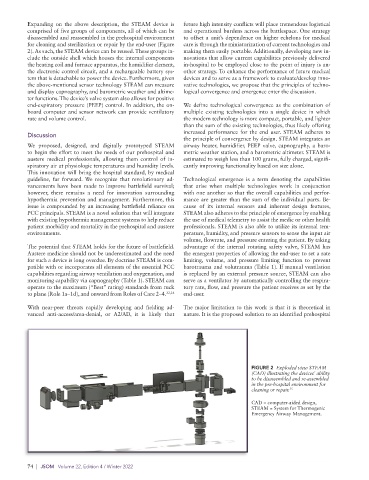
Expanding on the above description, the STEAM device  is   future high intensity conflicts will place tremendous logistical
          comprised of five groups of components, all of which can be   and operational burdens across the battlespace. One strategy
          disassembled and reassembled in the prehospital environment   to offset a unit’s dependence on higher echelons for medical
          for cleaning and sterilization or repair by the end-user (Figure   care is through the miniaturization of current technologies and
          2). As such, the STEAM device can be reused. These groups in-  making them easily portable. Additionally, developing new in-
          clude the outside shell which houses the internal components   novations that allow current capabilities previously delivered
          the heating coil and furnace apparatus, the humidifier element,   in-hospital to be employed close to the point of injury is an-
          the electronic control circuit, and a rechargeable battery sys-  other strategy. To enhance the performance of future medical
          tem that is detachable to power the device. Furthermore, given   devices and to serve as a framework to evaluate/develop inno-
          the above-mentioned sensor technology STEAM can measure   vative technologies, we propose that the principles of techno-
          and display capnography, and barometric weather and altime-  logical convergence and emergence enter the discussion.
          ter functions. The device’s valve system also allows for positive
          end-expiratory pressure (PEEP) control. In addition, the on-  We define technological convergence as the combination of
          board computer and sensor network can provide ventilatory   multiple existing technologies into a single device in which
          rate and volume control.                           the modern technology is more compact, portable, and lighter
                                                             than the sum of the existing technologies, thus likely offering
                                                             increased  performance  for  the  end  user.  STEAM  adheres  to
          Discussion
                                                             the principle of convergence by design. STEAM integrates an
          We proposed, designed, and digitally prototyped STEAM   airway heater, humidifier, PEEP valve, capnography, a baro-
          to begin the effort to meet the needs of our prehospital and   metric weather station, and a barometric altimeter. STEAM is
          austere medical professionals, allowing them control of in-  estimated to weigh less than 100 grams, fully charged, signifi-
          spiratory air at physiologic temperatures and humidity levels.   cantly improving functionality based on size alone.
          This innovation will bring the hospital standard, by medical
          guideline,  far forward. We recognize  that revolutionary  ad-  Technological emergence is a term denoting the capabilities
          vancements have been made to improve battlefield survival;   that arise when multiple technologies work in conjunction
          however,  there  remains  a need  for  innovation surrounding   with one another so that the overall capabilities and perfor-
          hypothermia prevention and management. Furthermore, this   mance are greater than the sum of the individual parts. Be-
          issue is compounded by an increasing battlefield reliance on   cause of its internal sensors and inherent design features,
          PCC principals. STEAM is a novel solution that will integrate   STEAM also adheres to the principle of emergence by enabling
          with existing hypothermia management systems to help reduce   the use of medical telemetry to assist the medic or other health
          patient morbidity and mortality in the prehospital and austere   professionals. STEAM is also able to utilize its internal tem-
          environments.                                      perature, humidity, and pressure sensors to sense the input air
                                                             volume, flowrate, and pressure entering the patient. By taking
          The potential that STEAM holds for the future of battlefield.   advantage of the internal rotating safety valve, STEAM has
          Austere medicine should not be underestimated and the need   the emergent properties of allowing the end-user to set a rate
          for such a device is long overdue. By doctrine STEAM is com-  limiting,  volume, and  pressure  limiting function  to  prevent
          patible with or incorporates all elements of the essential PCC   barotrauma and volutrauma (Table 1). If manual ventilation
          capabilities regarding airway ventilation and oxygenation, and   is replaced by an external pressure source, STEAM can also
          monitoring capability via capnography (Table 1). STEAM can   serve as a ventilator by automatically controlling the respira-
          operate to the maximum (“Best” rating) standards from ruck   tory rate, flow, and pressure the patient receives as set by the
          to plane (Role 1a–1d), and onward from Roles of Care 2–4. 22,24  end-user.

          With near-peer threats rapidly developing and fielding ad-  The major limitation to this work is that it is theoretical in
          vanced anti-access/area-denial, or  A2/AD, it is likely that   nature. It is the proposed solution to an identified prehospital


                                                                                   FIGURE 2  Exploded view STEAM
                                                                                   (CAD) illustrating the devices’ ability
                                                                                   to be disassembled and re-assembled
                                                                                   in the pre-hospital environment for
                                                                                   cleaning or repair. 35

                                                                                   CAD = computer-aided design,
                                                                                   STEAM = System for Thermogenic
                                                                                   Emergency Airway Management.


          74  |  JSOM   Volume 22, Edition 4 / Winter 2022

