


Page 46 - JSOM Fall 2022
P. 46
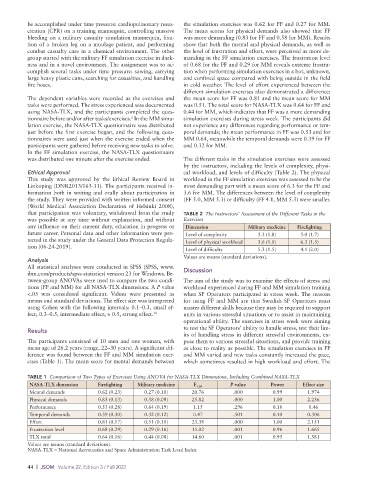
be accomplished under time pressure: cardiopulmonary resus the simulation exercises was 0.62 for FF and 0.27 for MM.
citation (CPR) on a training mannequin, controlling massive The mean scores for physical demands also showed that FF
bleeding on a military casualty simulation mannequin, fixa was more demanding (0.83 for FF and 0.58 for MM). Results
tion of a broken leg on a moulage patient, and performing show that both the mental and physical demands, as well as
combat casualty care in a chemical environment. The other the level of frustration and effort, were perceived as more de
group started with the military FF simulation exercise in dark manding in the FF simulation exercises. The frustration level
ness and in a novel environment. The assignment was to ac of 0.68 for the FF and 0.29 for MM reveals extreme frustra
complish several tasks under time pressure: sawing, carrying tion when performing simulation exercises in a hot, unknown,
large heavy plastic cans, searching for casualties, and handling and confined space compared with being outside in the field
fire hoses. in cold weather. The level of effort experienced between the
different simulation exercises also demonstrated a difference;
The dependent variables were recorded as the exercises and the mean score for FF was 0.81 and the mean score for MM
tasks were performed. The stress experienced was documented was 0.51. The total score for NASATLX was 0.64 for FF and
using NASATLX, and the participants completed the ques 0.44 for MM, which indicates that FF was a more demanding
2
tionnaire before and/or after tasks/exercises. In the MM simu simulation exercises during stress week. The participants did
lation exercise, the NASATLX questionnaire was distributed not experience any differences regarding performance or tem
just before the first exercise began, and the following ques poral demands; the mean performance in FF was 0.53 and for
tionnaires were used just when the exercise ended when the MM 0.64, meanwhile the temporal demands were 0.39 for FF
participants were gathered before receiving new tasks to solve. and 0.32 for MM.
In the FF simulation exercise, the NASATLX questionnaire
was distributed one minute after the exercise ended. The different tasks in the simulation exercises were assessed
by the instructors, including the levels of complexity, physi
Ethical Approval cal workload, and levels of difficulty (Table 2). The physical
This study was approved by the Ethical Review Board in workload in the FF simulation exercises was assessed to be the
Linkoping (DNR2013/16331). The participants received in most demanding part with a mean score of 6.3 for the FF and
formation both in writing and orally about participation in 3.6 for MM. The differences between the level of complexity
the study. They were provided with written informed consent (FF 5.0, MM 5.3) or difficulty (FF 4.1, MM 5.3) were smaller.
(World Medical Association Declaration of Helsinki 2008),
that participation was voluntary, withdrawal from the study TABLE 2 The Instructors’ Assessment of the Different Tasks in the
was possible at any time without explanation, and without Exercises
any influence on their current duty, education in progress or Dimension Military medicine Firefighting
future career. Personal data and other information were pro Level of complexity 5.3 (1.8) 5.0 (1.7)
tected in the study under the General Data Protection Regula Level of physical workload 3.6 (1.0) 6.3 (1.5)
tion (06242019).
Level of difficulty 5.3 (1.5) 4.1 (2.0)
Values are means (standard deviations).
Analysis
All statistical analyses were conducted in SPSS (SPSS, www.
ibm.com/products/spssstatistics) version 23 for Windows. Be Discussion
tweengroup ANOVAs were used to compare the two condi The aim of the study was to examine the effects of stress and
tions (FF and MM) for all NASATLX dimensions. A P value workload experienced during FF and MM simulation training
<.05 was considered significant. Values were presented as when SF Operators participated in stress week. The reasons
means and standard deviations. The effect size was interpreted for using FF and MM are that Swedish SF Operators must
using Cohen with the following intervals: 0.1–0.3, small ef master different skills because they may be required to support
fect; 0.3–0.5, intermediate effect; ≥ 0.5, strong effect. 30 units in various stressful situations or to assist in maintaining
operational ability. The exercises in stress week were aiming
to test the SF Operators’ ability to handle stress, test their lim
Results
its of handling stress in different stressful environments, ex
The participants consisted of 10 men and one woman, with pose them to various stressful situations, and provide training
mean age of 26.2 years (range, 22–30 years). A significant dif as close to reality as possible. The simulation exercises in FF
ference was found between the FF and MM simulation exer and MM varied and new tasks constantly increased the pace,
cises (Table 1). The mean score for mental demands between which sometimes resulted in high workload and effort. The
TABLE 1 Comparison of Two Types of Exercises Using ANOVA for NASA-TLX Dimensions, Including Combined NASA-TLX
NASA-TLX dimension Firefighting Military medicine F 1,20 P value Power Effect size
Mental demands 0.62 (0.23) 0.27 (0.10) 20.76 .000 0.99 1.974
Physical demands 0.83 (0.13) 0.58 (0.09) 25.82 .000 1.00 2.236
Performance 0.53 (0.28) 0.64 (0.19) 1.15 .296 0.18 0.46
Temporal demands 0.39 (0.30) 0.32 (0.12) 0.47 .501 0.10 0.306
Effort 0.81 (0.17) 0.51 (0.10) 23.38 .000 1.00 2.151
Frustration level 0.68 (0.29) 0.29 (0.16) 15.02 .001 0.96 1.665
TLX total 0.64 (0.16) 0.44 (0.08) 14.60 .001 0.95 1.581
Values are means (standard deviations).
NASATLX = National Aeronautics and Space Administration Task Load Index
44 | JSOM Volume 22, Edition 3 / Fall 2022

