


Page 149 - JSOM Fall 2022
P. 149
HOW DRONES WILL TRANSFORM efforts by Veterinary Services personnel to research and pre
BATTLEFIELD MEDICINE AND SAVE LIVES pare for the proper treatment of canine combat causalities. In
January 2022, DHA launched the Joint Trauma System Mili
Drones may become essential to combat medicine. “I think it’s tary Working Dog Trauma Registry.
going to come down to drone delivery of blood by some type
of unmanned vehicle that can fly in and drop off more blood Biological differences between humans and dogs dictate the
or more bullets, whatever is needed,” said Air Force Col (Dr) need for such a database and for varying approaches in pro
Stacy Shackelford, chief of the Joint Trauma System. tocol. For instance, dogs are historically much easier to intu
bate than humans and dogs are far more resistant to opioids.
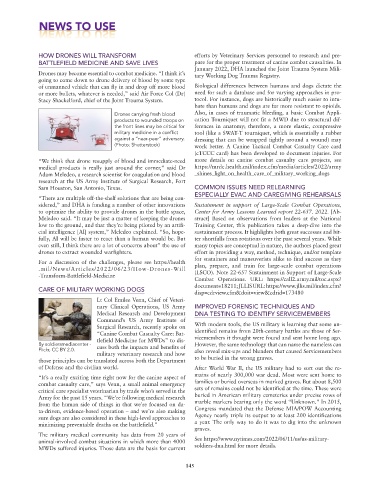
Drones carrying fresh blood Also, in cases of traumatic bleeding, a basic Combat Appli
products to wounded troops on cation Tourniquet will not fit a MWD due to structural dif
the front lines may be critical for ferences in anatomy; therefore, a more elastic, compressive
military medicine in a conflict tool (like a SWATT tourniquet, which is essentially a rubber
against a “near-peer” adversary. dressing that can be wrapped tightly around a wound) may
(Photo: Shutterstock) work better. A Canine Tactical Combat Casualty Care card
(cTCCC card) has been developed to document injuries. For
“We think that drone resupply of blood and immediateneed more details on canine combat casualty care projects, see
medical products is really just around the corner,” said Dr https://mrdc.health.mil/index.cfm/media/articles/2022/army
Adam Meledeo, a research scientist for coagulation and blood _shines_light_on_health_care_of_military_working_dogs
research at the US Army Institute of Surgical Research, Fort
Sam Houston, San Antonio, Texas. COMMON ISSUES NEED RELEARNING
ESPECIALLY EVAC AND CAREGIVING REHEARSALS
“There are multiple offtheshelf solutions that are being con
sidered,” and DHA is funding a number of other innovations Sustainment in support of Large-Scale Combat Operations,
to optimize the ability to provide drones in the battle space, Center for Army Lessons Learned report 22-657. 2022. [Ab
Meledeo said. “It may be just a matter of keeping the drones stract] Based on observations from leaders at the National
low to the ground, and that they’re being piloted by an artifi Training Center, this publication takes a deepdive into the
cial intelligence [AI] system,” Meledeo explained. “So, hope sustainment process. It highlights both great successes and bit
fully, AI will be faster to react than a human would be. But ter shortfalls from rotations over the past several years. While
even still, I think there are a lot of concerns about” the use of many topics are conceptual in nature, the authors placed great
drones to extract wounded warfighters. effort in providing a way, method, technique, and/or template
for sustainers and maneuverists alike to find success as they
For a discussion of the challenges, please see https://health
.mil/News/Articles/2022/06/23/HowDronesWill plan, prepare, and train for largescale combat operations
TransformBattlefieldMedicine (LSCO). Note 22657 Sustainment in Support of LargeScale
Combat Operations. URL: https://call2.army.mil/toc.aspx?
document=18211; JLLIS URL: https://www.jllis.mil/index.cfm?
CARE OF MILITARY WORKING DOGS disp=cdrview.cfm&doit=view&cdrid=173480
Lt Col Emilee Venn, Chief of Veteri
nary Clinical Operations, US Army IMPROVED FORENSIC TECHNIQUES AND
Medical Research and Development DNA TESTING TO IDENTIFY SERVICEMEMBERS
Command’s US Army Institute of
Surgical Research, recently spoke on With modern tools, the US military is learning that some un
“Canine Combat Casualty Care: Bat identified remains from 20thcentury battles are those of Ser
tlefield Medicine for MWDs” to dis vicemembers it thought were found and sent home long ago.
By soldiersmediacenter - However, the same technology that can name the nameless can
Flickr, CC BY 2.0. cuss both the impacts and benefits of also reveal mixups and blunders that caused Servicemembers
military veterinary research and how
those principles can be translated across both the Department to be buried in the wrong graves.
of Defense and the civilian world. After World War II, the US military had to sort out the re
“It’s a really exciting time right now for the canine aspect of mains of nearly 300,000 war dead. Most were sent home to
combat casualty care,” says Venn, a small animal emergency families or buried overseas in marked graves. But about 8,500
critical care specialist veterinarian by trade who’s served in the sets of remains could not be identified at the time. These were
Army for the past 15 years. “We’re following medical research buried in American military cemeteries under precise rows of
from the human side of things in that we’re focused on da marble markers bearing only the word “Unknown.” In 2015,
tadriven, evidencebased operation – and we’re also making Congress mandated that the Defense MIA/POW Accounting
sure dogs are also considered in these highlevel approaches to Agency nearly triple its output to at least 200 identifications
minimizing preventable deaths on the battlefield.” a year. The only way to do it was to dig into the unknown
graves.
The military medical community has data from 20 years of
animalinvolved combat situations in which more than 4000 See https://www.nytimes.com/2022/06/11/us/usmilitary
MWDs suffered injuries. Those data are the basis for current soldiersdna.html for more details.
145

