


Page 148 - JSOM Fall 2022
P. 148
(continued from page 7)
In Performance Evaluation of the Solo-T and the Combat Hypertonic Saline for Severe Traumatic Brain Injury With
Application Tourniquet in a Perfused Cadaver Model, the au Herniation: A Military Prehospital Case Report details the
thors evaluated a 10.2cmwide, minimally elastic, adhesive management of a pregnant patient with severe traumatic brain
wrap–based tourniquet (SoloT or ST) alongside a 3.8cm injury and signs of impending or ongoing herniation. Addi
wide windlassbased tourniquet (Combat Application Tourni tionally, the authors review the pathophysiology and signs of
quet Generation 7, or CAT). herniation, the mechanism of action of hyperosmotic thera
pies, and the rationale behind the use of hypertonic saline in
the combat setting.
The Present State of Military Physician Leadership: A Lack-
ing Paradigm? (Editorial) discusses the military health system
and suggests (1) Make clinical practice matter, (2) Emphasize
the need for ICTL training for everyone, (3) Perform an evi
dencebased evaluation of nonmedical training requirements
and eliminate those that have little value, and (4) Build clinical
practice into staffing models for all leadership, administrative,
and operational positions.
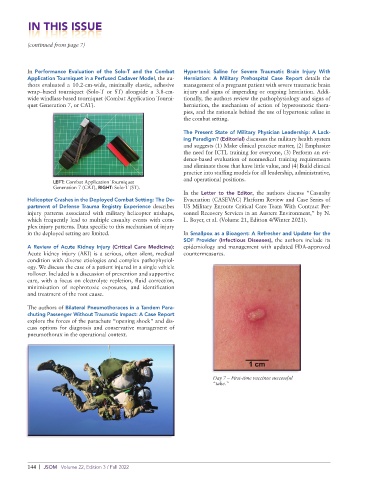
LEFT: Combat Application Tourniquet
Generation 7 (CAT), RIGHT: SoloT (ST).
In the Letter to the Editor, the authors discuss “Casualty
Helicopter Crashes in the Deployed Combat Setting: The De- Evacuation (CASEVAC) Platform Review and Case Series of
partment of Defense Trauma Registry Experience describes US Military Enroute Critical Care Team With Contract Per
injury patterns associated with military helicopter mishaps, sonnel Recovery Services in an Austere Environment,” by N.
which frequently lead to multiple casualty events with com L. Boyer, et al. (Volume 21, Edition 4/Winter 2021).
plex injury patterns. Data specific to this mechanism of injury
in the deployed setting are limited. In Smallpox as a Bioagent: A Refresher and Update for the
SOF Provider (Infectious Diseases), the authors include its
A Review of Acute Kidney Injury (Critical Care Medicine): epidemiology and management with updated FDAapproved
Acute kidney injury (AKI) is a serious, often silent, medical countermeasures.
condition with diverse etiologies and complex pathophysiol
ogy. We discuss the case of a patient injured in a single vehicle
rollover. Included is a discussion of prevention and supportive
care, with a focus on electrolyte repletion, fluid correction,
minimization of nephrotoxic exposures, and identification
and treatment of the root cause.
The authors of Bilateral Pneumothoraces in a Tandem Para-
chuting Passenger Without Traumatic Impact: A Case Report
explore the forces of the parachute “opening shock” and dis
cuss options for diagnosis and conservative management of
pneumothorax in the operational context.
Day 7 – First-time vaccinee successful
“take.”
144 | JSOM Volume 22, Edition 3 / Fall 2022

