


Page 146 - JSOM Winter 2021
P. 146
Hail and Farewell!                                 Following his early successes, Tom continued to deliver ground-
          Melissa Givens, MD, MPH, has joined the Consortium for Health   breaking research that resulted in further understanding and
          and Military Performance, A DoD Center of Excellence, Depart-  improved  clinical  care in  many areas.  Because many  innova-
          ment of Military and Emergency Medicine, Uniformed Services   tions have been adopted by civilian trauma care providers, the
          University, as executive director, and Patricia Deuster, PhD, MPH,   research produced by Tom has saved innumerable lives world-
          FACSM, will be leaving that position. As the section contributor   wide. In 2018, Tom was selected to serve as the manager of
          of Human Performance Optimization, Patty has provided the   the Prolonged Field Care (PFC) Capability Area for the US Army
          JSOM with many reports on a range of fascinating issues, and   Medical Research and Development Command’s Combat Ca-
          we are grateful to her for all of her hard work. Recently, Patty   sualty Care Research Program (CCCRP). In this role he led a
          received a 2021 MHSRS Distinguished Service Award. Missy has   multidisciplinary research team to advance areas including ex-
          worked with JSOM previously; we are excited to welcome her!  tracorporeal life support, trauma, and hemorrhage.
                                                             Some of the significance of the work by Tom and his colleagues
          Thank You for Your Service
          Thomas J. Walters, PhD, retired from his position as supervisory   can be summed up in this excerpt from the 2013 JSOM article
          research physiologist at the US Army Institute of Surgical Re-  “Tragedy Into Drama: An American History of Tourniquet Use in
          search (USAISR) in October 2021 after 21 years of service. He   the Current War”:
          was awarded the Superior Civilian Service Medal in recognition   In 2009, a nephew, Army SGT Daniel Archer, and three of his
          of exemplary service. As a transformative scientific leader, Tom   buddies visited his uncle, Dr Tom Walters, during a day off
          has been at the forefront of combat casualty care research and is   from their medic training, a postdeployment refresher. In con-
          an internationally recognized expert in tourniquet use for hem-  versation about their training, the nephew told his buddies
          orrhage control and muscle injury sequelae. His research efforts   that his uncle as a researcher was involved in getting the new
          have resulted in great strides in military battlefield medicine and   tourniquet issued earlier that decade. The buddies said, “No
          have paid off in the most important criterion of success: lives   way,” that there always had been a tourniquet issued to all.
          saved both on the battlefield and in civilian trauma victims.  The uncle replied, “Way,” and told them the story of how
          Tom first came to the USAISR in 2000 as a research physiologist   history happened. Over beer and barbecue, Walters told his
          with a focus on extremity trauma and regenerative medicine.   nephew and his buddies that only a few years earlier, all the
          At that time, tourniquets were used as a last resort to control   training they would have had would have been an hour or
          extremity hemorrhage as the prevailing wisdom suggested im-  so of instruction with a stick-and-cravat tourniquet, not the
          pending limb loss. Beyond being an exemplary scientist and an   standard-issue tourniquet of today.
          extra ordinary mentor and colleague, Tom had an interpersonal   They were amazed and asked, “You mean it hasn’t always
          connection to community members. Key to this connection was     been this way?’
          the conference “USAISR/USSOCOM Conference” (15–16 August    “No, it has not,” replied Walters.
          2002). Medics from the war relayed their problems, such as a   The 2013 JSOM article has legs, still.
          need for a good tourniquet. This was pivotal for Tom’s new con-
          nection to our community.                          Scott Is Our Special Santa
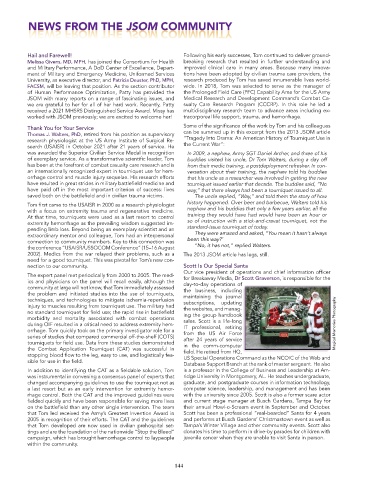
                                                             Our vice president of operations and chief information officer
          The expert panel met periodically from 2000 to 2005. The med-  for Breakaway Media, Dr Scott Graverson, is responsible for the
          ics and physicians on the panel will recall easily, although the   day-to-day operations of
          community at large will not know, that Tom immediately assessed   the business, including
          the problem and initiated studies into the use of tourniquets,   maintaining the journal
          techniques, and technologies to mitigate ischemia-reperfusion   subscriptions, updating
          injury to muscles resulting from tourniquet use. The military had   the web sites, and manag-
          no standard tourniquet for field use; the rapid rise in battlefield   ing the group handbook
          morbidity and mortality associated with combat operations   sales. Scott is a life-long
          during OIF resulted in a critical need to address extremity hem-  IT professional, retiring          Magical Memories Photography
          orrhage. Tom quickly took on the primary investigator role for a   from the US Air Force
          series of studies that compared commercial off-the-shelf (COTS)   after  24 years of  service
          tourniquets for field use. Data from these studies demonstrated   in the comm- computer
          the Combat Application Tourniquet (CAT) was successful in   field. He retired from HQ,
          stopping blood flow to the leg, easy to use, and logistically fea-  US Special Operations Command as the NCOIC of the Web and
          sible for use in the field.
                                                             Database Support Branch at the rank of master sergeant. He also
          In addition to identifying the CAT as a fieldable solution, Tom   is a professor in the College of Business and Leadership at Am-
          was instrumental in convening a consensus panel of experts that   ridge University in Montgomery, AL. He teaches undergraduate,
          changed accompanying guidelines to use the tourniquet not as   graduate, and postgraduate courses in information technology,
          a last resort but as an early intervention for extremity hemor-  computer science, leadership, and management and has been
          rhage control. Both the CAT and the improved guidelines were   with the university since 2005. Scott is also a former scare actor
          fielded quickly and have been responsible for saving more lives   and current stage manager at Busch Gardens, Tampa Bay for
          on the battlefield than any other single intervention. The team   their annual Howl-o-Scream event in September and October.
          that Tom led received the Army’s Greatest Invention Award in   Scott has been a professional “ real-bearded” Santa for 4 years
          2005 in recognition of their efforts. The CAT and the guidelines   and performs at Busch Gardens’ Christmastown event as well as
          that Tom developed are now used in civilian prehospital set-  Tampa’s Winter Village and other community events. Scott also
          tings and are the foundation of the nationwide “Stop the Bleed”   donates his time to perform in drive-by parades for children with
          campaign, which has brought hemorrhage control to laypeople   juvenile cancer when they are unable to visit Santa in person.
          within the community.


                                                          144

