


Page 111 - JSOM Fall 2021
P. 111
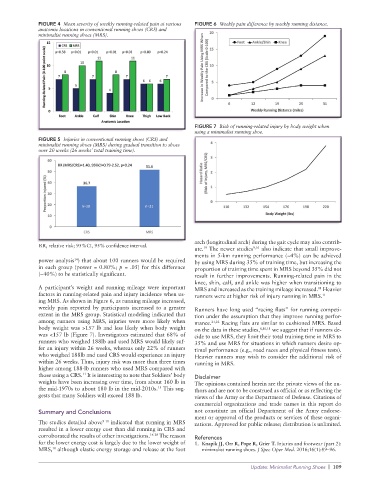
FIGURE 4  Mean severity of weekly running-related pain at various   FIGURE 6  Weekly pain difference by weekly running distance.
              anatomic locations in conventional running shoes (CRS) and
              minimalist running shoes (MRS).


                                                                 FIGURE 7  Risk of running-related injury by body weight when
                                                                 using a minimalist running shoe.
              FIGURE 5  Injuries in conventional running shoes (CRS) and
              minimalist running shoes (MRS) during gradual transition to shoes
              over 20 weeks (26 weeks’ total training time).


                                                                 arch (longitudinal arch) during the gait cycle may also contrib-
              RR, relative risk; 95%CI, 95% confidence interval.
                                                                 ute.  The newer studies 9,10  also indicate that small improve-
                                                                   19
                                                                 ments in 5-km running performance (~4%) can be achieved
              power analysis ) that about 100 runners would be required   by using MRS during 35% of training time, but increasing the
                         14
              in each group (power = 0.80%; p = .05) for this difference   proportion of training time spent in MRS beyond 35% did not
              (~40%) to be statistically significant.            result in further improvements. Running-related pain in the
                                                                 knee, shin, calf, and ankle was higher when transitioning to
              A participant’s weight and running mileage were important   MRS and increased as the training mileage increased.  Heavier
                                                                                                         11
              factors in running-related pain and injury incidence when us-  runners were at higher risk of injury running in MRS. 11
              ing MRS. As shown in Figure 6, as running mileage increased,
              weekly pain reported by participants increased to a greater   Runners have long used “racing flats” for running competi-
              extent in the MRS group. Statistical modeling indicated that   tion under the assumption that they improve running perfor-
              among runners using MRS, injuries were more likely when   mance. 21,22  Racing flats are similar to cushioned MRS. Based
              body weight was >157 lb and less likely when body weight   on the data in these studies, 8,10,11  we suggest that if runners de-
              was <157 lb (Figure 7). Investigators estimated that 68% of   cide to use MRS, they limit their total training time in MRS to
              runners who weighed 188lb and used MRS would likely suf-  35% and use MRS for situations in which runners desire op-
              fer an injury within 26 weeks, whereas only 22% of runners   timal performance (e.g., road races and physical fitness tests).
              who weighed 188lb and used CRS would experience an injury   Heavier runners may wish to consider the additional risk of
              within 26 weeks. Thus, injury risk was more than three times   running in MRS.
              higher among 188-lb runners who used MRS compared with
              those using a CRS.  It is interesting to note that Soldiers’ body   Disclaimer
                            11
              weights have been increasing over time, from about 160 lb in   The opinions contained herein are the private views of the au-
              the mid-1970s to about 180 lb in the mid-2010s.  This sug-  thors and are not to be construed as official or as reflecting the
                                                     15
              gests that many Soldiers will exceed 188 lb.       views of the Army or the Department of Defense. Citations of
                                                                 commercial organizations and trade names in this report do
              Summary and Conclusions                            not constitute an official Department of the Army endorse-
                                                                 ment or approval of the products or services of these organi-
              The studies detailed above 9-11  indicated that running in MRS   zations. Approved for public release; distribution is unlimited.
              resulted in a lower energy cost than did running in CRS and
              corroborated the results of other investigations. 16-20  The reason   References
              for the lower energy cost is largely due to the lower weight of   1.  Knapik JJ, Orr R, Pope R, Grier T. Injuries and footwear (part 2):
              MRS,  although elastic energy storage and release at the foot   minimalist running shoes. J Spec Oper Med. 2016;16(1):89–96.
                  18
                                                                                   Update: Minimalist Running Shoes  |  109

