


Page 110 - JSOM Fall 2021
P. 110
in < 23 min. Runners were excluded if they had had an injury   FIGURE 2  Energy cost at two different run speeds in conventional
          in the previous 3 months, undergone surgery in the past year,   running shoes (CRS) and minimalist running shoes (MRS) during
          or had used orthotics. Selected participants gradually adapted   26-week study.
          to either CRS or a MRS over 20 weeks. The CRS group (n
          = 30) transitioned from their usual running shoe to an Asics
          Gel Cumulus (ASICS) (weight = 0.73 ± 0.06 lb, heel height =
          1.3 in, heel drop = 0.4 in). The MRS group (n = 31) gradually
          transitioned from their usual running shoes to an Asics Pira-
          nha SP4 (weight = 0.30 ± 0.02 lb, heel height = 0.9 in, heel
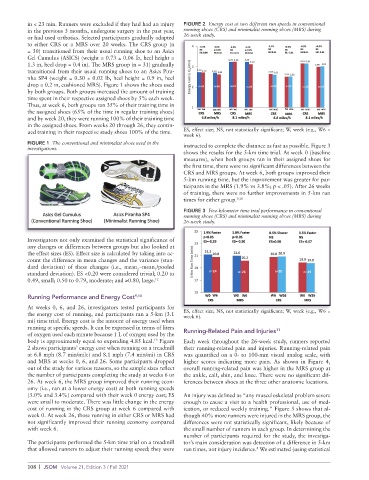
          drop = 0.2 in, cushioned MRS). Figure 1 shows the shoes used
          by both groups. Both groups increased the amount of training
          time spent in their respective assigned shoes by 5% each week.
          Thus, at week 6, both groups ran 35% of their training time in
          the assigned shoes (65% of the time in regular training shoes)
          and by week 20, they were running 100% of their training time
          in the assigned shoes. From weeks 20 through 26, they contin-
          ued training in their respective study shoes 100% of the time.  ES, effect size; NS, not statistically significant; W, week (e.g., W6 =
                                                             week 6).
          FIGURE 1  The conventional and minimalist shoes used in the   instructed to complete the distance as fast as possible. Figure 3
          investigations.
                                                             shows the results for the 5-km time trial. At week 0 (baseline
                                                             measures), when both groups ran in their assigned shoes for
                                                             the first time, there were no significant differences between the
                                                             CRS and MRS groups. At week 6, both groups improved their
                                                             5-km running time, but the improvement was greater for par-
                                                             ticipants in the MRS (1.9% vs 3.8%; p < .05). After 26 weeks
                                                             of training, there were no further improvements in 5-km run
                                                             times for either group. 9,10
                                                             FIGURE 3  Five-kilometer time trial performance in conventional
                                                             running shoes (CRS) and minimalist running shoes (MRS) during
                                                             26-week study.

          Investigators not only examined the statistical significance of
          any changes or differences between groups but also looked at
          the effect sizes (ES). Effect size is calculated by taking into ac-
          count the difference in mean changes and the variance (stan-
          dard deviation) of these changes (i.e., mean -mean /pooled
                                              2
                                                    1
          standard deviation). ES <0.20 were considered trivial; 0.20 to
          0.49, small; 0.50 to 0.79, moderate; and ≥0.80, large. 12
          Running Performance and Energy Cost 9,10
          At weeks 0, 6, and 26, investigators tested participants for
          the energy cost of running, and participants ran a 5-km (3.1   ES, effect size; NS, not statistically significant; W, week (e.g., W6 =
                                                             week 6).
          mi) time trial. Energy cost is the amount of energy used when
          running at specific speeds. It can be expressed in terms of liters               11
          of oxygen used each minute because 1 L of oxygen used by the   Running-Related Pain and Injuries
                                                   13
          body is approximately equal to expending 4.85 kcal.  Figure   Each week throughout the 26-week study, runners reported
          2 shows participants’ energy cost when running on a treadmill   their running-related pain and injuries. Running-related pain
          at 6.8 mph (8.7 min/mile) and 8.1 mph (7.4 min/mi) in CRS   was quantified on a 0- to 100-mm visual analog scale, with
          and MRS at weeks 0, 6, and 26. Some participants dropped   higher scores indicating more pain. As shown in Figure 4,
          out of the study for various reasons, so the sample sizes reflect   overall running-related pain was higher in the MRS group at
          the number of participants completing the study at weeks 6 or   the ankle, calf, shin, and knee. There were no significant dif-
          26. At week 6, the MRS group improved their running econ-  ferences between shoes at the three other anatomic locations.
          omy (i.e., ran at a lower energy cost) at both running speeds
          (3.0% and 3.4%) compared with their week 0 energy cost; ES   An injury was defined as “any musculoskeletal problem severe
          were small to moderate. There was little change in the energy   enough to cause a visit to a health professional, use of med-
          cost of running in the CRS group at week 6 compared with   ication, or reduced weekly training.” Figure 5 shows that al-
          week 0. At week 26, those running in either CRS or MRS had   though 40% more runners were injured in the MRS group, the
          not significantly improved their running economy compared   differences were not statistically significant, likely because of
          with week 6.                                       the small number of runners in each group. In determining the
                                                             number of participants required for the study, the investiga-
          The participants performed the 5-km time trial on a treadmill   tor’s main consideration was detection of a difference in 5-km
          that allowed runners to adjust their running speed; they were   run times, not injury incidence.  We estimated (using statistical
                                                                                     8

          108  |  JSOM   Volume 21, Edition 3 / Fall 2021

