


Page 135 - JSOM Spring 2021
P. 135
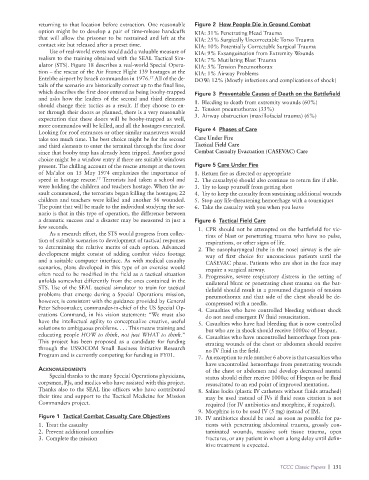
returning to that location before extraction. One reasonable   Figure 2  How People Die in Ground Combat
              option might be to develop a pair of time-release handcuffs   KIA: 31% Penetrating Head Trauma
              that will allow the prisoner to be restrained and left at the   KIA: 25% Surgically Uncorrectable Torso Trauma
              contact site but released after a preset time.     KIA: 10% Potentially Correctable Surgical Trauma
                 Use of real-world events would add a valuable measure of   KIA: 9% Exsanguination from Extremity Wounds
              realism to the training obtained with the SEAL Tactical Sim-  KIA: 7% Mutilating Blast Trauma
              ulator (STS). Figure 18 describes a real-world Special Opera-  KIA: 5% Tension Pneumothorax
              tion – the rescue of the Air France Flight 139 hostages at the   KIA: 1% Airway Problems
              Entebbe airport by Israeli commandos in 1976.  All of the de-  DOW: 12% (Mostly infections and complications of shock)
                                                  17
              tails of the scenario are historically correct up to the final line,
              which describes the first door entered as being booby-trapped   Figure 3  Preventable Causes of Death on the Battlefield
              and asks how the leaders of the second and third elements
              should change their tactics as a result. If they choose to en-  1.  Bleeding to death from extremity wounds (60%)
              ter through their doors as planned, there is a very reasonable   2.  Tension pneumothorax (33%)
              expectation that these doors will be booby-trapped as well,   3.  Airway obstruction (maxillofacial trauma) (6%)
              more commandos will be killed, and all the hostages executed.
              Looking for roof entrances or other similar maneuvers would   Figure 4  Phases of Care
              take too much time. The best choice might be for the second   Care Under Fire
              and third elements to enter the terminal through the first door   Tactical Field Care
              since that booby trap has already been tripped. Another good   Combat Casualty Evacuation (CASEVAC) Care
              choice might be a window entry if there are suitable windows
              present. The chilling account of the rescue attempt at the town   Figure 5 Care Under Fire
              of Ma’alot on 15 May 1974 emphasizes the importance of   1.  Return fire as directed or appropriate
              speed in hostage rescue.  Terrorists had taken a school and   2.  The casualty(s) should also continue to return fire if able.
                                 17
              were holding the children and teachers hostage. When the as-  3.  Try to keep yourself from getting shot
              sault commenced, the terrorists began killing the hostages; 22   4.  Try to keep the casualty from sustaining additional wounds
              children and teachers were killed and another 56 wounded.   5.  Stop any life-threatening hemorrhage with a tourniquet
              The point that will be made to the individual studying the sce-  6.  Take the casualty with you when you leave
              nario is that in this type of operation, the difference between
              a dramatic success and a disaster may be measured in just a   Figure 6  Tactical Field Care
              few seconds.                                        1.  CPR should not be attempted on the battlefield for vic-
                 As a research effort, the STS would progress from collec-  tims of blast or penetrating trauma who have no pulse,
              tion of suitable scenarios to development of tactical responses   respirations, or other signs of life.
              to determining the relative merits of each option. Advanced   2.  The nasopharyngeal (tube in the nose) airway is the air-
              development  might  consist  of  adding  combat  video  footage   way of first choice for unconscious patients until the
              and a suitable computer interface. As with medical casualty   CASEVAC phase. Patients who are shot in the face may
              scenarios, plans developed in this type of an exercise would   require a surgical airway.
              often need to be modified in the field as a tactical situation   3.  Progressive, severe respiratory distress in the setting of
              unfolds somewhat differently from the ones contained in the   unilateral blunt or penetrating chest trauma on the bat-
              STS. Use of the SEAL tactical simulator to train for tactical   tlefield should result in a presumed diagnosis of tension
              problems that emerge during a Special Operations mission,   pneumothorax and that side of the chest should be de-
              however, is consistent with the guidance provided by General   compressed with a needle.
              Peter Schoomaker, commander-in-chief of the US Special Op-  4.  Casualties who have controlled bleeding without shock
              erations Command, in his vision statement: “We must also   do not need emergent IV fluid resuscitation.
              have the intellectual agility to conceptualize creative, useful   5.  Casualties who have had bleeding that is now controlled
              solutions to ambiguous problems. . . . This means training and   but who are in shock should receive 1000cc of Hespan.
              educating people HOW to think, not just WHAT to think.”   6.  Casualties who have uncontrolled hemorrhage from pen-
              This project has been proposed as a candidate for funding   etrating wounds of the chest or abdomen should receive
              through the USSOCOM Small Business Initiative Research   no IV fluid in the field.
              Program and is currently competing for funding in FY01.  7.  An exception to rule number 6 above is that casualties who
                                                                    have uncontrolled hemorrhage from penetrating wounds
              AcknoWledGMents                                       of the chest or abdomen and develop decreased mental
                 Special thanks to the many Special Operations physicians,   status should either receive 1000cc of Hespan or be fluid
              corpsmen, PJs, and medics who have assisted with this project.   resuscitated to an end point of improved mentation.
              Thanks also to the SEAL line officers who have contributed   8.  Saline locks (plastic IV catheters without fluids attached)
              their time and support to the Tactical Medicine for Mission   may be used instead of IVs if fluid resus citation is not
              Commanders project.                                   required (for IV antibiotics and morphine, if required).
                                                                  9.  Morphine is to be used IV (5 mg) instead of IM.
              Figure 1  Tactical Combat Casualty Care Objectives  10.  IV antibiotics should be used as soon as possible for pa-
              1.  Treat the casualty                                tients with penetrating abdominal trauma, grossly con-
              2.  Prevent additional casualties                     taminated wounds, massive soft tissue trauma, open
              3.  Complete the mission                              fractures, or any patient in whom a long delay until defin-
                                                                    itive treatment is expected.


                                                                                             TCCC Classic Papers  |  131

