


Page 129 - JSOM Spring 2021
P. 129
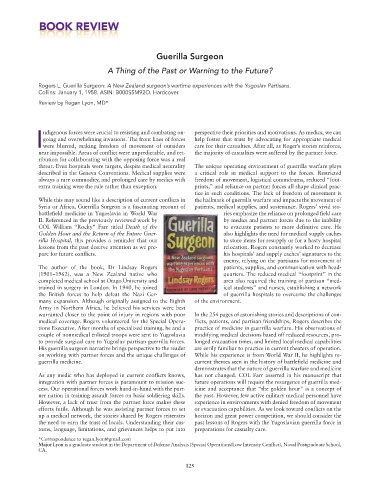
Guerilla Surgeon


                                    A Thing of the Past or Warning to the Future?

              Rogers L. Guerilla Surgeon: A New Zealand surgeon’s wartime experiences with the Yugoslav Partisans.
              Collins: January 1, 1958. ASIN: B000S5M92O. Hardcover.
              Review by Regan Lyon, MD*


               ndigenous forces were crucial to resisting and combating on-  perspective their priorities and motivations. As medics, we can
               going and overwhelming invasions. The front lines of forces   help foster that trust by advocating for appropriate medical
             Iwere blurred, making freedom of movement of outsiders   care for their casualties. After all, as Roger’s stories reinforce,
              near impossible. Areas of conflict were unpredictable, and ret-  the majority of casualties were suffered by the partner force.
              ribution for collaborating with the opposing force was a real
              threat. Even hospitals were targets, despite medical neutrality   The unique operating environment of guerrilla warfare plays
              described in the Geneva Conventions. Medical supplies were   a critical role in medical support to the forces. Restricted
              always a rare commodity, and prolonged care by medics with   freedom of movement, logistical conundrums, reduced “foot-
              extra training were the rule rather than exception.  prints,” and reliance on partner forces all shape clinical prac-
                                                                 tice in such conditions. The lack of freedom of movement is
              While this may sound like a description of current conflicts in   the hallmark of guerrilla warfare and impacts the movement of
              Syria or Africa, Guerrilla Surgeon is a fascinating recount of   patients, medical supplies, and sustenance. Rogers’ vivid sto-
              battlefield medicine in Yugoslavia in World War             ries emphasize the reliance on prolonged field care
              II. Referenced in the previously reviewed work by           by medics and partner forces due to the inability
              COL William “Rocky” Farr titled  Death of the               to evacuate patients to more definitive care. He
              Golden Hour and the Return of the Future Guer-              also highlights the need for medical supply caches
              rilla Hospital, this provides a reminder that our           to store items for resupply or for a hasty hospital
              lessons from the past deserve attention as we pre-          relocation. Rogers constantly worked to decrease
              pare for future conflicts.                                  his hospitals’ and supply caches’ signatures to the
                                                                          enemy, relying on the partisans for movement of
              The author of the book, Dr Lindsay Rogers                   patients, supplies, and communication with head-
              (1901–1962), was a New Zealand native who                   quarters. The reduced medical “footprint” in the
              completed medical school at Otago University and            area also required the training of partisan “med-
              trained in surgery in London. In 1940, he joined            ical students” and nurses, establishing a network
              the British forces to help defeat the Nazi Ger-             of guerrilla hospitals to overcome the challenges
              many expansion. Although originally assigned to the Eighth   of the environment.
              Army in Northern Africa, he believed his services were best
              warranted closer to the point of injury in regions with poor   In the 254 pages of astonishing stories and descriptions of con-
              medical coverage. Rogers volunteered for the Special Opera-  flicts, patients, and partisan friendships, Rogers describes the
              tions Executive. After months of specialized training, he and a   practice of medicine in guerrilla warfare. His observations of
              couple of nonmedical enlisted troops were sent to Yugoslavia   modifying medical decisions based off reduced resources, pro-
              to provide surgical care to Yugoslav partisan guerrilla forces.   longed evacuation times, and limited local medical capabilities
              His guerrilla surgeon narrative brings perspective to the reader   are eerily familiar to practice in current theaters of operation.
              on working with partner forces and the unique challenges of   While his experience is from World War II, he highlights re-
              guerrilla medicine.                                current themes seen in the history of battlefield medicine and
                                                                 demonstrates that the nature of guerrilla warfare and medicine
              As any medic who has deployed in current conflicts knows,   has not changed. COL Farr asserted in his manuscript that
              integration with partner forces is paramount to mission suc-  future operations will require the resurgence of guerrilla med-
              cess. Our operational forces work hand-in-hand with the part-  icine and acceptance that “the golden hour” is a concept of
              ner nation in training assault forces on basic soldiering skills.   the past. However, few active military medical personnel have
              However, a lack of trust from the partner force makes these   experience in environments with denied freedom of movement
              efforts futile. Although he was assisting partner forces to set   or evacuation capabilities. As we look toward conflicts on the
              up a medical network, the stories shared by Rogers reiterates   horizon and great power competition, we should consider the
              the need to earn the trust of locals. Understanding their cus-  past lessons of Rogers with the Yugoslavian guerrilla force in
              toms, language, limitations, and grievances helps to put into   preparations for casualty care.
              *Correspondence to regan.lyon@gmail.com
              Major Lyon is a graduate student in the Department of Defense Analysis (Special Operations/Low Intensity Conflict), Naval Postgraduate School,
              CA.

                                                              125

