


Page 125 - JSOM Spring 2021
P. 125
by evaluation using the AVPU scale (i.e., alert, verbal, pain,   in a 10- to 12-month-old infant; Table 1), and based on North
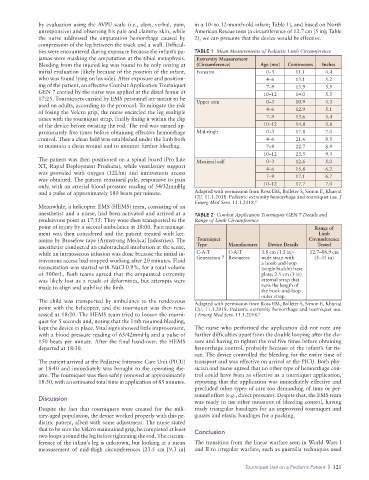
              unresponsive) and observing his pale and clammy skin, while   American Rescue tests (a circumference of 12.7 cm [5 in]; Table
              the nurse addressed the amputation hemorrhage caused by   2), we can presume that the device would be effective.
              compression of the leg between the truck and a wall. Difficul-
              ties were encountered during exposure because the infant’s pa-  TABLE 1  Mean Measurements of Pediatric Limb Circumference
              jamas were masking the amputation at the tibial metaphysis.   Extremity Measurement
              Bleeding from the injured leg was found to be only oozing at   (Circumference)  Age (mo)  Centimeters  Inches
              initial evaluation (likely because of the position of the infant,   Forearm   0–3   11.1     4.4
              who was found lying on his side). After exposure and position-            4–6       13.1     5.2
              ing of the patient, an effective Combat Application Tourniquet            7–9       13.9     5.5
              GEN 7 carried by the nurse was applied at the distal femur at            10–12      14.0     5.5
              17:25. Tourniquets carried by EMS personnel are meant to be
              used on adults, according to the protocol. To mitigate the risk   Upper arm   0–3   10.9     4.3
              of losing the Velcro grip, the nurse encircled the leg multiple           4–6       12.9     5.1
              times with the tourniquet strap, finally fixing it within the clip        7–9       13.6     5.4
              of the device before twisting the rod. The rod was turned ap-            10–12      14.8     5.8
              proximately five times before obtaining effective hemorrhage   Mid-thigh   0–3      17.8     7.0
              control. Then a clean field was established under the limb both           4–6       21.6     8.5
              to maintain a clean wound and to monitor further bleeding.                7–9       22.7     8.9
                                                                                       10–12      23.5     9.3
              The patient was then positioned on a spinal board (Pro Lite   Maximal calf   0–3    12.6     5.0
              XT, Rapid Deployment Products), while ventilatory support
              was provided with oxygen (12L/m) and intravenous access                   4–6       15.8     6.2
              was obtained. The patient remained pale, responsive to pain               7–9       17.1     6.7
              only, with an arterial blood pressure reading of 54/32mmHg               10–12      17.7     7.0
              and a pulse of approximately 180 beats per minute.  Adapted with permission from Ross EM, Bolleter S, Simon E, Kharod
                                                                 CU. 11.1.2018. Pediatric extremity hemorrhage and tourniquet use. J
                                                                 Emerg Med Serv. 11.1.2018. 8
              Meanwhile, a helicopter EMS (HEMS) team, consisting of an
              anesthetist and a nurse, had been activated and arrived at a   TABLE 2  Combat Application Tourniquet GEN 7 Details and
              rendezvous point at 17:55. They were then transported to the   Range of Limb Circumference
              point of injury by a second ambulance at 18:00. Pain manage-                              Range of
              ment was then considered and the patient treated with ket-                                 Limb
              amine by Broselow tape (Armstrong Medical Industries). The   Tourniquet                 Circumference
              anesthetist conducted an endotracheal intubation at the scene,   Type  Manufacturer  Device Details  Tested
              while an intraosseous infusion was done because the initial in-  C-A-T   C-A-T   3.8 cm (1.5 in)-  12.7–88.9 cm
              travenous access had stopped working after 20 minutes. Fluid   Generation 7 Resources  wide strap with   (5–35 in)
                                                                                      a hook-and-loop
              resuscitation was started with NaCl 0.9%, for a total volume            (single buckle) base
              of 500mL. Both teams agreed that the amputated extremity                plate; 2.5 cm (1 in)
              was likely lost as a result of deformities, but attempts were           internal strap that
              made to align and stabilize the limb.                                   runs the length of
                                                                                      the hook-and-loop
                                                                                      outer strap
              The child was transported by ambulance to the rendezvous   Adapted with permission from Ross EM, Bolleter S, Simon E, Kharod
              point with the helicopter, and the tourniquet was then reas-  CU. 11.1.2018. Pediatric extremity hemorrhage and tourniquet use.
              sessed at 18:20. The HEMS team tried to loosen the tourni-  J Emerg Med Serv. 11.1.2018. 8
              quet for 5 seconds and, noting that the limb resumed bleeding,
              kept the device in place. Vital signs showed little improvement,   The nurse who performed the application did not note any
              with a blood pressure reading of 65/42mmHg and a pulse of   further difficulties apart from the double looping after the clo-
              150 beats per minute. After the final hand-over, the HEMS   sure and having to tighten the rod five times before obtaining
              departed at 18:30.                                 hemorrhage control, probably because of the infant’s fat tis-
                                                                 sue. The device controlled the bleeding for the entire time of
              The patient arrived at the Pediatric Intensive Care Unit (PICU)   transport and was effective on arrival at the PICU. Both phy-
              at 18:40 and immediately was brought to the operating the-  sician and nurse agreed that no other type of hemorrhage con-
              atre. The tourniquet was then safely removed at approximately   trol could have been as effective as a tourniquet application,
              18:50, with an estimated total time in application of 85 minutes.  reporting that the application was immediately effective and
                                                                 precluded other types of care too demanding of time or per-
                                                                 sonnel effort (e.g., direct pressure). Despite that, the EMS team
              Discussion
                                                                 was ready to use other measures of bleeding control, having
              Despite the fact that tourniquets were created for the mili-  ready triangular bandages for an improvised tourniquet and
              tary-aged population, the device worked properly with this pe-  gauzes and elastic bandages for a packing.
              diatric patient, albeit with some adjustment. The nurse stated
              that to be sure the Velcro maintained grip, he completed at least   Conclusion
              two loops around the leg before tightening the rod. The circum-
              ference of the infant’s leg is unknown, but looking at a mean   The transition from the linear warfare seen in World Wars I
              measurement of mid-thigh circumferences (23.5 cm [9.3 in]    and II to irregular warfare, such as guerrilla techniques used

                                                                                 Tourniquet Use on a Pediatric Patient  |  121

