


Page 58 - 2020 JSOM Winter
P. 58
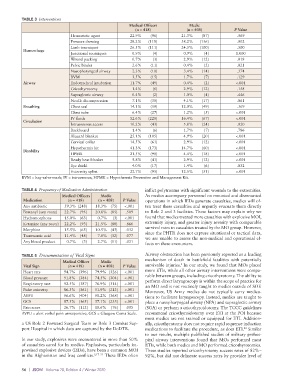
TABLE 3  Interventions
                                                      Medical Officers         Medic
                                                         (n = 418)            (n = 408)           P Value
                              Hemostatic agent          22.9%    (96)        21.3%    (87)         .569
                              Pressure dressing         28.2%    (118)       38.2%    (156)        .002
                              Limb tourniquet           26.5%    (111)       24.5%    (100)        .500
           Hemorrhage
                              Junctional tourniquet     0.9%    (4)          0.9%    (4)          1.000
                              Wound packing             0.7%    (3)          2.9%    (12)          .018
                              Pelvic binder             2.6%    (11)         0.4%    (2)           .021
                              Nasopharyngeal airway     2.3%    (10)         3.4%    (14)          .374
                              BVM                       3.5%    (15)         1.7%    (7)           .129
           Airway             Endotracheal intubation    11.7%    (49)       0.4%    (2)          <.001
                              Cricothyrotomy            1.4%    (6)          2.9%    (12)          .158
                              Supraglottic airway       0.4%    (2)          1.0%    (4)           .446
                              Needle decompression      7.1%    (30)         4.1%    (17)          .061
           Breathing          Chest seal                14.1%    (59)        12.0%    (49)         .369
                              Chest tube                6.4%    (27)         1.2%    (5)          <.001
                              IV fluids                 52.6%    (220)       16.4%   (67)         <.001
           Circulation
                              Intraosseous access       10.2%   (43)         5.8%    (24)          .020
                              Backboard                 1.4%    (6)          1.7%    (7)           .786
                              Blizzard blanket          25.1%    (105)       4.9%    (20)         <.001
                              Cervical collar           14.5%    (61)        2.9%    (12)         <.001
                              Hypothermia kit           41.3%    (173)       14.7%    (60)        <.001
           Disability
                              HPMK                      21.5%    (90)        4.4%    (18)         <.001
                              Ready heat blanket        9.8%    (41)         2.9%    (12)         <.001
                              Eye shield                4.0%    (17)         1.4%    (6)           .032
                              Extremity splint          22.7%    (95)        12.5%    (51)        <.001
          BVM = bag-valve-mask; IV = intravenous; HPMK = Hypothermia Prevention and Management Kit.

          TABLE 4  Frequency of Medication Administration    inflict polytrauma with significant wounds to the extremities.
                           Medical Officers    Medic         As medics accompany personnel on mounted and dismounted
           Medication        (n = 418)    (n = 408)  P Value  operations in which IEDs generate casualties, medics will of-
           Any antibiotic    59.3%  (248)   18.3%  (75)  <.001  ten treat these casualties and urgently evacuate them directly
           Fentanyl (any route)   22.7%   (95)   20.8%   (85)  .509  to Role 2 and 3 facilities. These factors may explain why we
           Hydromorphone     15.0%   (63)    0.7%   (3)  <.001  found that medics treated more casualties with explosive MOI,
           Ketamine (any route)   22.2%   (93)   21.5%   (88)  .866  extremity injury, and greater injury severity with comparable
           Morphine          15.5%   (65)   10.5%   (43)  .032  survival rates to casualties treated by the MO group. However,
                                                             since the PHTR does not capture situational or tactical data,
           Tranexamic acid   11.4%   (48)    7.8%   (32)  .077  we are unable to assess the non-medical and operational ef-
           Any blood product    0.7%    (3)    2.7%   (11)  .031
                                                             fects on these encounters.
          TABLE 5  Documentation of Vital Signs              Airway obstruction has been previously reported as a leading
                           Medical Officer    Medic          mechanism  of  death in  battlefield  fatalities  with potentially
                                                                            5
           Vital Sign        (n = 418)    (n = 408)  P Value  survivable injuries.  In our study, we found that MOs placed
           Heart rate       94.7%   (396)   79.9%  (326)  <.001  more ETIs, while all other airway interventions were compa-
           Blood pressure   91.8%   (384)   74.5%  (304)  <.001  rable between groups, including cricothyrotomy. The ability to
                                                             perform direct laryngoscopy is within the scope of practice for
           Respiratory rate   92.5%   (387)   76.9%  (314)  <.001  an MO and is not routinely taught to medics outside of SOF.
           Pulse oximetry   86.3%   (361)   51.9%  (212)  <.001  Moreover, US Army medics do not typically carry medica-
           AVPU             96.6%   (404)   90.2%  (368)  <.001  tions to facilitate laryngoscopy. Instead, medics are taught to
           GCS              87.3%   (365)   57.1%  (233)  <.001  place a nasopharyngeal airway (NPA) and supraglottic airway
           Pain score       26.7%   (112)   18.6%   (76)  .005  (SGA) or perform a cricothyroidotomy. The TCCC guidelines
          AVPU = alert verbal pain unresponsive; GCS = Glasgow Coma Scale.  recommend cricothyroidotomy over ETI at the POI because
                                                             most medics are not trained or equipped for ETI. Addition-
          a US Role 2 Forward Surgical Team or Role 3 Combat Sup-  ally, cricothyrotomy does not require rapid sequence induction
          port Hospital in which data are captured by the DoDTR.  medications to facilitate the procedure, as does ETI.  Similar
                                                                                                      22
                                                             to our results, multiple published studies of military prehos-
          In our study, explosives were encountered in more than 50%   pital airway interventions found that MOs performed most
          of casualties cared for by medics. Explosives, particularly im-  ETIs, while both medics and MO performed cricothyrotomies.
          provised explosive devices (IEDs), have been a common MOI   These studies reported cricothyrotomy success rates of 82%–
          in the Afghanistan and Iraq conflicts. 5,17–21  These IEDs often   92%, but did not delineate success rates by provider level of


          56  |  JSOM   Volume 20, Edition 4 / Winter 2020

