


Page 14 - JSOM Spring 2020
P. 14
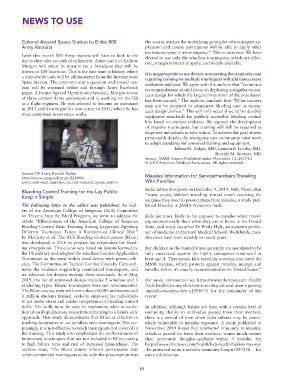
Colonel Aboard Space Station to Enlist 800         the course teaches the underlying principles of tourniquet ap-
          Army Recruits                                      plication and course participants will be able to apply other
                                                             tourniquet types in an emergency.” This is incorrect. We have
          Later this month 800 Army recruits will have to look to the   elected to use only the windlass tourniquets, which are effec-
          sky as they take an oath of enlistment. Astronaut Col Andrew   tive, straightforward to apply, and widely available.
          Morgan will swear in recruits via a broadcast that will be
          shown in 100 locations. This is the first time in history where   It is inappropriate to use devices not meeting the standards, and
          a nationwide oath will be administered from the International   requiring training on multiple tourniquets will add unnecessary
          Space Station. The ceremony and a question and answer ses-  confusion and cost. We agree with the authors that “consensus
          sion  will  be  streamed  online  and  through  Army  Facebook   recommendations should focus on deploying a singular tourni-
          pages. A former Special Operations physician, Morgan is one   quet design for which the largest proportion of the population
          of three current Army astronauts and is working on the ISS   has been trained.” The authors conclude that “BCon trainees
          as a flight engineer. He was selected to become an astronaut   may not  be prepared  to administer  bleeding  care  as tourni-
          in 2013 and then began his new career in 2015, where he has   quet design evolves.” This will only occur if we fail to develop
          since completed seven space walks.
                                                             equipment  standards  for  publicly  accessible  bleeding  control
                                                             kits based on current evidence. We support the development
                                                             of intuitive tourniquets, but training will still be required to
                                                             empower individuals to take action. To achieve the goal of zero
                                                             preventable deaths, the emergency care community must work
                                                             to adopt standards for universal training and equipment.
                                                                         Eileen M. Bulger, MD, Lenworth Jacobs, MD,
                                                                                          Ronald M. Stewart, MD
                                                             Source: JAMA Surgery Published online November 13, 2019 E1
                                                             © 2019 American Medical Association. All rights reserved.

          Source: US Army, Ronald Bailey.                    Measles Information for Servicemembers Traveling
          https://www.army.mil/article/224806/
          army_astronaut_launches_to_international_space_station  With Families
                                                             Erika Edwards reports on December 9, 2019, NBC News, that
          Bleeding Control Training for the Lay Public:
          Keep it Simple                                     “many young children traveling abroad aren’t receiving the
                                                             vaccines they need to protect them from measles, a study pub-
          The following letter to the editor was published:  As lead-  lished Monday in JAMA Pediatrics finds.
          ers of the American College of Surgeons (ACS) Committee
          on Trauma Stop the Bleed Program, we write to address the   Kids are more likely to be exposed to measles when travel-
          article  “Effectiveness  of  the American  College  of Surgeons   ing internationally than when they are at home in the United
          Bleeding Control Basic Training Among Laypeople Applying   State, said study coauthor Dr Emily Hyle, an assistant profes-
          Different Tourniquet Types: A Randomized Clinical Trial”   sor of medicine at Harvard Medical School. Worldwide, mea-
          by McCarty et al. The ACS Bleeding Control course (BCon)   sles cases have risen steadily in recent years.
          was developed in 2016 to prepare lay responders for bleed-
          ing emergencies. This course was based on lessons learned by   But children in the United States generally are not slated to be
          the US military and adopted the windlass Combat Application   fully vaccinated against the highly contagious virus until at
          Tourniquet as the most widely used device with proven effi-  least age 4. That means kids traveling overseas may need the
          cacy. The Committee on Tactical Combat Casualty Care eval-  MMR vaccine, which protects against measles, mumps and
          uates the evidence supporting commercial tourniquets, and   rubella, before it’s usually recommended in the United States.”
          we advocate for devices meeting those standards. As of May
          2019, the list of approved devices includes 5 windlass and 3   For more information see https://www.nbcnews.com /health
          ratcheting types. Elastic tourniquets were not recommended.   /kids-health/young-children-traveling-abroad-aren-t-getting
          The BCon course, now with more than 60,000 instructors and   -measles-vaccines-they-n1098071 for the remainder of her
          1 million students trained, seeks to empower lay individuals   report.
          to act under stress and confer competence in bleeding control
          skills. The skills must be easy to implement, akin to evolu-  In addition, although babies are born with a certain level of
          tion of cardiopulmonary resuscitation training to a hands-only   immunity, thanks to antibodies passed from their mothers,
          approach. This study demonstrates that BCon is effective in   there is a period of time when older infants may be partic-
          teaching bystanders to use windlass style tourniquets. Not sur-  ularly vulnerable to measles exposure. A study published in
          prisingly, it is not effective to teach tourniquets not covered in   November 2019 found that newborns’ immunity to measles,
          the training. This study also emphasizes the ineffectiveness of   which is passed on from their mothers, wanes much sooner
          improvised tourniquets that are not included in BCon, owing   than previously thought—perhaps within 3 months. See
          to high failure rates and risk of increased hemorrhage. The   https://www.nbcnews.com/health/kids-health/babies-may-not
          authors state, “the BCon course informs participants that   -be-protected-mom-s-measles-immunity-long-n1087356  for
          other commercial tourniquets exist, with the presumption that   more information.

                                                           10

