


Page 9 - JSOM Winter 2019
P. 9
training. In Pharmacokinetics of Tranexamic Acid via Intravenous,
              Intraosseous, and Intramuscular Routes in a Porcine (Sus scrofa)
              Hemorrhagic Shock Model, we investigated the pharmacokinetics
              of TXA via IV, IO, and IM routes in a swine model of controlled
              hemorrhagic shock. TXA administration via IO and IM routes
              during hemorrhagic shock achieves serum concentrations neces-
              sary for inhibition of fibrinolysis and may be practical alternatives
              when IV access is not available.

              US Special Operations Forces work by, with, and through partner
              forces (PFs) to accomplish mutual objectives. Surgical teams sup-
              port these forces directly and may assist in treating injuries sus-
              tained by PF, based on established medical rules of engagement.
              These surgical operations are often conducted in austere condi-
              tions, with limited access to blood products. In  Shared Blood:
              Expeditionary Resuscitative Surgical Team (ERST-5) Use of Local
              Whole Blood to Improve Resuscitation of Host Nation Partner
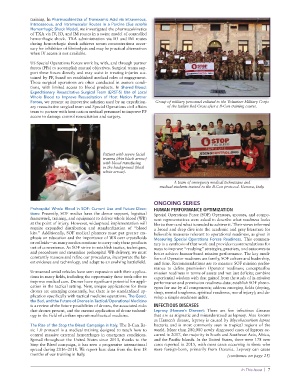
              Forces, we present an innovative solution used by an expedition-  Group of military personnel enlisted to the Volunteer Military Corps
              ary resuscitative surgical team and Special Operations civil affairs   of the Italian Red Cross after a B-Con training course.
              team to partner with host nation medical personnel to improve PF
              access to damage control resuscitation and surgery.


                                            Patient with severe facial
                                            trauma (thin black arrow)
                                            with blood transfusing
                                            in the background (thick
                                            white arrow).
                                                                         A team of emergency medical technicians and
                                                                   medical students trained to the B-Con protocol. Genova, Italy.


                                                                 ONGOING SERIES
              Prehospital Whole Blood in SOF: Current Use and Future Direc-  HUMAN PERFORMANCE OPTIMIZATION
              tions:  Presently, SOF medics have the donor support, logistical   Special Operations Force (SOF) Operators, spouses, and compo-
              framework, training, and equipment to deliver whole blood (WB)   nent representatives were asked to describe what readiness looks
              at the point of injury. However, widespread implementation will   like to them and what is needed to achieve it. Their views informed
              require expanded distribution and standardization of “blood   a broad and deep dive into the academic and gray literature for
              kits.” Additionally, SOF medical planners must put greater em-  believable measures relevant to operational readiness, as given in
              phasis on education and the importance of WB over crystalloids   Measuring Special Operations Forces Readiness. This commen-
              or colloids—as many medics continue to carry only these products   tary is a synthesis of that work and provides recommendations for
              out of convenience. As SOF strive to establish tactics, techniques,   ways to improve “readying” strategies, practices, and outcomes to
              and procedures and streamline prehospital WB delivery, we must   better achieve human-based mission performance. The key modi-
              constantly reassess and refine our procedures, incorporate the lat-  fiers of Operator readiness are family, SOF culture and leadership,
              est evidence and technology, and adapt to an evolving battlefield.  and time. Recommendations are to measure SOF mission perfor-
                                                                 mance to define premission Operator readiness; conceptualize
              Unmanned aerial vehicles have seen expansion with their applica-  mission readiness in terms of assets and not just deficits; combine
              tions in many fields, including the opportunity these tools offer to   experiential wisdom with that gained from the study of in-mission
              improve medical care. Drones have significant potential for appli-  performance and premission readiness data; establish SOF pheno-
              cation in the tactical setting. New, unique applications for these   types for use by all components; address emerging fields (doping,
              drones are emerging constantly, but there is no standardized ap-  sleep, mental toughness. spiritual readiness, moral injury); and de-
              plication specifically with tactical medicine operations. The Good,   velop a simple readiness index.
              the Bad, and the Future of Drones in Tactical/Operational Medicine
              is a review of the future possibilities of drones, the associated risks   INFECTIOUS DISEASES
              that drones present, and the current application of drone technol-  Leprosy (Hansen’s Disease):  There are few infectious diseases
              ogy in the field of civilian operational/tactical medicine.  that are as stigmatic and misunderstood as leprosy. Also known
                                                                 as Hansen’s disease, leprosy is caused by Mycobacterium leprae
              The Rise of the Stop the Bleed Campaign in Italy. The B-Con Ba-  bacteria and is most commonly seen in tropical regions of the
              sic 1.0 protocol is a medical training designed to teach how to   world. More than 200,000 newly diagnosed cases of leprosy oc-
              control massive external hemorrhages in emergency conditions.   curred in 2017, the majority in South and Southeast Asia, Africa,
              Spread throughout the United States since 2013, thanks to the   and the Pacific Islands. In the United States, there were 178 new
              Stop the Bleed campaign, it has seen a progressive international   cases reported in 2015, with most cases occurring in those who
              spread during 2016–2018. We report here data from the first 18   were   foreign-born, primarily from Oceania. Leprosy can cause
              months of our training in Italy.                                                 (continues on page 25)

                                                                                                     In This Issue  |  7

