


Page 10 - JSOM Winter 2019
P. 10
by Allison Esposito, Managing Editor


          Top Army Surgeon Blasts Military’s Capability to
          Handle War Traumas

          As  reported  by  Steve  Sternberg,  Assistant  Managing Editor,
          Health Initiatives, US News, on 28 October 2019, the Army’s
          top trauma surgeon has issued a powerful critique of military
          surgery, asserting that Army medicine is not “manned, trained
          or equipped” for the flood of complex battlefield casualties
          that would occur in even a limited war. “The failure of mili-
          tary medical leaders to acknowledge the critical requirement
          for trauma surgeons . . . puts our future wounded in great
          peril,” asserts Col Shawn Nessen, MD, trauma consultant to
          Army Surgeon General R. Scott Dingle and director of the
          medical theater in Iraq. Nessen is a distinguished graduate of
          the US Army War College and a surgeon with nearly 30 years
          of military experience,  including multiple combat deploy-
          ments. During the global war on terror, Nessen served as chief
          of surgery at Landstuhl Regional Medical Center in Germany.

          His appraisal of Army medicine’s lack of readiness for ma-
          jor combat operations—a mission that competes for resources
          with the military’s commitment to provide comprehensive care
          for service members and their families—reinforces the find-
          ings of a 9-month US News investigation. The investigation
          identified flaws in the military’s combat casualty care system                                   Photo by David DeKunder.
          that could, in a major conflict, cost hundreds or thousands of
          injured young combatants their limbs or their lives.

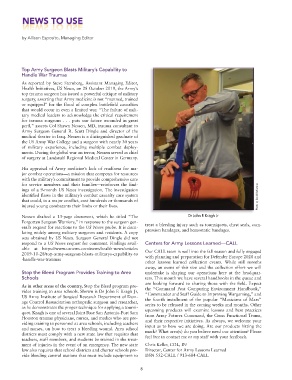
          Nessen drafted a 13-page document, which he titled “The              Dr John F. Kragh Jr
          Forgotten Surgeon Warriors,” in response to the surgeon gen-  treat a bleeding injury such as tourniquets, chest seals, com-
          eral’s request for reactions to the US News probe. It is circu-  pression bandages, and hemostatic bandages.
          lating widely among military surgeons and residents. A copy
          was obtained by US News. Surgeon General Dingle did not
          respond to a US News request for comment. Findings avail-  Centers for Army Lessons Learned—CALL
          able at https://www.usnews.com/news/health-news/articles   Our CALL team is well into the fall season and fully engaged
          2019-10-28/top-army-surgeon-blasts-militarys-capability-to   with planning and preparation for Defender Europe 2020 and
          -handle-war-traumas
                                                             other lessons learned collection events. While still months
                                                             away, an event of this size and the collection effort we will
          Stop the Bleed Program Provides Training to Area   undertake is shaping our operations here at the headquar-
          Schools                                            ters. This month we have several handbooks in the queue and
                                                             are looking forward to sharing those with the field. Expect
          As in other areas of the country, Stop the Bleed program pro-  the “Command Post Computing Environment Handbook,”
          vides training to area schools. Shown is Dr John F. Kragh Jr,   “Commander and Staff Guide to Improving Wargaming,” and
          US Army Institute of Surgical Research Department of Dam-  the fourth installment of the popular “Musicians of Mars”
          age Control Resuscitation orthopedic surgeon and researcher,   series to be released in the coming weeks and months. Other
          as he demonstrates the proper technique for applying a tourni-  upcoming products will examine lessons and best practices
          quet. Kragh is one of several Joint Base San Antonio-Fort Sam   from Army Futures Command, the Cross Functional Teams,
          Houston trauma physicians, nurses, and medics who are pro-  and their respective initiatives. As always, we welcome your
          viding training to personnel at area schools, including teachers   input as to how we are doing. Are our products hitting the
          and nurses, on how to treat a bleeding wound. Area school   mark? What area(s) do you believe need our attention? Please
          districts must comply with a new state law that requires that   feel free to contact me or my staff with your feedback.
          teachers, staff members, and students be trained in the treat-
          ment of injuries in the event of an emergency. The new state   Chris Keller, COL, IN
          law also requires that school districts and charter schools pro-  Director, Center for Army Lessons Learned
          vide bleeding control stations that must include equipment to   DSN 552-CALL / 913-684-CALL

                                                           8

