


Page 9 - JSOM Winter 2018
P. 9
Evaluation of a Concept for a Military Expedition   Efficacy of the Abdominal Aortic Junctional Tourniquet–
              Performance Environment                            Torso Plate in a Lethal Model of Noncompressible
              To evaluate four factors essential in the preparation of high-al-  Torso Hemorrhage
              titude expeditions and of the performance during these expedi-  The Abdominal Aortic Junctional Tourniquet, when modified
              tions, the Manaslu 2016 Medical Team, as part of the medical   with  an  off-label,  prototype,  accessory  pressure  distribution
              team of the Royal Netherlands Marine Corps (RNLMC), de-  plate (AAJT-TP), has the potential to control noncompressible
              veloped the Military Expedition Performance Environment   torso hemorrhage in prolonged
              (MEPE) concept.                                    field care. Using a lethal, non-
                                                                 compressible  torso  animal
                                                                 hem orrhage model, the authors
                                                                 found that the   AAJT-TP did not
                                                                 provide any survival benefit
                                                                 compared with Hextend alone.

                                                                 2018 COMBAT MEDICAL CARE
                                                                 CONFERENCE ABSTRACTS
                                                                 An Overview of the Combat Medical Care (CMC) Conference
                                                                 2018 and a Summary of the CMC Scientific Program 2018 are
                                                                 given before the 2018 Combat Medical Care (CMC) Confer-
                                                                 ence Abstracts
                                                                 ONGOING SERIES
              Willingness of Emergency Medical Services Professionals
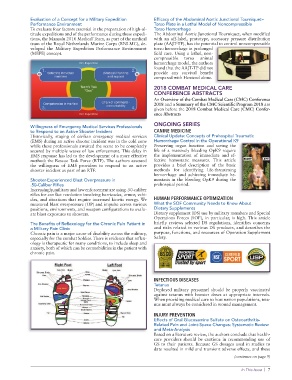
              to Respond to an Active Shooter Incident           CANINE MEDICINE
              Historically, staging of civilian emergency medical services   Clinical Update: Concepts of Prehospital Traumatic
              (EMS) during an active shooter incident was in the cold zone   Hemorrhage Control in the Operational K9
              while these professionals awaited the scene to be completely   Preserving organ function and saving the
              secured by multiple waves of law enforcement. This delay in   life of a massively bleeding OpK9 require
              EMS response has led to the development of a more effective   the implementation of immediate and ef-
              method: the Rescue Task Force (RTF). The authors assessed   fective hemostatic measures. This article
              the willingness of EMS providers to respond to an active   provides a brief description of the basic
              shooter incident as part of an RTF.                methods for identifying life-threatening
                                                                 hemorrhage and achieving immediate he-
              Shooter-Experienced Blast Overpressure in          mostasis in the bleeding OpK9 during the
              .50-Caliber Rifles                                 prehospital period.
              Increasingly, military and law enforcement are using .50- caliber
              rifles for conflict resolution involving barricades, armor, vehi-
              cles, and situations that require increased kinetic energy. We   HUMAN PERFORMANCE OPTIMIZATION
              measured blast overpressure (OP) and impulse across various   What the SOF Community Needs to Know About
              positions, environments, and weapon configurations to evalu-  Dietary Supplements
              ate blast exposures to shooters.                   Dietary supplement (DS) use by military members and Special
                                                                 Operations Forces (SOF), in particular, is high. This  article
              The Benefits of Reflexology for the Chronic Pain Patient in   briefly  reviews  selected DS regulations,  identifies  concerns
              a Military Pain Clinic                             and risks related to various DS products, and describes the
              Chronic pain is a major cause of disability across the military,   purpose, functions, and resources of Operation Supplement
              especially for the combat Soldier. There is evidence that reflex-  Safety.
              ology is therapeutic for many conditions, to include sleep and
              anxiety, both of which can be comorbidities in the patient with
              chronic pain.


                                                                 INFECTIOUS DISEASES
                                                                 Tetanus
                                                                 Deployed military personnel should be properly vaccinated
                                                                 against tetanus with booster doses at appropriate intervals.
                                                                 When providing medical care to host nation populations, teta-
                                                                 nus must always be considered in wound management.
                                                                 INJURY PREVENTION
                                                                 Effects of Oral Glucosamine Sulfate on Osteoarthritis-
                                                                 Related Pain and Joint-Space Changes: Systematic Review
                                                                 and Meta-Analysis
                                                                 Based on a literature review, the authors conclude that health-
                                                                 care providers should be cautious in recommending use of
                                                                 GS to their patients. Because GS dosages used in studies to
                                                                 date resulted in mild and transient adverse effects, and these
                                                                                                  (continues on page 9)

                                                                                                     In This Issue  |  7

