


Page 6 - JSOM Winter 2018
P. 6
in the Journal of Trauma in 2000. “This paper is the best and
                                                             most detailed analysis of the casualties sustained in this his-
                                                             toric battle and marks one of the very few times in history
          (continued from page 1)                            that a medical person has participated in a battle as a com-
                                                             batant and ten gone on to describe the casualties sustained
          received the Silver Star for his courage and initiative during   and the care rendered and then analyze the lessons learned in
          this engagement.                                   a scholarly article,” Butler said. Mabry has subsequently au-
                                                             thored a number of well-regarded articles on tourniquet use,
          “It  is  likely  that  there  will  never  be  a  candidate  with  more   airways, combat casualty evacuation from the battlefield, and
          significant accomplishments in all aspects of prehospital com-  high-level analyses of the organization and function of mili-
          bat casualty care—from decorated combat medic to Emer-  tary medicine. “In addition to his skill in communicating in
          gency Medicine physician to superlative researcher to combat   the published medical literature, Col. Mabry is an individual
          medical leader—than Bob Mabry,” Dr. Butler said. Currently,   who knows how to turn academic publications into action and
          Mabry serves as the Command Surgeon for the Joint Special   into lives saved.”
          Operations Command—one of the most important and most
          sought- after operational medicine positions in the U.S. mili-  Mabry assisted in the development of the Combat Application
          tary. The selection for this coveted position is made by some of   Tourniquet—the most widely-used tourniquet in the U.S. mil-
          the most senior officers in the U.S. Special Operations commu-  itary at present—and then developed the initial guidelines on
          nity. As the JSOC Command Surgeon, Col. Mabry is responsi-  tourniquet use for the U.S. Army at a time when most of the
          ble for all aspects of the health and readiness of our military’s   military had not yet even fielded tourniquets. He later helped
          most elite forces and provides oversight of the medical support   to bring about a landmark change in the Army’s Combat Life-
          of the highest priority missions that U.S. Special Operations   saver program. His research resulted in intravenous access (IV
          forces are called upon to carry out.               starting) being taken out of the Army Combat Lifesaver cur-
                                                             riculum, thereby removing a task that has never been shown
          “I am humbled and honored to be have been chosen for this
          award,” the colonel said. “It is truly an honor to be considered   to improve outcomes in combat casualties, when crystalloid
          in the same company as past recipients like Dr. Frank Butler   fluids are used for resuscitation, as they were at the time. This
          and Dr. John Holcomb.”                             impactful change in the guidelines allowed Combat Lifesavers
                                                             to focus on more important interventions, such as control of
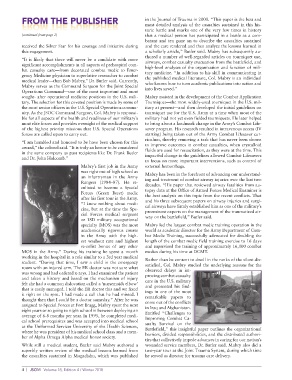
                                  Mabry’s first job in the Army   external hemorrhage.
                                  was right out of high school as   Mabry has been in the forefront of advancing our understand-
                                  an infantryman in the Army   ing and treatment of combat airway injuries over the last two
                                  Rangers (1984–87). He re-   decades. “His paper that reviewed airway fatalities from au-
                                  enlisted to become a Special   topsy data at the Office of Armed Forces Medical Examiner is
                                  Forces (Green Beret) medic   the best analysis on this topic from the recent conflicts. That
                                  after his first tour in the Army.   and his three subsequent papers on airway injuries and surgi-
                                  “I knew nothing about medi-  cal airways have firmly established him as one of the military’s
                                  cine, but at the time the Spe-  preeminent experts on the management of the traumatized air-
                                  cial Forces  medical sergeant   way on the battlefield,” Butler said.
                                  or 18D military occupational
                                  specialty (MOS) was the most   Mabry led the largest combat medic training operation in the
                                  academically rigorous course   world as academic director for the Army Department of Com-
                                  in the Army with the high-  bat Medic Training, successfully advocated for doubling the
                                  est washout rate and highest   length of the combat medic field training exercise to 16 days
                                  re-enlist bonus of any other   and supervised the training of approximately 16,000 combat
          MOS in the Army.” During his training he spent a month   medics during his time at DCMT.
          working in the hospital in a role similar to a 3rd year medical   Rather than be content to dwell in the ranks of the silent dis-
          student. “During that time, I saw a child in the emergency   satisfied, Col. Mabry studied the underlying reasons for the
          room with an injured arm. The ER doctor was not sure what   observed delays in im-
          was wrong and had ordered x-rays. I had examined the patient   proving combat casualty
          and taken a  history and based on the  mechanism  of injury   care in the U.S. military
          felt she had a common dislocation called a ‘nursemaids elbow’   and presented his find-
          that is easily managed. I told the ER doctor this and we fixed   ings in one of the most
          it right on the spot. I had made a call that he had missed. I   remarkable papers to
          thought then that I could be a doctor someday.” After he was   come out of the conflicts
          assigned to Special Forces at Fort Bragg, Mabry spent the next   in Iraq and Afghanistan.
          eight years or so going to night school in between deploying an   Entitled “Challenges to
          average of 6-8 months per year. In 1995, he completed medi-  Improving Combat Ca-
          cal school prerequisites and was accepted into medical school   sualty Survival on the
          at the Uniformed Services University of the Health Sciences,   Battlefield,” this insightful paper outlines the organizational
          where he was president of his medical school class and a mem-  barriers, divided responsibilities, and the distributed authori-
          ber of Alpha Omega Alpha medical honor society.
                                                             ties that collectively impede advances in caring for our nation’s
          While still a medical student, Butler said Mabry authored a   wounded service members, Dr. Butler said. Mabry also did a
          superbly written review of the medical lessons learned from   two-year tour at the Joint Trauma System, during which time
          the casualties sustained in Mogadishu, which was published   he served as director for trauma care delivery.


          4  |  JSOM   Volume 18, Edition 4 / Winter 2018

