


Page 9 - JSOM Fall 2018
P. 9
first or second leading cause of medical separations in this pe SOFsono ULTRASOUND
riod. There is considerable evidence that among individuals Knowledge Versus Suspicion
who develop OA, moderate and regular exercise can reduce On a warm evening, you receive communication that a pla
pain and disability. There is no firm evidence that any partic toon of host nation forces has been hit by a vehicleborne IED
ular mode of exercise (e.g., aerobic training, resistance exer followed by sniper fire. Three casualties soon arrive at your
cise) is more effective than another for reducing OArelated casualty collection point. The MEDEVAC helicopter is en
pain and disability, but limited research suggests that exercise route and they can take only one of your patients. Which one
should be lifelong and conducted at least three times per week should you send first?
for optimal effects.
UNCONVENTIONAL MEDICINE
NSOCM COURSE Draw-over Anesthesia: Bringing the “Dark Art”
How the International Special Training Centre Is Back Into the Light
Training World-Class Medics: An Outline of the Drawover anesthesia has the favorable properties of robust
NATO Special Operations Combat Medic Course ness, portability, and the ability of the user to service the va
The NSOCM course is held at the International Special Train porizer along with being unaffected by unreliable electricity
ing Centre (ISTC) in Pfullendorf, Germany, and exemplifies supplies. This article aims to refresh the knowledge of draw
ISTC’s mission to build interoperability and strengthening al over equipment and the techniques used to operate them.
liances between multinational partners. This article outlines
ISTC’s development and design of the NSOCM course and
new adaptations.
PROLONGED FIELD CARE
Damage Control Resuscitation in Prolonged Field Care
Experience with fresh whole blood resuscitation by military
surgical teams deployed in US Central Command led to a rev
olutionary change in resuscitation practices, termed damage
control resuscitation (DCR).The purpose of this prolonged field
care guideline is to improve implementation of DCR in the Role
1 PFC environment by augmenting and consolidating the Tacti
cal Combat Casualty Care and Joint Trauma System guidelines
for PFC situations. When patient evacuation is delayed or not
available, evidencebased solutions may not be possible. In such
cases, experiencebased solutions may provide the best option
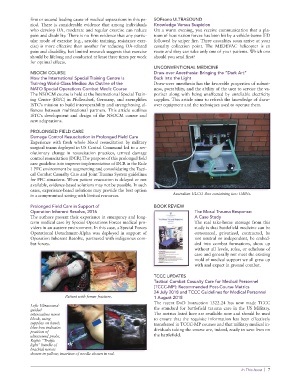
in a compromised setting with limited resources. Australian ULCO Box containing two OMVs.
Prolonged Field Care in Support of BOOK REVIEW
Operation Inherent Resolve, 2016 The Mosul Trauma Response:
The authors present their experience in emergency and long A Case Study
term medical care by Special Operations Forces medical pro The real takehome message from this
viders in an austere environment. In this case, a Special Forces study is that battlefield medicine can be
Operational DetachmentAlpha was deployed in support of outsourced, privatized, contracted, be
Operation Inherent Resolve, partnered with indigenous com not neutral or independent, be embed
bat forces. ded into combat formations, show up
without all levels, roles, or echelons of
care and generally not meet the existing
mold of medical support we all grew up
with and expect in ground combat.
TCCC UPDATES
Tactical Combat Casualty Care for Medical Personnel
(TCCC-MP): Recommended Post-Course Metrics
24 July 2018 and TCCC Guidelines for Medical Personnel
Patient with femur fracture. 1 August 2018
The recent DoD Instruction 1322.24 has now made TCCC
Left: Ultrasound- the standard for battlefield trauma care in the US Military.
guided
interscalene nerve The metrics listed here are available now and should be used
block, using to ensure that the requisite information has been effectively
supplies on hand; transferred in TCCCMP courses and that military medical in
blue box indicates dividuals taking the course are, indeed, ready to save lives on
position of
ultrasound probe. the battlefield.
Right: “Traffic
light” bundle of
brachial nerves
shown in yellow; insertion of needle shown in red.
In This Issue | 7

