


Page 7 - JSOM Fall 2018
P. 7
by Allison Esposito, Managing Editor
FEATURE ARTICLES Mechanical Forces Experienced by Simulated Patients
Study of Tourniquet Use in Simulated First Aid: Evacuated During Dismounted Military Movement in
User Judgment Mountainous Terrain
The purpose of this study was to survey the judgments of tour Given a denied or resourcelimited area of operations, when
niquet users in simulation to discern opportunities for further air medical evacuation would require extended delay, should
study. The study design constituted two parts: questions posed dismounted movement through difficult terrain dissuade an
to four tourniquet users and then their tourniquet use was attempt of immediate ground evacuation? We assessed the
surveyed in simulated first aid, where the users had to decide mechanical impact experienced during dismounted evacua
how to perform among five different cases. The questions ad tion from mountainous terrain with data collected during the
dressed judged confidence, blood volumes, a reason bleeding Army Mountain Warfare School Rough Terrain Evacuation
resumes, regret of preventable death, hemorrhage assessment, Course.
need for sidebyside use of tourniquets, shock severity, pre
dicting reliability, and difference in blood losses. The mechan
ical performance was tested on a manikin.
Your Metric Matters! Choose Wisely to Assess User
Performance With Tourniquets in Simulated First Aid
Readiness to perform lifesaving interventions during emer
gencies is based on a person’s preparation to proficiently exe
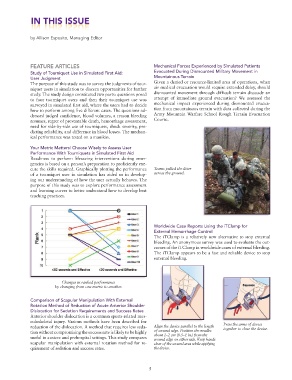
cute the skills required. Graphically plotting the performance Teams pulled the litter
of a tourniquet user in simulation has aided us in develop across the ground.
ing our understanding of how the user actually behaves. The
purpose of this study was to explore performance assessment
and learning curves to better understand how to develop best
teaching practices.
Worldwide Case Reports Using the iTClamp for
External Hemorrhage Control
The iTClamp is a relatively new alternative to stop external
bleeding. An anonymous survey was used to evaluate the out
comes of the iTClamp in worldwide cases of external bleeding.
The iTClamp appears to be a fast and reliable device to stop
external bleeding.
Changes in ranked performance
by changing from one metric to another.
Comparison of Scapular Manipulation With External
Rotation Method of Reduction of Acute Anterior Shoulder
Dislocation for Sedation Requirements and Success Rates
Anterior shoulder dislocation is a common sportsrelated mus
cu loskeletal injury. Various methods have been described for
reduction of the dislocation. A method that requires less seda Align the device parallel to the length Press the arms of device
together to close the device.
tion without compromising the success rate is likely to be highly of wound edge. Position the needles
useful in austere and prehospital settings. This study compares about 1–2 cm (0.5–1 in.) from the
wound edge on either side. Keep hands
scapular manipulation with external rotation method for re clear of the wound area while applying
quirement of sedation and success rates. the device.
5

