


Page 9 - JSOM Summer 2018
P. 9
Methods for Early Control of Abdominal Hemorrhage: An As-  in the United States, ascaris infections are common in the de-
              sessment of Potential Benefit, by Cantle et al., is a single-center   veloping world. Details are given by Burnett in Ascariasis.
              retrospective study of patients who received a trauma laparot-
              omy from 2013 to 2015. Operative reports were reviewed. The   Injury Prevention
              probable benefit of each of three hemorrhage control methods—
              placement of a resuscitative endovascular balloon occlusion of   Part 1 of this series by Knapik and Bedno reviewed the ep-
              the aorta (REBOA), injection of intracavitary self-expanding   idemiologic evidence for the association between cigarette
              foam, and application of the Abdominal Aortic Junctional   smoking and injuries and possible biological and psychosocial
              Tourniquet (AAJT )—was evaluated for each patient.  mechanisms to account for this relationship. In the present ar-
                            ™
                                                                 ticle, nine criteria are explored to determine if smoking is a
              ONGOING SERIES                                     direct cause of injuries (i.e., a causal relationship): Epidemi-
                                                                 ologic Evidence and Possible Mechanisms for the Association
              Canine Medicine
                                                                 Between Cigarette Smoking and Injuries: Part 2: Is the Rela-
              Picture This: Management of Canine Pyotraumatic Der-  tionship Between Smoking and Injuries Causal?
              matitis (a.k.a., Hot Spot),  by Palmer, covers pyotraumatic
              dermatitis (a.k.a., hot spot), which is a rapidly developing,   Prolonged Field Care
              superficial, moist, exudative dermatitis commonly induced
              by self-inflicted trauma. “Although not acutely life threat-  Nursing Interventions in Prolonged Field Care, by Ostberg and
              ening, these lesions are extremely pruritic and distracting   colleagues. “This Role 1, prolonged field care (PFC) guideline
              and significantly interfere with the canine’s operational ef-  is intended to be used after Tactical Combat Casualty Care
              fectiveness and ability to stay on task. The review discusses   (TCCC) Guidelines when evacuation to a higher level of care
              a case, including clinical presentation, diagnosis, treatment,   is not immediately possible. A provider of PFC first must be an
              and prognosis.”                                    expert in TCCC. The intent of this guideline is to provide med-
                                                                 ical professionals who encounter extended casualty evacuation
                                                                 times in austere environments the evidence-based guidance for
                                                                 nursing interventions necessary to improve patient outcomes.”
                                                                 In What’s in a Rash? Viral Exanthem Versus CBRNE Expo-
                                                                 sure: Teleconsultation Support for Two Special Forces Soldiers
                                                                 With Diffuse Rash in an Austere Environment, Lee and col-
                                                                 leagues review clinical thought process and key principles for
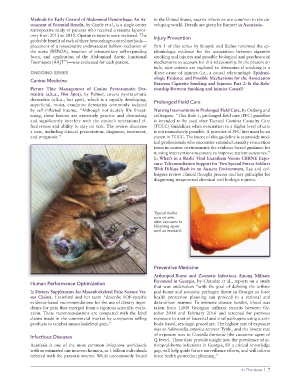
                                                                 diagnosing weaponized chemical and biologic injuries.


                                                                 Typical bullae
                                                                 seen on arm
                                                                 after exposure to
                                                                 blistering agent
                                                                 such as mustard.


                                                                 Preventive Medicine
                                                                 Arthropod-Borne and Zoonotic Infections Among Military
                                                                 Personnel in Georgia, by Chitadze et al., reports on a study
              Human Performance Optimization
                                                                 that was undertaken “with the goal of defining the arthro-
              In Dietary Supplements for Musculoskeletal Pain: Science Ver-  pod-borne and zoonotic pathogen threat in Georgia so force
              sus Claims, Crawford and her team “describe SOF-specific   health protection planning can proceed in a rational and
              evidence-based recommendations for the use of dietary ingre-  data-driven manner. To estimate disease burden, blood was
              dients for pain that emerged from a rigorous scientific evalu-  taken from 1,000 Georgian military recruits between Oc-
              ation. These recommendations are compared with the label   tober 2014 and February 2016 and screened for previous
              claims made in the commercial market by companies selling   exposure to a set of bacterial and viral pathogens using a anti-
              products to combat musculoskeletal pain.”          body-based, serologic procedure. The highest rate of exposure
                                                                 was to Salmonella enterica serovar Typhi, and the lowest rate
                                                                 of exposure was to Coxiella burnettii (the causative agent of
              Infectious Diseases
                                                                 Q fever). These data provide insight into the prevalence of ar-
              Acariasis  is  one  of  the  most  common  infections  worldwide   thropod-borne infections in Georgia, fill a critical knowledge
              with an estimated one in seven humans, or 1 billion individuals   gap, will help guide future surveillance efforts, and will inform
              infected with the parasitic worms. While uncommonly found   force health protection planning.”

                                                                                                     In This Issue  |  7

