


Page 8 - JSOM Summer 2018
P. 8
by Allison Esposito, Managing Editor


          CASE REPORT                                        12 months that was administered to Army Special Operations
                                                             Forces Soldiers.
          In  A Case of Rhabdomyolysis Caused by Blood Flow–
          Restricted Resistance Training, Krieger et al. present the case   Special Operations Force Risk Reduction: Integration of Expe-
          of an active duty Soldier who developed rhabdomyolysis as   ditionary Surgical and Resuscitation Teams by Satterly et al.:
          a result of a single course of blood flow–restricted resistance   Hemorrhage in the presurgical setting has been the most sig-
          training. This is an increasingly common mode of rehabilita-  nificant cause of death on the battlefield. DCS near the POI is
          tion in the military, and practitioners and providers should be   not a new concept, but conventional medical teams supporting
          aware of it and its possible adverse effects.
                                                             SOF beyond robust military medical infrastructure is unique
                                                             for the US military. The ERST was formed by the US Army
          FEATURE ARTICLES
                                                             Medical Command as a pilot team to fulfill a request for forces
          Butler and colleagues provide Management of Suspected Ten-  to provide “Golden Hour” DCS and personnel recovery near
          sion Pneumothorax in Tactical Combat Casualty Care: TCCC   POI for Special Operations.
          Guidelines Change 17-02. NDC is a rapid and effective means
          of decompressing a tension pneumothorax, but it is not a com-  Austere environments and initial wound contamination in-
          pletely benign intervention. As a minimum, in the absence of   crease the risk for infection. Wound infections continue to
          penetrating thoracic trauma, NDC may necessitate the place-  cause significant morbidity among injured Servicemembers.
          ment of a chest tube in a casualty who would not otherwise   Prehospital Administration of Antibiotic Prophylaxis for Open
          have required one. There is also the potential for life-threat-  Combat Wounds in Afghanistan: 2013–2014 by Schauer and
          ening hemothorax. As a result of these considerations, there   colleagues demonstrates that overall, “relatively few patients
          is  some  disagreement  in  the  medical  literature  about  when   with open combat wounds receive antibiotic administration
          in the sequence of evolving signs/symptoms that NDC for a   as recommended by TCCC guidelines. In the group that re-
          suspected tension pneumothorax should be undertaken. This   ceived antibiotics, few received the specific antibiotics recom-
          report discusses some of these varying perspectives and reeval-  mended by TCCC guidelines. The development of strategies
          uates the CoTCCC recommendations on this topic.    to improve adherence to these TCCC recommendations is a
                                                             research priority.”
          New and Established Models of Limb Tourniquet Compared
          in Simulated First Aid,  by  Kragh and colleagues, compared   Although TCCC is fairly recent, the construct is similar to
          the performance of a new tourniquet model with that of an   that first suggested during the mid-nineteenth century by John
          established model in simulated first aid.          Turner Caddy (1822–1902), a British Royal Navy staff sur-
                                                             geon. After being completely overlooked for nearly two centu-
                                                             ries, Reynolds discusses Caddy’s guidelines in Old Tricks for
                                                             New Dogs? John Caddy and the Victorian Origins of TCCC.

                                                             The US Navy initiated design concepts for a Medical Mis-
                                                             sion Module Support Container (M3SC), a mobile operating
                                                             room capable of rapid installation aboard maneuverable ships
                                                             within proximity of active combat units. The M3SC provides
                                                             an alternative echelon of care in the current trauma system.
                                                             The mobile ships used as M3SC platforms, however, are more
                                                             susceptible to oceanic conditions that can induce detrimental
                                                             physiologic motion sickness in medical personnel and patients
                                                             aboard the vessels. This study by Pierce and colleagues inves-
                                                             tigated the effects of different sea-state motion conditions on
                                                             the performance of surgical teams: Surgery at Sea: The Effect
                                                             of Simulated High Sea States on Surgical Performance.
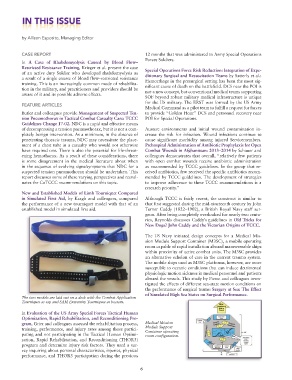
          The two models are laid out on a desk with the Combat Application
          Tourniquet at top and SAM Extremity Tourniquet at bottom.

          In Evaluation of the US Army Special Forces Tactical Human
          Optimization, Rapid Rehabilitation, and Reconditioning Pro-
          gram, Grier and colleagues assessed the rehabilitation process,   Medical Mission
          training, performance, and injury rates among those partici-  Module Support
          pating and not participating in the Tactical Human Optimi-  Container operating
                                                             room configuration.
          zation, Rapid Rehabilitation, and Reconditioning (THOR3)
          program and determine injury risk factors. They used a sur-
          vey inquiring about personal characteristics, injuries, physical
          performance, and THOR3 participation during the previous

                                                           6

