


Page 9 - JSOM Spring 2018
P. 9
FEATURE ARTICLES                                   then compare the results of a commercially available, human-
                                                                 blood lead testing system with those of a benchtop inductively
              In “Laboratory Model of a Collapsible Tube to Develop Bleed-  coupled plasma–mass spectrometry analysis technique.
              ing Control Interventions: Effects of Compression on Flow,”
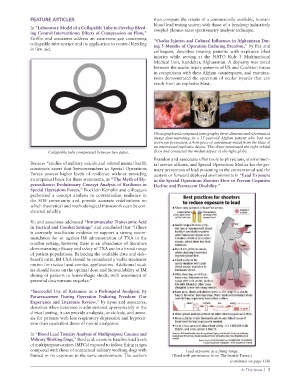
              Griffin and associates address an awareness gap concerning   “Ocular Injuries and Cultural Influences in Afghanistan Dur-
              collapsible tube science and its application to control bleeding   ing 5 Months of Operation Enduring Freedom,” by Paz and
              in first aid.
                                                                 colleagues,  describes  treating  patients  with  explosive  blast
                                                                 injuries while serving at the NATO Role 3 Multinational
                                                                 Medical Unit, Kandahar, Afghanistan. A disparity was noted
                                                                 between the ocular injury patterns of US and Coalition forces
                                                                 in comparison with their Afghan counterparts, and examina-
                                                                 tions demonstrated the spectrum of ocular injuries that can
                                                                 result from an explosive blast.


                                                                 Photograph and computed tomography three-dimensional reformatted
                                                                 image demonstrating, in a 35-year-old Afghan patient who had not
                                                                 worn eye protection, a 4cm piece of curvilinear metal from the blast of
                                                                 an improvised explosive device. The object penetrated the right orbital
                     Collapsible tube compressed between two pipes.  floor and contacted the medial aspect of the right globe.
                                                                 Brandon and associates offer tools to physicians, environmen-
              Because “studies of military suicide and related mental health   tal service officers, and Special Operations Medics for the pri-
              constructs assert that Servicemembers in Special Operations   mary prevention of lead poisoning in the conventional and the
              Forces possess higher levels of resilience without providing   austere or forward deployed environments in “Lead Exposure
              an empirical basis for these statements, in “The Myth of Hy-  in the Special Operations Shooter: How to Prevent Cognitive
              perresilience: Evolutionary Concept Analysis of Resilience in   Decline and Permanent Disability.”
              Special Operations Forces,” Rocklein Kemplin and colleagues
              performed a concept analysis to contextualize resilience in
              the SOF community and provide accurate redefinitions on
              which theoretical and methodological frameworks can be con-
              structed reliably.
              Vu and associates addressed “Intramuscular Tranexamic Acid
              in Tactical and Combat Settings” and concluded that “[t]here
              is currently insufficient evidence to support a strong recom-
              mendation for or against IM administration of TXA in the
              combat setting; however, there is an abundance of literature
              demonstrating efficacy and safety of TXA use in a broad range
              of patient populations. Balancing the available data and risk–
              benefit ratio, IM TXA should be considered a viable treatment
              option for tactical and combat applications. Additional stud-
              ies should focus on the optimal dose and bioavailability of IM
              dosing of patients in hemorrhagic shock, with assessment of
              potential downstream sequelae.”
              “Successful Use of Ketamine as a Prehospital Analgesic by
              Pararescuemen  During Operation  Enduring Freedom:  Our
              Experience and Literature Review,” by Lyon and associates,
              describes when ketamine is administered appropriately in the
              clinical setting, it can provide analgesia, anxiolysis, and amne-
              sia for patients with less respiratory depression and hypoten-
              sion than equivalent doses of opioid analgesics.
              In “Blood Lead Toxicity Analysis of Multipurpose Canines and
              Military Working Dogs,” Reid et al. examine baseline lead levels
              of multipurpose canines (MPCs) exposed to indoor firing ranges
              compared with those of nontactical military working dogs with   Lead exposure at a firing range.
              limited or no exposure to the same environment. The authors   (Used with permission from The Seattle Times.)
                                                                                                (continues on page 158)
                                                                                                     In This Issue  |  5

