


Page 8 - JSOM Spring 2018
P. 8
by Allison Esposito, Managing Editor


          CASE REPORTS                                       and colleagues, presents the case of a patient with new-onset
                                                             diabetes, severe acidosis, hypothermia, and shock who pre-
          A case report is a description of an individual patient that can   sented to a Role 1 Battalion Aid Station and made a rapid and
          document unusual or rare medical occurrences and often rep-  full recovery without needing hemodialysis.
          resents the first incidence in the identification of new disease
          entities. Case series are collections of individual case reports.
          Although both case reports and case series are useful for un-  IN BRIEF
          derstanding the epidemiology of new diseases or conditions,   “The Shrail: A Comparison of a Novel Attachable Rail System
          they are not generalizable and any correlations may be coinci-  With the Current Deployment Operating Table,” by Dilday
          dental. Readers should realize that case reports and case series   and associates, describes  a novel attachable rail system, the
          provide anecdotal evidence only.
                                                             Shrail, which turns a North Atlantic Treaty Organization litter
                                                             into a functional operating table.
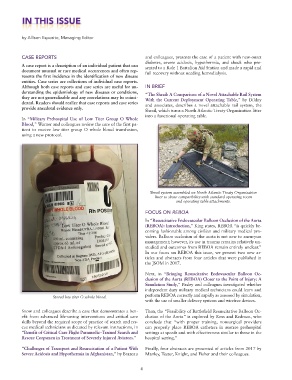
          In “Military Prehospital Use of Low Titer Group O Whole
          Blood,” Warner and colleagues review the care of the first pa-
          tient to receive  low titer group O whole blood transfusion,
          using a new protocol.


                                                               Shrail system assembled on North Atlantic Treaty Organization
                                                                 litter to show compatibility with standard operating room
                                                                          and operating table attachments.

                                                             FOCUS ON REBOA
                                                             In “Resuscitative Endovascular Balloon Occlusion of the Aorta
                                                             (REBOA): Introduction,” King states, REBOA “is quickly be-
                                                             coming fashionable among civilian and military medical pro-
                                                             viders. Balloon occlusion of the aorta is not new to aneurysm
                                                             management; however, its use in trauma remains relatively un-
                                                             studied and outcomes from REBOA remain entirely unclear.”
                                                             In our focus on REBOA this issue, we present two new ar-
                                                             ticles and abstracts from four articles that were published in
                                                             the JSOM in 2017.

                                                             Next, in “Bringing Resuscitative Endovascular Balloon Oc-
                                                             clusion of the Aorta (REBOA) Closer to the Point of Injury: A
                                                             Simulation Study,” Pasley and colleagues investigated whether
                                                             independent duty military medical technicians could learn and
                       Stored low titer O whole blood.       perform  REBOA correctly and rapidly as assessed by simulation,
                                                             with the use of smaller delivery sys tems and wirefree devices.
          Snow and colleagues describe a case that demonstrates a ben-  Then, the “Feasibility of Battlefield Resuscitative Balloon Oc-
          efit from  advanced life-saving interventions and critical care   clusion of the Aorta” is explored by Ross and Redman, who
          skills beyond the required scope of practice of search and res-  conclude that “with proper training, nonsurgical providers
          cue medical technicians as dictated by relevant instructions, in   can properly place REBOA catheters in austere prehospital
          “Benefit of Critical Care Flight Paramedic–Trained Search and   settings at speeds and with effectiveness similar to those in the
          Rescue Corpsmen in Treatment of Severely Injured Aviators.”  hospital setting.”

          “Challenges of Transport and Resuscitation of a Patient With   Finally, four abstracts are presented of articles from 2017 by
          Severe Acidosis and Hypothermia in Afghanistan,” by Brazeau   Manley, Teeter, Knight, and Fisher and their colleagues.


                                                           4

