


Page 123 - Journal of Special Operations Medicine - Fall 2017
P. 123
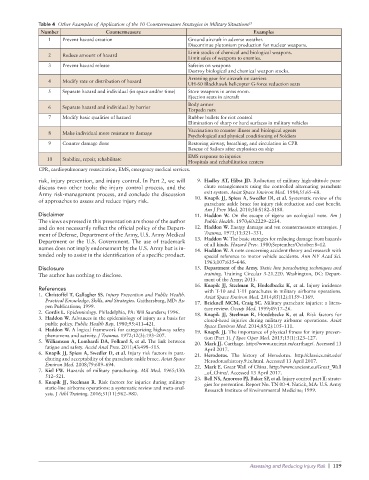
Table 4  Other Examples of Application of the 10 Countermeasure Strategies in Military Situations 23
              Number                Countermeasure                                  Examples
                 1   Prevent hazard creation                  Ground aircraft in adverse weather.
                                                              Discontinue plutonium production for nuclear weapons.
                                                              Limit stocks of chemical and biological weapons.
                 2   Reduce amount of hazard
                                                              Limit sales of weapons to enemies.
                 3   Prevent hazard release                   Safeties on weapons
                                                              Destroy biological and chemical weapon stocks.
                                                              Arresting gear for aircraft on carriers
                 4   Modify rate or distribution of hazard
                                                              UH-60 Blackhawk helicopter G-force reduction seats
                 5   Separate hazard and individual (in space and/or time)  Store weapons in arms room.
                                                              Ejection seats in aircraft
                                                              Body armor
                 6   Separate hazard and individual by barrier
                                                              Torpedo nets
                 7   Modify basic qualities of hazard         Rubber bullets for riot control
                                                              Elimination of sharp or hard surfaces in military vehicles
                                                              Vaccination to counter illness and biological agents
                 8   Make individual more resistant to damage
                                                              Psychological and physical conditioning of Soldiers
                 9   Counter damage done                      Restoring airway, breathing, and circulation in CPR
                                                              Rescue of Sailors after explosion on ship
                                                              EMS response to injuries
                10   Stabilize, repair, rehabilitate
                                                              Hospitals and rehabilitation centers
              CPR, cardiopulmonary resuscitation; EMS, emergency medical services.
              risk, injury prevention, and injury control. In Part 2, we will     9.  Hadley AT, Hibst JD. Reduction of military high-altitude para-
              discuss two other tools: the injury control process, and the   chute entanglements using the controlled alternating parachute
              Army risk-management process, and conclude the discussion   exit system. Aviat Space Environ Med. 1984;55:65–68.
              of approaches to assess and reduce injury risk.    10.  Knapik JJ, Spiess A, Swedler DI, et al. Systematic review of the
                                                                    parachute ankle brace for injury risk reduction and cost benefit.
                                                                    Am J Prev Med. 2010;38:S182–S188.
              Disclaimer                                         11.  Haddon W. On the escape of tigers: an ecological note.  Am J
              The views expressed in this presentation are those of the author   Public Health. 1970;60:2229–2234.
              and do not necessarily reflect the official policy of the Depart-  12.  Haddon W. Energy damage and ten countermeasure strategies. J
              ment of Defense, Department of the Army, U.S. Army Medical   Trauma. 1973;13:321–331.
              Department or the U.S. Government. The use of trademark   13.  Haddon W. The basic stategies for reducing damage from hazards
                                                                    of all kinds. Hazard Prev. 1980;September/October:8–12.
              names does not imply endorsement by the U.S. Army but is in-  14.  Haddon W. A note concerning accident theory and research with
              tended only to assist in the identification of a specific product.  special reference to motor vehicle accidents. Ann NY Acad Sci.
                                                                    1963;107:635–646.
              Disclosure                                         15.  Department of the Army. Static line parachuting techniques and
              The author has nothing to disclose.                   training. Training Circular 3-21.220. Washington, DC: Depart-
                                                                    ment of the Army; 2013.
                                                                 16.  Knapik JJ,  Steelman R,  Hodedbecke K,  et al. Injury  incidence
              References                                            with T-10 and T-11 parachutes in military airborne operations.
              1.  Christoffel T, Gallagher SS. Injury Prevention and Public Health.   Aviat Space Environ Med. 2014;85(12):1159–1169.
                Practical Knowledge, Skills, and Strategies. Gaithersburg, MD: As-  17.  Bricknell MCM, Craig SC. Military parachute injuries: a litera-
                pen Publications; 1999.                             ture review. Occup Med. 1999;49:17–26.
              2.  Gordis L. Epidemiology. Philadelphia, PA: WB Saunders; 1996.  18.  Knapik JJ, Steelman R, Hoedebecke K, et al. Risk factors for
              3.  Haddon W. Advances in the epidemiology of injury as a basis for   closed-head injuries during military airborne operations.  Aviat
                public policy. Public Health Rep. 1980;95:411–421.  Space Environ Med. 2014;85(2):105–111.
              4.  Haddon W. A logical framework for categorizing highway safety   19.  Knapik JJ. The importance of physical fitness for injury preven-
                phenomena and activity. J Trauma. 1972;12(3):193–207.  tion (Part 1). J Spec Oper Med. 2015;15(1):123–127.
              5.  Williamson A, Lombardi DA, Folkard S, et al. The link between   20.  Mark JJ. Carthage. http://www.ancient.eu/carthage/. Accessed 13
                fatigue and safety. Accid Anal Prev. 2011;43:498–515.  April 2017.
              6.  Knapik JJ, Spiess A, Swedler D, et al. Injury risk factors in para-  21.  Herodotus.  The history  of Herodotus.  http://classics.mit.edu/
                chuting and acceptability of the parachute ankle brace. Aviat Space   Herodotus/history.9.ix.html. Accessed 13 April 2017.
                Environ Med. 2008;79:689–694.                    22.  Mark E. Great Wall of China. http://www.ancient.eu/Great_Wall
              7.  Kiel FW. Hazards of military parachuting.  Mil Med. 1965;130:   _of_China/. Accessed 13 April 2017.
                512–521.                                         23.  Bell NS, Amoroso PJ, Baker SP, et al. Injury control part II: strate-
              8.  Knapik  JJ,  Steelman  R.  Risk  factors  for  injuries  during  military   gies for prevention. Report No. TN 00-4. Natick, MA: U.S. Army
                static-line airborne operations: a systematic review and meta-anal-  Research Institute of Environmental Medicine; 1999.
                ysis. J Athl Training. 2016;51(11):962–980.


                                                                                   Assessing and Reducing Injury Risk  |  119

