


Page 122 - Journal of Special Operations Medicine - Fall 2017
P. 122
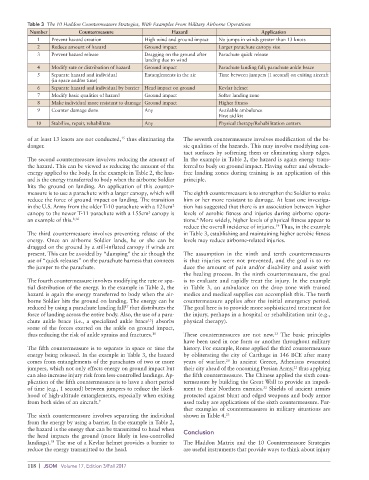
Table 3  The 10 Haddon Countermeasure Strategies, With Examples From Military Airborne Operations
           Number          Countermeasure                Hazard                       Application
             1    Prevent hazard creation       High wind and ground impact  No jumps in winds greater than 13 knots
             2    Reduce amount of hazard       Ground impact           Larger parachute canopy size
             3    Prevent hazard release        Dragging on the ground after   Parachute quick release
                                                landing due to wind
             4    Modify rate or distribution of hazard   Ground impact  Parachute landing fall; parachute ankle brace
             5    Separate hazard and individual    Entanglements in the air  Time between jumpers (1 second) on exiting aircraft
                  (in space and/or time)
             6    Separate hazard and individual by barrier  Head impact on ground  Kevlar helmet
             7    Modify basic qualities of hazard   Ground impact      Softer landing zone
             8    Make individual more resistant to damage  Ground impact  Higher fitness
             9    Counter damage done           Any                     Available ambulance
                                                                        First aid kit
             10   Stabilize, repair, rehabilitate  Any                  Physical therapy/Rehabilitation centers


          of at least 13 knots are not conducted,  thus eliminating the   The seventh countermeasure involves modification of the ba-
                                         15
          danger.                                            sic qualities of the hazards. This may involve modifying con-
                                                             tact surfaces by softening them or eliminating sharp edges.
          The second countermeasure involves reducing the amount of   In the example in Table 2, the hazard is again energy trans-
          the hazard. This can be viewed as reducing the amount of the   ferred to body on ground impact. Having softer and obstacle-
          energy applied to the body. In the example in Table 2, the haz-  free landing zones during training is an application of this
          ard is the energy transferred to body when the airborne Soldier   principle.
          hits  the  ground  on landing.  An  application  of  this  counter-
          measure is to use a parachute with a larger canopy, which will   The eighth countermeasure is to strengthen the Soldier to make
          reduce the force of ground impact on landing. The transition   him or her more resistant to damage. At least one investiga-
          in the U.S. Army from the older T-10 parachute with a 121cm    tion has suggested that there is an association between higher
                                                         2
          canopy to the newer T-11 parachute with a 155cm  canopy is   levels of aerobic fitness and injuries during airborne opera-
                                                  2
          an example of this. 8,16                           tions.  More widely, higher levels of physical fitness appear to
                                                                 6
                                                             reduce the overall incidence of injuries.  Thus, in the example
                                                                                           19
          The third countermeasure involves preventing release of the   in Table 3, establishing and maintaining higher aerobic fitness
          energy.  Once  an  airborne  Soldier  lands,  he  or  she  can  be   levels may reduce airborne-related injuries.
          dragged on the ground by a still-inflated canopy if winds are
          present. This can be avoided by “dumping” the air though the   The assumption in the ninth and tenth countermeasures
          use of “quick releases” on the parachute harness that connects   is that injuries were not prevented, and the goal is to re-
          the jumper to the parachute.                       duce the amount of pain and/or disability and assist with
                                                             the healing process. In the ninth countermeasure, the goal
          The fourth countermeasure involves modifying the rate or spa-  is to evaluate and rapidly treat the injury. In the example
          tial distribution of the energy. In the example in Table 2, the   in Table 3, an ambulance on the drop zone with trained
          hazard is again the energy transferred to body when the air-  medics and medical supplies can accomplish this. The tenth
          borne Soldier hits the ground on landing. The energy can be   countermeasure applies after the initial emergency period.
          reduced by using a parachute landing fall  that distributes the   The goal here is to provide more sophisticated treatment for
                                          17
          force of landing across the entire body. Also, the use of a para-  the injury, perhaps in a hospital or rehabilitation unit (e.g.,
          chute  ankle  brace  (i.e.,  a  specialized  ankle  brace )  absorbs   physical therapy).
                                                 15
          some of the forces exerted on the ankle on ground impact,
          thus reducing the risk of ankle sprains and fractures. 10  These countermeasures are not new.  The basic principles
                                                                                           13
                                                             have been used in one form or another throughout military
          The fifth countermeasure is to separate in space or time the   history. For example, Rome applied the third countermeasure
          energy being released. In the example in Table 3, the hazard   by obliterating the city of Carthage in 146 BCE after many
          comes from entanglements of the parachutes of two or more   years of warfare.  In ancient Greece, Athenians evacuated
                                                                           20
          jumpers, which not only effects energy on ground impact but   their city ahead of the oncoming Persian Army,  thus applying
                                                                                                 21
          can also increase injury risk from less-controlled landings. Ap-  the fifth countermeasure. The Chinese applied the sixth coun-
          plication of the fifth countermeasure is to have a short period   termeasure by building the Great Wall to provide an impedi-
          of time (e.g., 1 second) between jumpers to reduce the likeli-  ment to their Northern enemies.  Shields of ancient armies
                                                                                       22
          hood of high-altitude entanglements, especially when exiting   protected against blunt and edged weapons and body armor
          from both sides of an aircraft. 9                  used today are applications of the sixth countermeasure. Fur-
                                                             ther examples of countermeasures in military situations are
          The sixth countermeasure involves separating the individual   shown in Table 4. 23
          from the energy by using a barrier. In the example in Table 2,
          the hazard is the energy that can be transmitted to head when   Conclusion
          the head impacts the ground (more likely in less-controlled
          landings).  The use of a Kevlar helmet provides a barrier to   The Haddon  Matrix and the 10 Countermeasure  Strategies
                  18
          reduce the energy transmitted to the head.         are useful instruments that provide ways to think about injury
          118  |  JSOM   Volume 17, Edition 3/Fall 2017

