


Page 116 - Journal of Special Operations Medicine - Fall 2017
P. 116
and physical health are not simply the absence of illness and   These efforts will continue to evolve, but questions still re-
          cannot be determined solely by the absence of a condition or   main about what are the best practices and what is the efficacy
          event. Future measurement efforts should acknowledge that   of such efforts. New models on how to keep pace with the
          positive and negative metrics are often orthogonal. We also   ever-changing landscape of modern warfare will evolve, but
          need to examine how positive adaptation in the TFF domains   HPO initiatives that encompasses the triple aims, a “left of the
          can lead to cost savings. Metrics that either directly or indi-  bang” orientation, and a holistic POTFF/TFF approach offer
          rectly measure outcomes of interest and reach beyond medical   the most comprehensive way to support SOF and their fami-
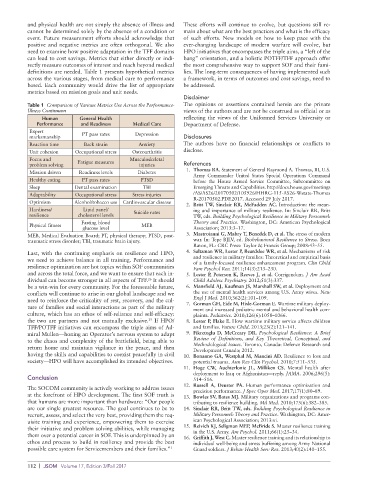
          definitions are needed. Table 1 presents hypothetical metrics   lies. The long-term consequences of having implemented such
          across the various stages, from medical care to performance   a framework, in terms of outcomes and cost savings, need to
          based. Each community would drive the list of appropriate   be addressed.
          metrics based on mission goals and unit needs.
                                                             Disclaimer
          Table 1  Comparison of Various Metrics Use Across the Performance-  The opinions or assertions contained herein are the private
          Illness Continuum                                  views of the authors and are not be construed as official or as
               Human       General Health                    reflecting the views of the Uniformed Services University or
             Performance   and Readiness    Medical Care     Department of Defense.
           Expert
           marksmanship     PT pass rates    Depression      Disclosures
           Reaction time    Back strain       Anxiety        The  authors  have  no  financial  relationships  or  conflicts  to
           Unit cohesion  Occupational stress   Osteoarthritis  disclose.
           Focus and      Fatigue measures  Musculoskeletal
           problem solving                     injuries      References
           Mission driven  Readiness levels   Diabetes         1.  Thomas RA. Statement of General Raymond A. Thomas, III, U.S.
                                                                Army Commander United States Special Operations Command
           Healthy eating   PT pass rates      PTSD             before the House Armed Service Committee, Subcommittee on
           Sleep          Dental examination    TBI             Emerging Threats and Capabilities. http://docs.house.gov/meetings
           Adaptability   Occupational stress   Stress injuries  /AS/AS26/20170502/105926/HHRG-115-AS26-Wstate-Thomas
                                                                R-20170502.PDF.2017. Accessed 29 July 2017.
           Optimism      Alcohol/tobacco use  Cardiovascular disease
                                                               2.  Britt TW, Sinclair RR, McFadden AC. Introduction: the mean-
           Hardiness/       Lipid panel/                        ing and importance of military resilience. In: Sinclair RR, Britt
           resilience      cholesterol levels  Suicide rates    TW, eds. Building Psychological Resilience in Military Personnel:
                            Fasting blood                       Theory and Practice. Washington, DC: American Psychological
           Physical fitness                    MEB
                            glucose level                       Association; 2013:3–17.
          MEB, Medical Evaluation Board; PT, physical therapy; PTSD, post-    3.  Mastroianni G, Mabry T, Benedek D, et al. The stress of modern
          traumatic stress disorder; TBI, traumatic brain injury.  war. In: Tepe BJLV, ed. Biobehavioral Resilience to Stress. Boca
                                                                Raton, FL: CRC Press: Taylor & Francis Group; 2008:43–55.
          Last, with the continuing emphasis on resilience and HPO,     4.  Saltzman WR, Lester P, Beardslee WR, et al. Mechanisms of risk
          we need to achieve balance in all training. Performance and   and resilience in military families: Theoretical and empirical basis
          resilience optimization are hot topics within SOF communities   of a family-focused resilience enhancement program. Clin Child
                                                                Fam Psychol Rev. 2011;14(3):213–230.
          and across the total force, and we want to ensure that each in-    5.  Lester P, Peterson K, Reeves J, et al. Corrigendum. J Am Acad
          dividual can become stronger in all aspects of TFF.  It should   Child Adolesc Psychiatry. 2012;51(3):337.
                                                 26
          be a win-win for every community. For the foreseeable future,     6.  Mansfield AJ, Kaufman JS, Marshall SW, et al. Deployment and
          conflicts will continue to arise in our global landscape and we   the use of mental health services among U.S. Army wives. New
          need to reinforce the criticality of rest, recovery, and the cul-  Engl J Med. 2010;362(2):101–109.
          ture of families and social interactions as part of the military     7.  Gorman GH, Eide M, Hisle-Gorman E. Wartime military deploy-
                                                                ment and increased pediatric mental and behavioral health com-
          culture, which has an ethos of self-reliance and self-efficacy:   plaints. Pediatrics. 2010;126(6):1058–1066.
          the two are partners and not mutually exclusive.  If HPO/    8.  Lester P, Flake E. How wartime military service affects children
                                                  29
          TFF/POTFF initiatives can encompass the triple aims of Ad-  and families. Future Child. 2013;23(2):121–141.
          miral Mullen—honing an Operator’s nervous system to adapt     9.  Fikretoglu D, McCreary DR.  Psychological Resilience: A Brief
          to the chaos and complexity of the battlefield, being able to   Review of Definitions, and Key Theoretical, Conceptual,  and
          return  home  and maintain  vigilance  in  the  peace,  and  then   Methodological Issues. Toronto, Canada: Defence Research and
                                                                Development Canada; 2012.
          having the skills and capabilities to coexist peacefully in civil   10.  Bonanno GA, Westphal M, Mancini AD. Resilience to loss and
          society—HPO will have accomplished its intended objectives.  potential trauma. Ann Rev Clin Psychol. 2010;7:511–535.
                                                             11.  Hoge CW, Auchterlonie JL, Milliken CS. Mental health after
                                                                deployment to Iraq or Afghanistan—reply. JAMA. 2006;296(5):
          Conclusion                                            514–516.
          The SOCOM community is actively working to address issues   12.  Russell A, Deuster PA. Human performance optimization and
                                                                precision performance. J Spec Oper Med. 2017;17(1):80–89.
          at the forefront of HPO development. The first SOF truth is   13.  Bowles SV, Bates MJ. Military organizations and programs con-
          that humans are more important than hardware: “Our people   tributing to resilience building. Mil Med. 2010;175(6):382–385.
          are our single greatest resource. The goal continues to be to   14.  Sinclair RR, Britt TW, eds. Building Psychological Resilience in
          recruit, assess, and select the very best, providing them the req-  Military Personnel: Theory and Practice. Washington, DC: Amer-
          uisite training and experience, empowering them to exercise   ican Psychological Association; 2013:xi.
          their initiative and problem solving abilities, while managing   15.  Reivich KJ, Seligman MEP, McBride S. Master resilience training
                                                                in the U.S. Army. Am Psychol. 2011;66(1):25–34.
          them over a potential career in SOF. This is underpinned by an   16.  Griffith J, West C. Master resilience training and its relationship to
          ethos and process to build in resiliency and provide the best   individual well-being and stress buffering among Army National
          possible care system for Servicemembers and their families.” 1  Guard soldiers. J Behav Health Serv Res. 2013;40(2):140–155.

          112  |  JSOM   Volume 17, Edition 3/Fall 2017

