


Page 114 - Journal of Special Operations Medicine - Fall 2017
P. 114
remain ready to withstand the many, diverse, known, and un-  participation in kinetic operations. A comprehensive approach
          expected stressors of training and combat, and have prioritized   would incorporate the TFF/POTFF framework and broaden
          the design and delivery of programs to enhance performance,   programmatic interventions to include the entire performance-
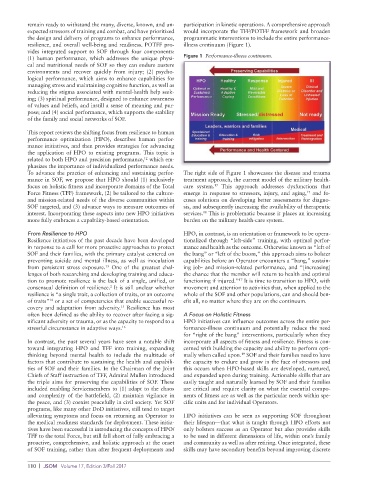
          resilience, and overall well-being and readiness. POTFF pro-  illness continuum (Figure 1).
          vides  integrated  support to  SOF  through four  components:
          (1) human performance, which addresses the unique physi-  Figure 1  Performance-illness continuum.
          cal and nutritional needs of SOF so they can endure austere
            environments and recover quickly from injury; (2) psycho-
          logical  performance,  which aims to  enhance capabilities  for
          managing stress and maintaining cognitive function, as well as
          reducing the stigma associated with mental-health help seek-
          ing; (3) spiritual performance, designed to enhance awareness
          of values and beliefs, and instill a sense of meaning and pur-
          pose; and (4) social performance, which supports the stability
          of the family and social networks of SOF.
          This report reviews the shifting focus from resilience to human
          performance  optimization  (HPO), describes  human perfor-
          mance initiatives, and then provides strategies for advancing
          the application of HPO to existing programs. This topic is
          related to both HPO and precision performance,  which em-
                                                12
          phasizes the importance of individualized performance needs.
          To advance the practice of enhancing and sustaining perfor-  The right side of Figure 1 showcases the disease and trauma
          mance in SOF, we propose that HPO should (1) inclusively   treatment approach, the current model of the military health-
          focus on holistic fitness and incorporate domains of the Total   care system.  This approach addresses dysfunctions that
                                                                       17
          Force Fitness (TFF) framework, (2) be tailored to the culture-   emerge in response to stressors, injury, and aging,  and fo-
                                                                                                     17
          and mission-related needs of the diverse communities within   cuses solutions on developing better assessments for diagno-
          SOF targeted, and (3) advance ways to measure outcomes of   sis, and subsequently increasing the availability of therapeutic
          interest. Incorporating these aspects into new HPO initiatives   services.  This is problematic because it places an increasing
                                                                   18
          more fully embraces a capability-based orientation.  burden on the military health-care system.
          From Resilience to HPO                             HPO, in contrast, is an orientation or framework to be opera-
          Resilience initiatives of the past decade have been developed   tionalized  through  “left-side”  training,  with  optimal  perfor-
          in response to a call for more proactive approaches to protect   mance and health as the outcome. Otherwise known as “left of
          SOF and their families, with the primary catalyst centered on   the bang” or “left of the boom,” this approach aims to bolster
          preventing suicide and mental illness, as well as inoculation   capabilities before an Operator encounters a “bang,” sustain-
          from persistent stress exposure.  One of the greatest chal-  ing job- and mission-related performance, and “[increasing]
                                   13
          lenges of both researching and developing training and educa-  the chance that the member will return to health and optimal
          tion to promote resilience is the lack of a single, unified, or   functioning if injured.”  It is time to transition to HPO, with
                                                                               17
          consensual definition of resilience.  It is still unclear whether   movement and attention to activities that, when applied to the
                                     2
          resilience is “a single trait, a collection of traits, or an outcome   whole of the SOF and other populations, can and should ben-
          of traits”  or a set of competencies that enable successful re-  efit all, no matter where they are on the continuum.
                 14
          covery and adaptation from adversity.  Resilience has most
                                         15
          often been defined as the ability to recover after facing a sig-  A Focus on Holistic Fitness
          nificant adversity or trauma, or as the capacity to respond to a   HPO initiatives can influence outcomes across the entire per-
          stressful circumstance in adaptive ways. 16        formance-illness continuum and potentially reduce the need
                                                             for “right of the bang” interventions, particularly when they
          In contrast, the past several years have seen a notable shift   incorporate all aspects of fitness and resilience. Fitness is con-
          toward integrating HPO and TFF into training, expanding   cerned with building the capacity and ability to perform opti-
          thinking beyond mental health to include the multitude of   mally when called upon.  SOF and their families need to have
                                                                                19
          factors that contribute to sustaining the health and capabili-  the capacity to endure and grow in the face of stressors and
          ties of SOF and their families. In the Chairman of the Joint   this occurs when HPO-based skills are developed, nurtured,
          Chiefs of Staff instruction of TFF, Admiral Mullen introduced   and expanded upon during training. Actionable skills that are
          the triple aims for preserving the capabilities of SOF. These   easily taught and naturally learned by SOF and their families
          included enabling Servicemembers to (1) adapt to the chaos   are critical and require clarity on what the essential compo-
          and complexity of the battlefield, (2) maintain vigilance in   nents of fitness are as well as the particular needs within spe-
          the peace, and (3) coexist peacefully in civil society. Yet SOF   cific units and for individual Operators.
          programs, like many other DoD initiatives, still tend to target
          alleviating symptoms and focus on returning an Operator to   HPO initiatives  can be seen as supporting SOF throughout
          the medical readiness standards for deployment. These initia-  their lifespan—that what is taught through HPO efforts not
          tives have been successful in introducing the concepts of HPO/  only bolsters success as an Operator but also provides skills
          TFF to the total Force, but still fall short of fully embracing a   to be used in different dimensions of life, within one’s family
          proactive, comprehensive, and holistic approach at the onset   and community as well as after retiring. Once integrated, these
          of SOF training, rather than after frequent deployments and   skills may have secondary benefits beyond improving discrete

          110  |  JSOM   Volume 17, Edition 3/Fall 2017

