


Page 9 - Journal of Special Operations Medicine - Spring 2017
P. 9
on child-specific battlefield resuscitation and training   which is one of the most common causes of sepsis and
              for initial providers,” Gray and colleagues “believe   meningitis in the United States and a feared disease
              that, with appropriately tailored pediatric resuscitation   worldwide.
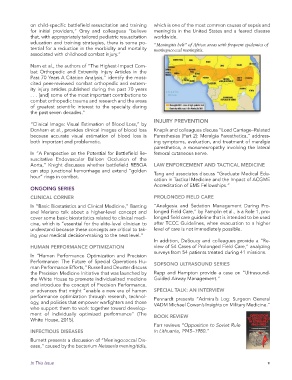
              education and training strategies, there is some po-  “Meningitis belt” of Africa: areas with frequent epidemics of
              tential for a reduction in the morbidity and mortality   meningococcal meningitis.
              associated with childhood combat injury.”

              Nam et al., the authors of “The Highest-Impact Com-
              bat Orthopedic and Extremity Injury Articles in the
              Past 70 Years A Citation Analysis,” identify the most-
              cited peer-reviewed combat orthopedic and extrem-
              ity injury articles published during the past 70 years
              . . . [and] some of the most important contributions to
              combat orthopedic trauma and research and the areas
              of  greatest  scientific  interest  to  the specialty  during
              the past seven decades.”
                                                                 INJURY PREVENTION
              “Clinical Image: Visual Estimation of Blood Loss,” by
              Donham et al., provides clinical images of blood loss   Knapik and colleagues discuss “Load Carriage–Related
              because accurate visual estimation of blood loss is   Paresthesias (Part 2): Meralgia Paresthetica,” address-
              both important and problematic.                    ing symptoms, evaluation, and treatment of meralgia
                                                                 paresthetica, a mononeuropathy involving the lateral
              In “A Perspective on the Potential for Battlefield Re-  femoral cutaneous nerve.
              suscitative  Endovascular  Balloon  Occlusion  of  the
              Aorta,” Knight discusses whether battlefield  REBOA   LAW ENFORCEMENT AND TACTICAL MEDICINE
              can stop junctional hemorrhage and extend “golden   Tang and associates discuss “Graduate Medical Edu-
              hour” rings in combat.
                                                                 cation in Tactical Medicine and the Impact of ACGME
                                                                 Accreditation of EMS Fellowships.”
              ONGOING SERIES
              CLINICAL CORNER                                    PROLONGED FIELD CARE
              In “Basic Biostatistics and Clinical Medicine,” Banting   “Analgesia and Sedation Management During Pro-
              and Meriano talk about a higher-level concept and   longed Field Care,” by Pamplin et al., is a Role 1, pro-
              cover some basic biostatistics related to clinical medi-  longed field care guideline that is intended to be used
              cine, which is “essential for the elite-level clinician to   after TCCC Guidelines, when evacuation to a higher
              understand because these concepts are critical to tak-  level of care is not immediately possible.
              ing your medical decision-making to the next level.”
                                                                 In addition, DeSoucy and colleagues provide a “Re-
              HUMAN PERFORMANCE OPTIMIZATION                     view of 54 Cases of Prolonged Field Care,” analyzing
                                                                 surveys from 54 patients treated during 41 missions.
              In “Human Performance Optimization  and Precision
              Performance: The Future of Special Operations Hu-  SOFSONO ULTRASOUND SERIES
              man Performance Efforts,” Russell and Deuster discuss
              the Precision Medicine Initiative that was launched by   Rapp and Hampton provide a case on “Ultrasound-
              the White House to promote individualized medicine   Guided Airway Management.”
              and introduce the concept of Precision Performance,
              or advances that might “enable a new era of human   SPECIAL TALK: AN INTERVIEW
              performance optimization through research, technol-  Pennardt presents “Admiral’s Log: Surgeon General
              ogy, and policies that empower warfighters and those   VADM Michael Cowan’s Insights on Military Medicine.”
              who support them to work together toward develop-
              ment of individually optimized performance” (The   BOOK REVIEW
              White House, 2015).
                                                                 Farr reviews “Opposition to Soviet Rule
              INFECTIOUS DISEASES                                in Lithuania, 1945–1980.”
              Burnett presents a discussion of “Meningococcal Dis-
              ease,” caused by the bacterium Neisseria  meningitidis,


              In This Issue                                                                                     v

