


Page 8 - Journal of Special Operations Medicine - Spring 2017
P. 8
by Allison Esposito, Managing Editor


          HOW IT WORKS                                       WHITE PAPER
          In “Liberating the Oppressed: Research Knowledge   Teeter and his colleagues present “Resuscitative Endo-
          Differentials and Ethical Investigation in Special Op-  vascular Balloon Occlusion of the Aorta: Pushing Care
          erations Forces Clinical Science,” Academic Content   Forward” and assert that their “study demonstrates
          Advisory Editor Kate Rocklein Kemplin and F. Young   that nonsurgeon and nonphysician providers can learn
          Bowling present the first in a series on what research is,   the steps required for REBOA after arterial access is
          ethics, how to start doing research, what statistics are   established. Although insertion is relatively straight-
                                                             forward, the inability to gain arterial access percuta-
          appropriate and what they mean, how to critique an   neously is prohibitive in providers without a surgical
          article, and the basics of when and how to go through   skillset and should be the focus of further training.”
          the institutional review board.

                                                             IN BRIEF
          CASE REPORTS
                                                             Monti describes a novel ultrasound gel alternative that
          “A Modern Case Series of Resuscitative Endovascular   may be better suited for resource-constrained environ-
          Balloon Occlusion of the Aorta (REBOA) in an Out-of-  ments than standard ultrasound gel in “A Novel Ul-
          Hospital, Combat Casualty Care Setting,” by Manley   trasound  Transmission  Gel  for  Resource-Constrained
          and colleagues, presents “to our knowledge, . . . the   Environments.”
          first series to demonstrate the feasibility and effective-
          ness of REBOA in modern combat casualty care and
          the first to describe use of the ER-REBOA catheter.”

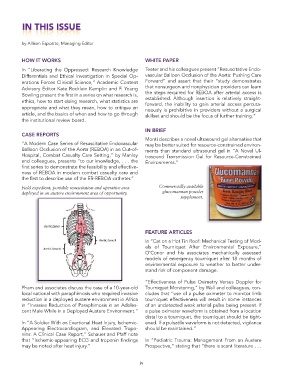
          Field expedient, portable resuscitation and operative area   Commercially available
          deployed in an austere environment area of opportunity.   glucomannan powder
                                                                            supplement.


                                                             FEATURE ARTICLES
                                                             In “Cat on a Hot Tin Roof: Mechanical Testing of Mod-
                                                             els of Tourniquet After Environmental Exposure,”
                                                             O’Conor and his associates mechanically assessed
                                                             models of emergency tourniquet after 18 months of
                                                             environmental exposure to weather to better under-
                                                             stand risk of component damage.

                                                             “Effectiveness of Pulse Oximetry Versus Doppler for
          Pham and associates discuss the case of a 10-year-old   Tourniquet Monitoring,” by Wall and colleagues, con-
          local national with paraphimosis who required invasive   cludes that “use of a pulse oximeter to monitor limb
          reduction in a deployed austere environment in Africa   tourniquet effectiveness will result in some instances
          in “Invasive Reduction of Paraphimosis in an Adoles-  of an undetected weak arterial pulse being present. If
          cent Male While in a Deployed Austere Environment.”  a pulse oximeter waveform is obtained from a location
                                                             distal to a tourniquet, the tourniquet should be tight-
          In “A Soldier With an Exertional Heat Injury, Ischemic-  ened. If a pulsatile waveform is not detected, vigilance
          Appearing Electrocardiogram, and Elevated Tropo-   should be maintained.”
          nins: A Clinical Case Report,” Schauer and Pfaff note
          that “Ischemic-appearing ECG and troponin findings   In “Pediatric Trauma: Management From an Austere
          may be noted after heat injury.”                   Prospective,” stating that “there is scant literature . . .


                                                           iv

