


Page 154 - Journal of Special Operations Medicine - Spring 2017
P. 154
An Ongoing Series


                             Ultrasound-Guided Airway Management
                                           in the Austere Setting


                               Justin C. Rapp, 18D; Katarzyna (Kasia) Hampton, MD


             our team is participating in a remote operation in   Figure 1
          YAfghanistan together with an Afghan team. As a
          result of an IED blast, two Afghanis are killed in ac-
          tion and one of your team members is injured. On the
          initial  assessment,  the  US  Operator  has  reassuring  vi-
          tal signs: blood pressure (BP) 130/84mmHg, heart rate
          (HR) 85 beats per minute (bpm), respiratory rate (RR)
          20, and Spo  99% on room air, and the following inju-
                     2
          ries: multiple minor shrapnel wounds to the face and
          extremities, one large laceration of the right arm that
          requires tourniquet application, and a closed fracture of
          the right lower leg. He is also complaining of cough and
          minimal dyspnea. As part of your initial assessment, you
          perform  an  extended  FAST  examination,  which  is  es-
          sentially negative. You have excluded free fluid in the
          pericardium, peritoneal, and pleural cavities. There is
          no pneumothorax.

          The estimated time of arrival for the evacuation team is
          18 hours.

          At 6 hours after the injury, your patient begins to dete-  Join us at SOFsono.org for further case discussion.
          riorate from a respiratory standpoint. He has worsening
          cough, dyspnea, and hemoptysis. His repeat vital signs   Keywords: sonography; airway management
          are: BP 100/64mmHg, HR 120 bpm, RR 28, and Spo
                                                         2
          92% on room air. Your repeat lung ultrasound excludes
          pneumothorax but confirms your clinical suspicion of
          blast injury to the right lung. Due to rapid deterioration   SFC Rapp, USA, is a Special Forces Medical Sergeant (18D)
          despite  conservative measures,  you decide  to intubate   and is currently the director of the Special Operations Forces
          your patient. Immediately after a successful endotra-  Austere Care Course (SOFACC), which is conducted by the
          cheal intubation, you perform chest ultrasound to con-  Office of Special Warfare (OSW). He previously served in
          firm bilateral lung ventilation. Your patient is stable at   Charlie  and Bravo  Companies,  2nd  Battalion, 10th  Special
                                                             Forces Group.
          this point.
                                                             Dr Hampton  is an emergency physician and a volunteer
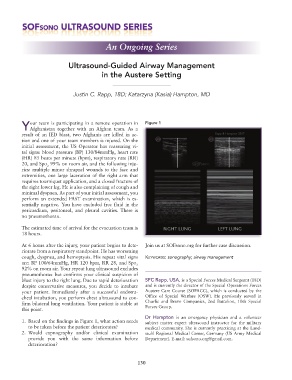
          1.  Based on the findings in Figure 1, what action needs   subject matter expert ultrasound instructor for the military
             to be taken before the patient deteriorates?    medical community. She is currently practicing at the Land-
          2.  Would capnography and/or clinical examination   stuhl Regional Medical Center, Germany (US Army Medical
             provide you with the same information before    Department). E-mail: sofsono.org@gmail.com.
             deterioration?


                                                          130

