


Page 138 - Journal of Special Operations Medicine - Spring 2017
P. 138
(continues)


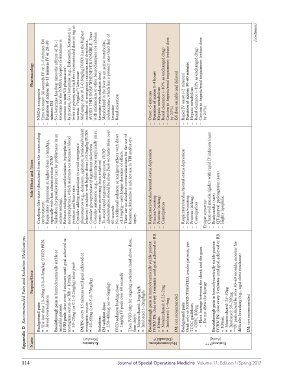
               Pharmacology Time to onset: 30 seconds IV or 1–5 minutes IM Duration of action: 10–15 minutes IV or 20–30   S(+) ketamine has four times the affinity of R(−)  ketamine for the NMDA receptor (S ketamine is  In practice, S(+) ketamine (e.g., Esketamin, Ketanest) is  twice as potent; use half the recommended dose in mg as  Mid-range dose (0.3–0.8mg/kg IV/IO) has the highest  incidence of emergence reactions and dysphoria.  AVOID THIS DOSE WHENEVER POSSIBLE. Treat


                 NMDA antagonist  minutes IM  common in non-US pharmacies)  racemic (“regular”) ketamine  ketamine with sedation dose)  ketamine  Renal excretion  Onset <5 minutes Duration of action 1–4 hours  Hepatic metabolism  by 25%) IM dose variable and delayed  Rapid IV onset (<2 minutes) Duration of action: 30–60 minutes  Hepatic metabolism  by 25%)


                 –  –  –  –   –    –        –     –            –  –  –  –  –  –  –  –  –  –  –


               Side-Effects and Notes Cataleptic-like state (dissociated from the surrounding  Respiratory depression at higher doses (>1mg/kg),  especially with fast administration IV/IO Sialorrhea (hypersalivation) (can be problematic in an  Releases endogenous catecholamines (epinephrine,  norepinephrine), which maintain (or increase) blood  Consider adding midazolam to avoid emergence  phenomenon (e.g., delusions, agitation, irrational/violent  behavior) in adults with hi


                   environment)  austere setting).  pressure and heart rate.  60 seconds  injury.  Nausea/vomiting  Pruritus (itching)  Constipation  Nausea/vomiting  Pruritus (itching)  Constipation  Unique concerns:  Bradycardia (rare) QT-interval prolongation (rare)  Highly lipophilic


                 –   –   –  –     –    –  –  –    –  –         –  –  –  –    –  –  –  –  –  –  –  –
           Appendix D  Recommended Pain and Sedation Medications


               Purpose/Dose Use low dose 10–20mg (0.1–0.2mg/kg) OV/IO PRN. Breakthrough pain in hemodynamically stable or   IV/IO push: dose every 5 minutes until goal achieved or  10–20mg (or 0.1–0.2mg/kg) slow push IM/IN: every 15 minutes until goal achieved or    Then IV/IO drip for ongoing sedation (load above dose,   Breakthrough pain in hemodynamically stable patient:  IV/IO/ IN: dose every 5 minutes until goal achieved or RR   Oral: only in NONINTUBATED, awake patients


                 Background pain:  Avoid oversedation  unstable patient:   nystagmus occurs or RR < 10/min.  nystagmus occurs 40–60mg (or 0.5–0.75mg/kg)  Sedation:  IM sedation dose: 250–400mg (or 4–5mg/kg)  IV/IO sedation loading dose:  1mg/kg IV push over 60 seconds  then drip):  Nonintubated: 1mg/kg/h  Intubated 1–2mg/kg/h  < 10/min. Nonintubated: 0.25–2mg   Intubated: 1–4mg   IM: not recommended  Background pain:  TCCC guidelines  OTFC 800μg  –   Do not chew the lozenge


               Name  •   •      •      •   (Ketalar)  Ketamine  •   •   •   •   •   •   (Dilaudid)*  Hydromorphone  •   (Actiq)  Fentanyl***  •   •


          114                                     Journal of Special Operations Medicine  Volume 17, Edition 1/Spring 2017

