


Page 130 - Journal of Special Operations Medicine - Winter 2016
P. 130
Embedded Fragment Removal and Wound Debridement
                                  in a Non-US Partner Force Soldier


               Robert D. McLeroy, MD; Sloan Spelman; Eric Jacobson, MD; Jennifer Gurney, MD;
                Sean Keenan, MD; Doug Powell, MD; Jamie Riesberg, MD; Jeremy Pamplin, MD


          Objective: Review application of telemedicine support     embedded in between the lateral border of his right
          for removal of fragment and wound management.      scapula and the humeral head. The embedded fragment
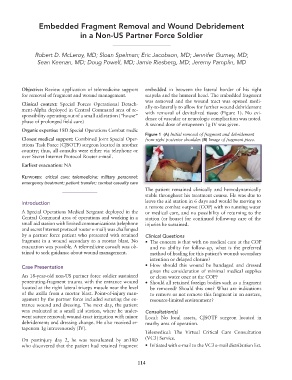
                                                             was  removed  and  the  wound  tract  was  opened  medi-
          Clinical context: Special Forces Operational Detach-  ally-to-laterally to allow for further wound debridement
          ment-Alpha deployed in Central Command area of re-  with removal of devitalized tissue (Figure 1). No evi-
          sponsibility operating out of a small aid station (“house”   dence of vascular or neurologic complication was noted.
          phase of prolonged field care)
                                                             A second dose of ertapenem 1g IV was given.
          Organic expertise: 18D Special Operations Combat medic
                                                             Figure 1  (A) Initial removal of fragment and debridement
          Closest medical support: Combined Joint Special Oper-  from right posterior shoulder. (B) Image of fragment piece.
          ations Task Force (CJSOTF) surgeon located in another
          country; thus, all consults were either via telephone or              A         B
          over Secret Internet Protocol Router e-mail.
          Earliest evacuation: NA

          Keywords:  critical care; telemedicine; military personnel;
          emergency treatment; patient transfer; combat casualty care
                                                             The patient remained clinically and hemodynamically
                                                             stable throughout his treatment course. He was due to
          Introduction                                       leave the aid station in 6 days and would be moving to
                                                             a remote combat outpost (COP) with no running water
          A Special Operations Medical Sergeant deployed in the   or medical care, and no possibility of returning to the
          Central Command area of operations and working in a   station (or house) for continued follow-up care of the
          small aid station with limited communications (telephone   injuries he sustained.
          and secret Internet protocol router e-mail) was challenged
          by a partner force patient who presented with retained   Clinical Questions
          fragment in a wound secondary to a mortar blast. No   •  The concern is that with no medical care at the COP
          evacuation was possible. A telemedicine consult was ob-  and no ability for follow-up, what is the preferred
          tained to seek guidance about wound management.      method of healing for this patient’s wound: secondary
                                                               intention or delayed closure?
          Case Presentation                                  •  How should this wound be bandaged and dressed
                                                               given the consideration of minimal medical supplies
          An 18-year-old non-US partner force soldier sustained   or clean water once at the COP?
          penetrating-fragment trauma with the entrance wound   •  Should all retained foreign bodies such as a fragment
          located at the right lateral triceps muscle near the level   be removed? Should this one? What are indications
          of the axilla from a mortar blast. Point-of-injury man-  to remove or not remove this fragment in an austere,
          agement by the partner force included suturing the en-  resource-limited environment?
          trance wound and dressing. The next day, the patient
          was evaluated at a small aid station, where he under-  Consultation(s)
          went suture removal; wound-tract irrigation with minor   Local: No local assets, CJSOTF surgeon located in
          debridement; and dressing change. He also received er-  nearby area of operation.
          tapenem 1g intravenously (IV).
                                                             Telemedical: The Virtual Critical Care  Consultation
          On postinjury day 2, he was reevaluated by an18D   (VC3) Service.
          who discovered that the patient had retained fragment   •  Initiated with e-mail to the VC3 e-mail distribution list.


                                                          114

