


Page 55 - Journal of Special Operations Medicine - Spring 2016
P. 55
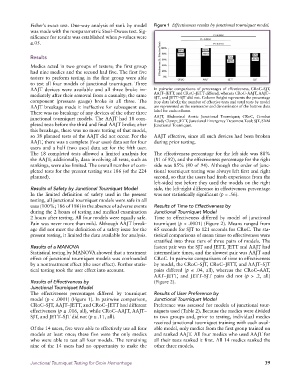
Fisher’s exact test. One-way analysis of rank by model   Figure 1  Effectiveness results by junctional tourniquet model.
              was made with the nonparametric Steel–Dwass test. Sig-
              nificance for results was established when p-values were
              ≤.05.


              Results
              Medics acted in two groups of testers; the first group
              had nine medics and the second had five. The first five
              testers to preform testing in the first group were able
              to test all four models of junctional tourniquet. Three
              AAJT devices were available and all three broke im-  In pairwise comparisons of percentages of effectiveness, CRoC–SJT,
              mediately after their removal from a casualty; the same   AAJT–JETT, and CRoC–JETT differed, whereas CRoC–AAJT, AAJT–
                                                                 SJT, and JETT–SJT did not. Column height represents the percentage
              component  (pressure  gauge)  broke  in  all  three.  The   (top data label); the number of effective tests and total tests by model
              AAJT breakage made it ineffective for subsequent use.   are represented as the numerator and denominator of the bottom data
              There was no breakage of any devices of the other three   label for each column.
              junctional tourniquet models. The AAJT had 18 com-  AAJT, Abdominal Aortic Junctional Tourniquet; CRoC, Combat
                                                                 Ready Clamp; JETT, Junctional Emergency Treatment Tool; SJT, SAM
              pleted tests before the third and final AAJT broke; after   Junctional Tourniquet.
              this breakage, there was no more testing of that model,
              so 38 planned tests of the AAJT did not occur. For the   AAJT effective, since all such devices had been broken
              AAJT, there was a complete (four uses) data set for four   during prior testing.
              users and a half (two uses) data set for the fifth user.
              The 18 completed tests allowed a limited analysis for   The effectiveness percentage for the left side was 88%
              the AAJT; additionally, data involving all tests, such as   (81 of 92), and the effectiveness percentage for the right
              rankings, were also limited. The overall number of com-  side was 85% (80 of 94). Although the order of junc-
              pleted tests for the present testing was 186 (of the 224   tional tourniquet testing was always left first and right
              planned).                                          second, so that the users had fresh experience from the
                                                                 left-sided test before they used the models on the right
              Results of Safety by Junctional Tourniquet Model   side, the left-right difference in effectiveness percentage
              In the  limited definition  of safety  used in  the present   was not statistically significant (p = .56).
              testing, all junctional tourniquet models were safe in all
              uses (100%; 186 of 186) in the absence of adverse events   Results of Time to Effectiveness by
              during the 2 hours of testing and medical examination   Junctional Tourniquet Model
              2 hours after testing. All four models were equally safe.   Time to effectiveness differed by model of junctional
              Pain was never more than mild. Although AAJT break-  tourniquet (p < .0001) (Figure 2). Means ranged from
              age did not meet the definition of a safety issue for the   65 seconds for SJT to 121 seconds for CRoC. The sta-
              present testing, it limited the data available for analysis.  tistical comparisons of mean times to effectiveness were
                                                                 stratified into three tiers of three pairs of models. The
              Results of a MANOVA                                fastest pair was the SJT and JETT, JETT and AAJT had
              Statistical testing by MANOVA showed that a treatment   intermediate times, and the slowest pair was AAJT and
              effect of junctional tourniquet models was confounded   CRoC. In pairwise comparisons of time to effectiveness
              by a nontreatment effect (the user effect). Further statis-  by model, the CRoC–SJT, CRoC–JETT, and AAJT–SJT
              tical testing took the user effect into account.   pairs differed (p  ≤ .04, all), whereas the CRoC–AAT,
                                                                 AAT–JETT, and JETT–SJT pairs did not (p > .2, all)
              Results of Effectiveness by                        (Figure 2).
              Junctional Tourniquet Model
              The effectiveness percentages differed by tourniquet   Results of User Preference by
              model (p < .0001) (Figure 1). In pairwise comparison,   Junctional Tourniquet Model
              CRoC–SJT, AAJT–JETT, and CRoC–JETT had different   Preference was assessed for models of junctional tour-
              effectiveness (p ≤ .016, all), while CRoC–AAJT, AAJT–  niquets used (Table 2). Because the medics were divided
              SJT, and JETT–SJT did not (p ≥ .11, all).          to two groups and, prior to testing, individual medics
                                                                 received junctional tourniquet training with each avail-
              Of the 14 users, five were able to effectively use all four   able model, only medics from the first group trained on
              models at least once; these five were the only medics   and ranked AAJT. All four medics who used AAJT for
              who were able to test all four models. The remaining   all their tests ranked it first. All 14 medics ranked the
              nine of the 14 users had no opportunity to make the   other three models.


              Junctional Tourniquet Testing for Groin Hemorrhage                                              39

