


Page 57 - Journal of Special Operations Medicine - Winter 2015
P. 57
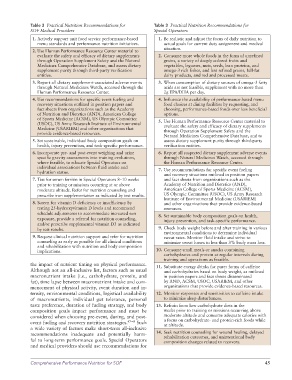
Table 2  Practical Nutrition Recommendations for    Table 3  Practical Nutrition Recommendations for
              SOF Medical Providers                              Special Operators
              1.  Actively support unit food service performance-based     1.  Be realistic and adjust the focus of daily nutrition to
                menu standards and performance nutrition initiatives.  actual goals for current duty assignment and medical
                                                                     situation.
              2.  Use Human Performance Resource Center material to
                evaluate the safety and efficacy of dietary supplements     2.  Consume more whole foods in the form of unrefined
                through Operation Supplement Safety and the Natural   grains, a variety of deeply colored fruits and
                Medicines Comprehensive Database, and assess dietary   vegetables, legumes, nuts, seeds, lean proteins, and
                supplement purity through third-party verification   omega-3 rich fishes, and less refined grains, full-fat
                entities.                                            dairy products, and red and processed meats.
              3.  Report all dietary supplement-associated adverse events     3.  When consumption of dietary sources of omega-3 fatty
                through Natural Medicines Watch, accessed through the   acids are not feasible, supplement with no more than
                Human Performance Resource Center.                   2g EPA/DHA per day.
              4.  Use recommendations for specific event fueling and     4.  Influence the availability of performance-based menu
                recovery situations outlined in position papers and   food choices at dining facilities by requesting, and
                fact sheets from organizations such as the Academy   choosing, performance-based foods over less beneficial
                of Nutrition and Dietetics (AND), American College   options.
                of Sports Medicine (ACSM), US Olympic Committee     5.  Use Human Performance Resource Center material to
                (USOC), US Army Research Institute of Environmental   evaluate the safety and efficacy of dietary supplements
                Medicine (USARIEM) and other organizations that      through Operation Supplement Safety and the
                provide evidence-based resources.
                                                                     Natural Medicines Comprehensive Database, and to
              5.  Set sustainable, individual body composition goals on   assess dietary supplement purity through third-party
                health, injury prevention, and task-specific performance.  verification entities.
              6.  Incorporate pre- and post-event weighing and urine     6.  Report all suspected dietary supplement adverse events
                specific gravity assessments into training evolutions,   through Natural Medicines Watch, accessed through
                where feasible, to educate Special Operators on      the Human Performance Resource Center.
                individual associations between fluid intake and     7.  Use recommendations for specific event fueling
                hydration status.
                                                                     and recovery situations outlined in position papers
              7.  Test for serum ferritin in Special Operators 8–10 weeks   and fact sheets from organizations such as the
                prior to training or missions occurring at or above   Academy of Nutrition and Dietetics (AND),
                moderate altitude. Refer for nutrition counseling and   American College of Sports Medicine (ACSM),
                prescribe iron supplementation as indicated by test results.  US Olympic Committee (USOC), US Army Research
                                                                     Institute of Environmental Medicine (USARIEM)
              8.  Screen for vitamin D deficiency or insufficiency by   and other organizations that provide evidence-based
                testing 25-hydroxyvitamin D levels and recommend     resources.
                schedule adjustments to accommodate increased sun     8.  Set sustainable body composition goals on health,
                exposure, provide a referral for nutrition counseling,   injury prevention, and task-specific performance.
                and/or prescribe supplemental vitamin D3 as indicated
                by test results.                                   9.  Check body weight before and after training in various
                                                                     environmental conditions to determine individual
              9.  Request clinical nutrition support and refer for nutrition   sweat rates. Monitor fluid intake and strive to
                counseling as early as possible for all clinical conditions   minimize sweat losses to less than 3% body mass loss.
                and rehabilitation with nutrition and body composition
                implications.                                    10.  Consume small meals or snacks containing
                                                                     carbohydrates and protein at regular intervals during
                                                                     training and operations as feasible.
              the impact of nutrient timing on physical performance.   11.  Substitute energy drinks for purer forms of caffeine
              Although not an all-inclusive list, factors such as usual   and carbohydrates based on body weight, as outlined
              macronutrient intake (i.e., carbohydrate, protein, and   in position papers and fact sheets disseminated
              fat), time lapse between macronutrient intake and com-  by AND, ACSM, USOC, USARIEM, and other
              mencement of physical activity, event duration and in-  organizations that provide evidence-based resources.
              tensity, environmental conditions, logistical availability   12.  Monitor responses and sensitivities to caffeine intake
              of macronutrients, individual gut tolerance, personal   to minimize sleep disturbances.
              taste preference, duration of fueling strategy, and body   13.  Refrain from low carbohydrate diets in the
              composition goals impact performance and must be       weeks prior to training or missions occurring above
              considered when choosing pre-event, during, and post-  moderate altitude and consume adequate calories with
              event fueling and recovery nutrition strategies. 47–49  Such   a focus on carbohydrate- and protein-rich foods while
                                                                     at altitude.
              a wide variety of factors make short-term all-inclusive
              recommendations  inadequate and  potentially  harm-  14.  Seek nutrition counseling for wound healing, delayed
                                                                     rehabilitation outcomes, and unintentional body
              ful to long-term performance goals. Special Operators   composition changes related to recovery.
              and medical providers should use recommendations for


              Comprehensive Performance Nutrition for SOF                                                     45

