


Page 54 - Journal of Special Operations Medicine - Winter 2015
P. 54
duty assignment and medical situation. Though Special   Proactive Component: Foundational Health
          Operators are, indeed, athletes, they are not always “in-  For Special Operators to perform optimally throughout
          season” athletes; therefore, nutrition strategies must be   their careers in assignments with varying levels of mental
          modified accordingly. A comprehensive performance   and physical requirements, they must be proactive and
          nutrition program addresses specificity of performance   place as much emphasis on foundational health as they
          outcomes by   focusing on individual Special Operator   do on task-specific performance. This entails chronic
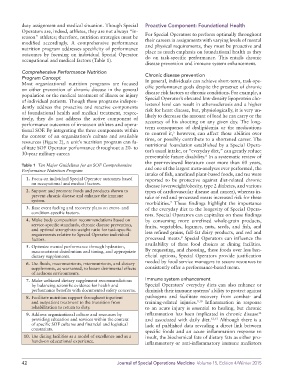
          occupational and medical factors (Table 1).
                                                             disease prevention and immune system enhancement.
          Comprehensive Performance Nutrition                Chronic disease prevention
          Program Concept                                    In general, individuals can achieve short-term, task-spe-
          Most organizational nutrition programs are focused   cific performance goals despite the presence of chronic
          on either prevention of chronic disease in the general   disease risk factors or chronic conditions. For example, a
          population or the medical treatment of illness or injury   Special Operator’s elevated low-density lipoprotein cho-
          of  individual patients. Though these programs indepen-  lesterol level can result in atherosclerosis and a higher
          dently address the proactive and reactive components   risk for heart disease, but, physiologically, it is very un-
          of foundational health and medical treatment, respec-  likely to decrease the amount of load he can carry or the
          tively, they do not address the active component of   accuracy of his shooting on any given day. The long-
          performance outcomes of in-season athletes and opera-  term  consequence of  dyslipidemia  or  the  medications
          tional SOF. By integrating the three components within   to  control  it,   however,  can  affect  those  abilities  over
                                                                         5
          the context of an organization’s culture and available   time, or possibly contribute to a shortened career. The
          resources (Figure 2), a unit’s nutrition program can fa-  nutritional foundation established by a Special Opera-
          cilitate SOF Operator performance throughout a 20- to   tor’s usual intake, or “everyday diet,” can greatly reduce
          30-year military career.
                                                             preventable future disability.  In a systematic review of
                                                                                      6
                                                             the peer-reviewed  literature over  more than 60 years,
          Table 1  Ten Major Guidelines for an SOF Comprehensive
          Performance Nutrition Program                      and one of the largest meta-analyses ever performed, the
                                                             intake of fish, unrefined plant-based foods, and tea were
             1.  Focus on individual Special Operator outcomes based   reported to be protective against diet-related chronic
              on occupational and medical factors.
                                                             disease (overweight/obesity, type 2 diabetes, and various
             2.  Support and promote foods and products shown to   types of cardiovascular disease and cancer), whereas in-
              prevent chronic disease and enhance the immune   take of red and processed meats increased risk for these
              system.
                                                             morbidities.  These findings highlight the importance
                                                                       7
             3.  Base event fueling and recovery plans on event- and   of the everyday diet to the longevity of Special Opera-
              condition-specific factors.
                                                             tors. Special Operators can capitalize on these findings
             4.  Make body composition recommendations based on   by consuming more unrefined whole-grain products,
              service-specific standards, chronic disease prevention,   fruits, vegetables, legumes, nuts, seeds, and fish, and
              and optimal strength-to-weight ratio for task-specific   less refined grains, full-fat dairy products, and red and
              requirements relative to Special Operator individual
                                                                            8
              factors.                                       processed meats.  Special Operators can influence the
                                                             availability  of  these  food  choices  at  dining  facilities.
             5.  Optimize mental performance through hydration,
              macronutrient distribution and timing, and appropriate   By requesting, and choosing, these foods over less ben-
              dietary supplements.                           eficial options, Special Operators provide justification
             6.  Use fluids, macronutrients, micronutrients, and dietary   needed by food service managers to secure resources to
              supplements, as warranted, to lessen detrimental effects   consistently offer a performance-based menu.
              of arduous environments.
             7.  Make unbiased dietary supplement recommendations   Immune system enhancement
              by balancing scientific evidence for health and   Special Operators’ everyday diets can also enhance or
              performance benefits with documented safety concerns.  diminish their immune systems’ ability to protect against
             8.  Facilitate nutrition support throughout inpatient   pathogens and facilitate recovery from combat- and
              and outpatient treatment to the transition from   training-related injuries. 9,10  Inflammation in response
              rehabilitation to return to duty.              to an acute injury is essential to healing, but chronic
                                                                                                            11
             9.  Address organizational culture and resources by     inflammation has been implicated in chronic disease
              providing education and services within the context   and associated with daily diet. 12,13  Although there is a
              of specific SOF cultures and financial and logistical   lack of published data revealing a direct link between
              constraints.
                                                             specific  foods  and  an  acute  inflammation  response  to
           10.  Use dining facilities as a model of excellence and as a   insult, the biochemical fate of dietary fats as either pro-
              hands-on educational experience.               inflammatory or anti-inflammatory immune  mediators


          42                                     Journal of Special Operations Medicine  Volume 15, Edition 4/Winter 2015

