


Page 26 - Journal of Special Operations Medicine - Fall 2015
P. 26
of 5mm, has an outer diameter of 9.4mm. Nonsurgeons   places an already potentially seriously ill patient at risk
          may have a difficult time inserting a tracheostomy tube   for aspiration. The Melker cuff diameter, when inflated
          into the CTM, as this may require significant force. 32  with 10mL of air is up to 29mm in diameter compared
                                                             with the 23mm diameter for a typical 6.0 ETT.
          Endotracheal Tubes
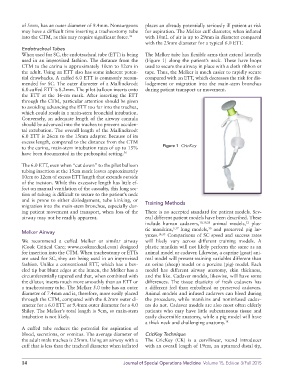
          When used for SC, the endotracheal tube (ETT) is being   The Melker tube has flexible arms that extend laterally
          used in an improvised fashion. The distance from the   (Figure 1) along the patient’s neck. These have loops
          CTM to the carina is approximately 10cm to 12cm in   used to secure the airway in place with a cloth ribbon or
          the adult. Using an ETT also has some inherent poten-  tape. Thus, the Melker is much easier to rapidly secure
          tial drawbacks. A cuffed 6.0 ETT is commonly recom-  compared with an ETT, which decreases the risk for dis-
          mended for SC. The outer diameter of a Mallinckrodt   lodgement or migration into the main-stem bronchus
          6.0 cuffed ETT is 8.2mm. The pilot balloon inserts onto   during patient transport or movement.
          the  ETT  at  the  16-cm  mark.  After  inserting  the  ETT
          through the CTM, particular attention should be given
          to avoiding advancing the ETT too far into the trachea,
          which could result in a main-stem bronchial intubation.
          Conversely, an adequate length of the airway cannula
          should be advanced into the trachea to prevent acciden-
          tal extubation. The overall length of the Mallinckrodt
          6.0 ETT is 26cm to the 15mm adapter. Because of its
          excess length, compared to the distance from the CTM
          to the carina, main-stem intubation rates of up to 15%    Figure 1  CricKey
          have been documented in the prehospital setting. 36

          The 6.0 ETT, even when “cut down” to the pilot balloon
          tubing insertion at the 15cm mark leaves approximately
          10cm to 12cm of excess ETT length that extends outside
          of the incision. While this excessive length has little ef-
          fect on manual ventilation of the casualty, this long sec-
          tion of tubing is difficult to secure to the patient’s neck
          and is prone to either dislodgement, tube kinking, or   Training Methods
          migration into the main-stem bronchus, especially dur-
          ing patient movement and transport, when loss of the   There is no accepted standard for patient models. Sev-
          airway may not be readily apparent.                eral different patient models have been described. These
                                                             include  human cadavers, 10,19,20  animal  models,  plas-
                                                                                                       32
                                                             tic manikins, 5,17  lung models,  and preserved pig lar-
                                                                                       30
          Melker Airway
                                                             ynxes. 14,35  Comparisons of SC speed and success rates
          We recommend a cuffed Melker or similar airway     will likely vary across different training models. A
          (Cook Critical Care; www.cookmedical.com) designed   plastic manikin will not likely perform the same as an
          for insertion into the CTM. When tracheotomy or ETTs   animal model or cadaver. Likewise, a caprine (goat) ani-
          are used for SC, they are being used in an improvised   mal model will present training variables different than
          fashion. Unlike a conventional ETT, which has a bev-  an ovine (sheep) model or a porcine (pig) model. Each
          eled tip but blunt edges at the lumen, the Melker has a   model has different airway anatomy, skin thickness,
          circumferentially tapered end that, when combined with   and the like. Cadaver models, likewise, will have some
          the dilator, inserts much more smoothly than an ETT or   differences. The tissue elasticity of fresh cadavers has
          a tracheostomy tube. The Melker 5.0 tube has an outer   a different feel than embalmed or preserved cadavers.
          diameter of 7.4mm and is, therefore, more easily placed   Animal models and infused cadavers can bleed during
          through the CTM, compared with the 8.2mm outer di-  the procedure, while manikins and noninfused cadav-
          ameter for a 6.0 ETT or 9.4mm outer diameter for a 4.0   ers do not. Cadaver models are also most often elderly
          Shiley. The Melker’s total length is 9cm, so main-stem   patients who may have little subcutaneous tissue and
          intubation is not likely.                          easily discernible anatomy, while a pig model will have
                                                             a thick neck and challenging anatomy. 18
          A cuffed tube reduces the potential for aspiration of
          blood, secretions, or vomitus. The average diameter of   CricKey Technique
          the adult male trachea is 25mm. Using an airway with a   The CricKey (CK)  is a curvilinear, round  introducer
          cuff that is less than the tracheal diameter when inflated   with an overall length of 19cm, an upturned distal tip,


          14                                        Journal of Special Operations Medicine  Volume 15, Edition 3/Fall 2015

