


Page 14 - Journal of Special Operations Medicine - Winter 2014
P. 14
previously described in a field environment of a patient   Table 2  Suggested Field Management
          on a jungle expedition who demonstrated resistance to   1. Lie patient supine if respiratory status allows.
          repeated IM epinephrine doses. 19
                                                              2. Administer 0.5mg IM epinephrine (into lateral thigh,
          Bolus IV administration of epinephrine has historically   if possible).
          been considered a high-risk activity and has not been   3. Repeat 0.5mg IM if no improvement within 10 minutes.
          recommended. It has been suggested that outside of a   4. Obtain IV access.
          fully equipped resuscitation environment with monitor-  5. If systolic BP <100mmHg and/or additional signs of
          ing facilities, IV epinephrine is not appropriate. 20  poor perfusion, administer 1000–2000mL of normal
                                                                saline (if available).
          The authors have personal experience with the use of   6. If deteriorating despite IM epinephrine, consider
          a dilute epinephrine infusion without invasive monitor-  1:1,000,000 infusion (1mg into 1000mL normal saline
          ing, central line access, or a syringe driver in the place of   or 0.5mg into 500mL or 0.25mg into 250mL):
          bolus administration with no apparent loss of efficacy    i.  Administer at 1–2mL/min titrated up to achieve a
          or increase in side effects. While this has not been sub-  clinical effect or the occurrence of side effects such
          jected to a randomized trial, there is good observational   as new onset tachycardia or hypertension.
          evidence of efficacy and safety.  In an emergency out-of-  ii.  Infusion can be increased up to “wide open” if
                                    3
                                                                  required. Side effects with a 1:1,000,000 solution
          hospital where there has been failure to respond to in-  are very uncommon even when given through a
          tramuscular dose(s), this option is supported by clinical   wide-open line.
          guidelines produced by both the Therapeutic Guidelines
          group (Australia) and the Australasian Society for Clini-
          cal Immunology and Allergy. 21,22                  but  field  medics  need  to  be  aware  of  these  options,
                                                             should evacuation to a nearby emergency center or hos-
          Fluid therapy is the second mainstay of resuscitation, af-  pital be feasible.
          ter epinephrine. Large volumes of fluid may be required.
          The majority of patients will respond to IV fluids and
          epinephrine, especially where the cause is venom related,   Summary
          and this is most commonly seen in a field environment. 3,23  Anaphylaxis is a relatively common resuscitative emer-
                                                             gency. In some patients, it can be difficult to manage
          Insertion of an IV line is now a common skill, and ad-  with intramuscular epinephrine. The consequence is
          ministration of fluid resuscitation is usually available to   that it can be a potential operational threat and require
          vocational medics or medically trained operators. It is   a medical evacuation. We suggest that the field care
          not a complicated step to use a dilute epinephrine infu-  can be optimized with the addition of a dilute epineph-
          sion in field settings, and any risks are likely to be ac-  rine infusion for cases not responsive to intramuscular
          ceptable if the alternative is death before medical care.  epinephrine.

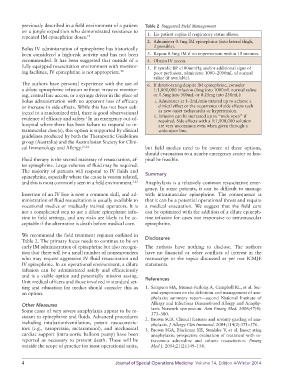
          We recommend the field treatment regimen outlined in
          Table 2. The primary focus needs to continue to be on   Disclosures
          early IM administration of epinephrine but also recogni-  The authors have nothing to disclose. The authors
          tion that there will be a small number of nonresponders   have no financial  or other  conflicts  of interest  in the
          who may require aggressive IV fluid resuscitation and   manuscript or the topics discussed as per our ICMJE
          IV epinephrine. In an operational environment, a dilute   statements.
          infusion can be administered safely and efficaciously
          and is a viable option and potentially mission saving.
          Unit medical officers and those involved in standard set-  References
          ting and education for medics should consider this as   1.  Sampson HA, Munoz-Furlong A, Campbell RL, et al. Sec-
          an option.                                           ond symposium on the definition and management of ana-
                                                               phylaxis: summary report—second National Institute of
          Other Measures                                       Allergy and Infectious Disease/Food Allergy and Anaphy-
          Some cases of very severe anaphylaxis appear to be re-  laxis Network symposium. Ann Emerg Med. 2006;47(4):
                                                               373–380.
          sistant to epinephrine and fluids. Advanced procedures   2.  Brown SGA. Clinical features and severity grading of ana-
          including intubation/ventilation, potent vasoconstric-  phylaxis. J Allergy Clin Immunol. 2004;114(2):371–376.
          tors (e.g., vasopressin, metaraminol), and mechanical   3.  Brown SGA, Blackman KE, Stenlake V, et al. Insect sting
          cardiac support (intra-aortic balloon pump) have been   anaphylaxis; prospective evaluation of treatment with in-
          reported  as  necessary  to  prevent  death.  These  will be   travenous adrenaline and volume resuscitation.  Emerg
          outside the scope of practice for most operational units,   Med J. 2004;21(2):149–154.


          4                                      Journal of Special Operations Medicine  Volume 14, Edition 4/Winter 2014

