


Page 110 - Journal of Special Operations Medicine - Winter 2014
P. 110
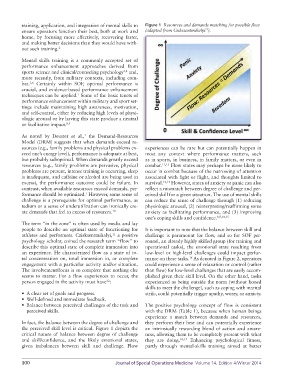
training, application, and integration of mental skills to   Figure 1  Resources and demands matching for possible flow
                                                                                      11
          ensure operators function their best, both at work and   (adapted from Csikszentmihalyi ).
          home, by focusing more effectively, recovering faster,
          and making better decisions than they would have with-
          out such training. 2

          Mental skills training is a commonly accepted set of
          performance enhancement approaches derived from
          sports science and clinical/counseling psychology  and,
                                                    3,4
          more recently, from military contexts, including com-
          bat.  Certainly within SOF, optimal performance  is
             5,6
          crucial, and evidence-based performance enhancement
          techniques can be applied.  Some of the basic tenets of
                                 7
          performance enhancement within military and sport set-
          tings include maintaining high awareness, motivation,
          and self-control, either by reducing high levels of physi-
          ologic arousal or by having this state produce a neutral
          or facilitative impact. 8,9

          As noted by Deuster et al.,  the Demand-Resources
                                    1
          Model (DRM) suggests that when demands exceed re-
          sources (e.g., family problems and physical problems ex-  experiences can be rare but can potentially happen in
          ceed one’s energy level), performance is adequate at best,   most  any context  where  performance  matters,  such
          but probably suboptimal. When demands greatly exceed   as in sports, in business, in family matters, or even in
          resources (e.g., family problems are pervasive, physical   combat. 12,13  Flow states may perhaps be more likely to
          problems are present, intense training is occurring, sleep   occur in combat because of the narrowing of attention
          is inadequate, and caffeine or alcohol are being used in   associated with fight or flight, and thoughts limited to
          excess), the performance outcome could be failure. In   survival. 12,13  However, states of anxiety or panic can also
          contrast, when available resources exceed demands, per-  reflect a mismatch between degree of challenge and per-
          formance should be optimized.  However, some sense of   ceived skill for a given situation. The use of mental skills
                                    1
          challenge is a prerequisite for optimal performance, as   can reduce the sense of challenge through (1) reducing
          tedium or a sense of underutilization can ironically cre-  physiologic arousal, (2) reinterpreting/reaffirming some
          ate demands that feel in excess of resources. 10   anxiety as facilitating performance, and (3) improving
                                                             one’s coping skills and confidence. 8,9,14,15
          The term “in the zone” is often used by media and lay
          people to describe an optimal state of functioning for   It is important to note that the balance between skill and
          athletes and performers. Czisksentmihalyi,  a positive   challenge is paramount for flow, and so for SOF per-
                                               11
          psychology scholar, coined the research term “flow” to   sonnel, an already highly skilled group (for training and
          describe this optimal state of complete immersion into   operational tasks), the emotional state resulting from
          an experience. He characterized flow as a state of to-  low-level or high-level challenges could impact perfor-
          tal concentration on, total immersion in, or complete   mance on these tasks.  As denoted in Figure 2, operators
                                                                               16
          engagement with a particular activity and/or situation.   could experience a sense of relaxation or control (rather
          The involvement/focus is so complete that nothing else   than flow) for low-level challenges that are easily accom-
          seems to matter. For a flow experiences to occur, the   plished given their skill level. On the other hand, tasks
          person engaged in the activity must have :         experienced as being outside the norm (without honed
                                             12
                                                             skills to meet the challenge), such as coping with marital
          •  A clear set of goals and progress.              strife, could potentially trigger apathy, worry, or anxiety.
          •  Well-defined and immediate feedback.
          •  Balance between perceived challenges of the task and   The positive psychology concept of flow is consistent
            perceived skills.                                with the DRM (Table 1), because when human beings
                                                             experience a match between demands and resources,
          In fact, the balance between the degree of challenge and   they perform their best and can potentially experience
          the perceived skill level is critical. Figure 1 depicts the   an intrinsically rewarding blend of action and aware-
          critical nature of balance between degree of challenge   ness, allowing them to be completely present with what
          and skill/confidence, and the likely emotional states,   they are doing. 10,17  Enhancing psychological fitness,
          given imbalances between skill and challenge. Flow   partly through mental-skills training aimed at better


          100                                    Journal of Special Operations Medicine  Volume 14, Edition 4/Winter 2014

