


Page 83 - Journal of Special Operations Medicine - Fall 2014
P. 83
Methods                                            75% of the time). There were minimal differences in
                                                                 success rates based on years of experience (Figure 2).
              Local intuitional review board approval was obtained.
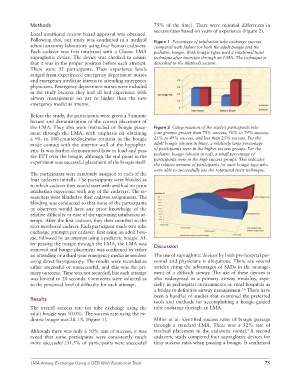
              Following this, our study was conducted in a medical   Figure 1  Percentage of intubation tube exchange success
              school anatomy laboratory using four human cadavers.   compared with failure for both the adult bougie and the
              Each cadaver was first intubated with a Classic LMA   pediatric bougie. Both bougie types used a rotational twist
              supraglottic device. The device was checked to ensure   technique after insertion through an LMA. The technique is
              that it was in the proper position before each attempt.   described in the Methods section.
              There  were  32 participants.  Their experience  levels
              ranged from experienced emergency department nurses
              and emergency medicine interns to attending emergency
              physicians. Emergency department nurses were included
              in the study because they had all had experience with
              airway management on par or higher than the new
              emergency medicine interns.

              Before the study, the participants were given a 5-minute
              lecture and demonstration of the correct placement of
              the LMA. They also were instructed on bougie place-  Figure 2  Categorization of the study’s participants into
              ment through the LMA, with emphasis on obtaining   four groups: greater than 74% success, 50% to 74% success,
              a 90- to 180-counterclockwise rotation as the bougie   25% to 49% success, and less than 25% success. For the
              made contact with the anterior wall of the hypophar-  adult bougie (shown in blue), a relatively large percentage
              ynx. It was further demonstrated how to load and pass   of participants were in the higher success groups. For the
              the ETT over the bougie, although the end point in the   pediatric bougie (shown in red), a small percentage of
              experiment was successful placement of the bougie itself.  participants were in the high success groups. This indicates
                                                                 the relative amount of participants for each bougie type who
                                                                 were able to successfully use the rotational twist technique.
              The participants were randomly assigned to each of the
              four cadavers initially. The participants were blinded as
              to which cadaver they would start with and had no prior
              intubation experience with any of the cadavers. The re-
              searchers were blinded to their cadaver assignments. The
              blinding was conducted so that none of the participants
              or observers would have any prior knowledge of the
              relative difficulty or ease of the upcoming intubation at-
              tempt. After the first cadaver, they then switched to the
              next numbered cadaver. Each participant made two tube
              exchange attempts per cadaver: first using an adult bou-
              gie, followed by an attempt using a pediatric bougie. Af-
              ter passing the bougie through the LMA, the LMA was
              removed and bougie placement was confirmed by either   Discussion
              an attending or a third-year emergency medicine resident   The use of supraglottic devices by both pre-hospital per-
              using direct laryngoscopy. The results were recorded as   sonnel and physicians is ubiquitous. There are several
              either successful or unsuccessful, and this was the pri-  articles citing the advantages of SADs in the manage-
              mary outcome. Time was not recorded, but each attempt   ment of a difficult airway. The use of these devices is
              was limited to 20 seconds. Comments were solicited as   also widespread as a primary airway modality, espe-
              to the perceived level of difficulty for each attempt.  cially in prehospital environments or rural hospitals as
                                                                 a bridge to definitive airway management.  There have
                                                                                                     5,6
                                                                 been a handful of studies that examined the preferred
              Results
                                                                 tools and methods for accomplishing a bougie-guided
              The overall success rate for tube exchange using the   tube exchange through an LMA.
              adult bougie was 50.0%. The success rate using the pe-
              diatric bougie was 28.1% (Figure 1).               Miller et al. identified success rates of bougie passage
                                                                 through a standard LMA. There was a 52% rate of
                                                                                                       2
              Although there was only a 50% rate of success, it was   tracheal placement in the cadaveric model. A second
              noted that some participants were consistently much   cadaveric study compared four supraglottic devices for
              more successful (31.3% of participants were successful   their success rates when passing a bougie. It confirmed


              LMA Airway Exchange Using a GEB With Rotational Twist                                           75

